


The Zhitong Finance App learned that the China Automobile Dealers Association published an article stating that September ushered in the traditional “Golden Nine” peak season, but the effects of this year's peak season were weak. The market was mainly moderately repaired month-on-month, and the year-on-year pressure was still under pressure. Appropriate temperatures, the pre-release of demand for car purchases during the Mid-Autumn Festival and National Day, large-scale local auto shows, centralized promotions for car companies, and phased local car purchase subsidies all formed a favorable market; combined with the easing of production capacity restrictions for some new energy models, speeding up delivery, increased supply-side support, and the early backlog of car purchase demand was released at an accelerated pace. However, the industry's price war continued, and consumers continued to wait and see the National Day discount. Combined with the higher base for the same period last year, the September market's recovery efforts were limited to a certain extent. Passenger car terminal sales are expected to reach 1.75 million units for the month of September.
In the first half of September, the passenger car market entered the traditional peak season window, and the market ushered in a gentle month-on-month recovery. Driven by multiple factors such as the gradual cooling of the weather, the Mid-Autumn Festival approaching, and increasing sales efforts, the cumulative demand for car purchases began to be released in the early stages, and the market will gradually break out of the off-season pattern in July and August; however, due to weak terminal demand, continued industry price wars, continued consumer wait-and-see sentiment, and the high base for the same period last year, the peak season effect in September was weak. Overall, it showed the characteristics of a moderate month-on-month recovery and year-on-year pressure.
Based on the dealer's feedback on customer attraction, sales volume, and inventory biweekly report data, it can be seen that:
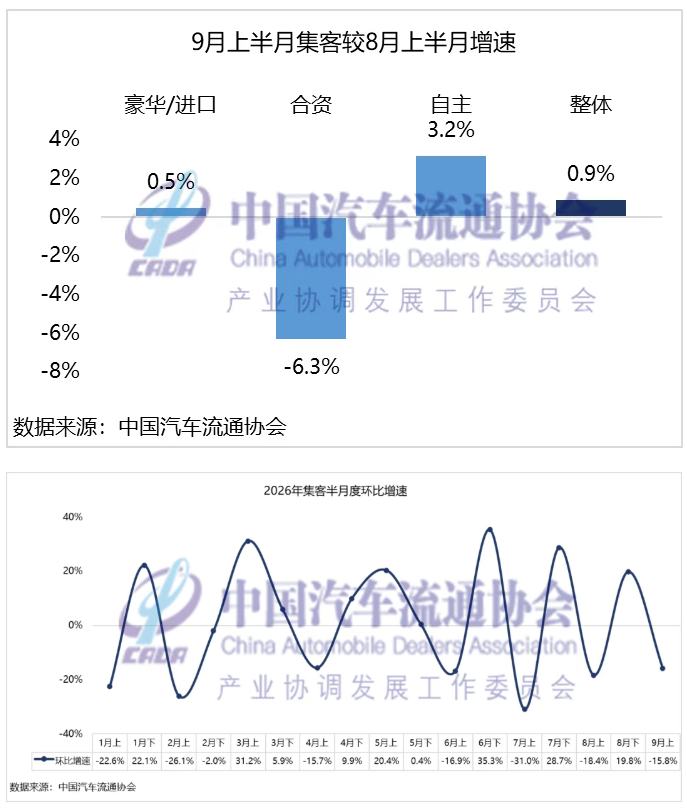
The number of visitors attracted in the first half of September increased slightly by 0.9% compared to the same period in August, and decreased by 15.8% compared to the second half of August. In September, most regions of the country bid farewell to the high summer temperatures. The climate conditions were comfortable, and consumers' willingness to watch and test drive cars offline increased markedly. However, some consumers are still waiting for the Mid-Autumn Festival and National Day promotions, and the mentality of holding coins diverted the number of visitors to the store in the first half of the month to a certain extent. Overall, customer traffic has entered an upward channel during the peak season, and the number of store arrivals will further increase as the Double Festival approaches.
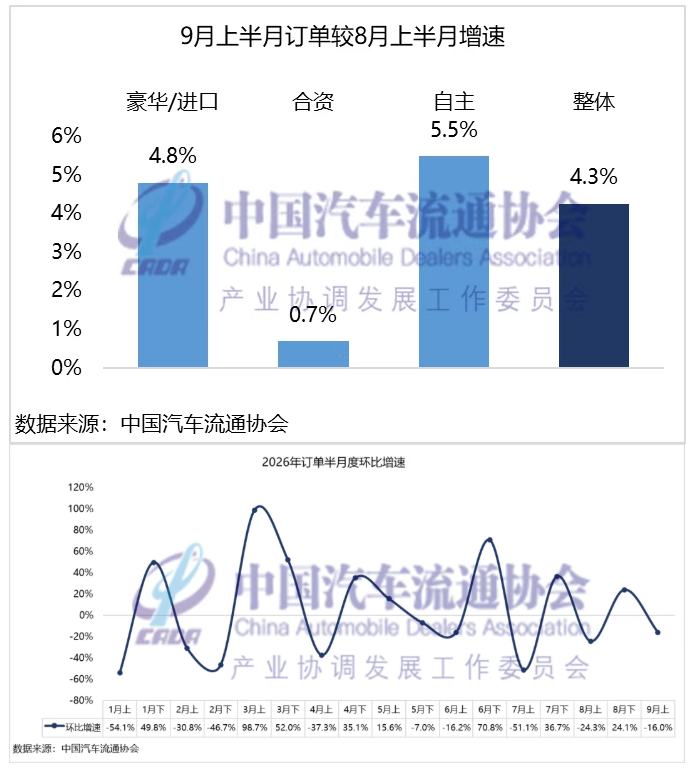
Orders in the first half of September increased by 4.3% compared to the same period in August and decreased by 16.0% from the second half of August. In early September, a number of car companies launched promotions, covering the entire lineup of luxury, joint ventures, and autonomous (including new forces) brands; in addition, some regions issued a new round of phased car purchase subsidies and quarterly targets for dealers to increase their concessions. The backlog of demand for car purchases in the off-season was gradually released, driving an increase in order volume. Currently, some consumers will continue to compare preferential policies during the National Day Auto Show and the Double Festival, and slow down the pace of car bookings to a certain extent. Looking ahead to the second half of September, it is expected that orders intended to buy cars will continue to expand as many car shows kick off one after another and double promotions warm up.
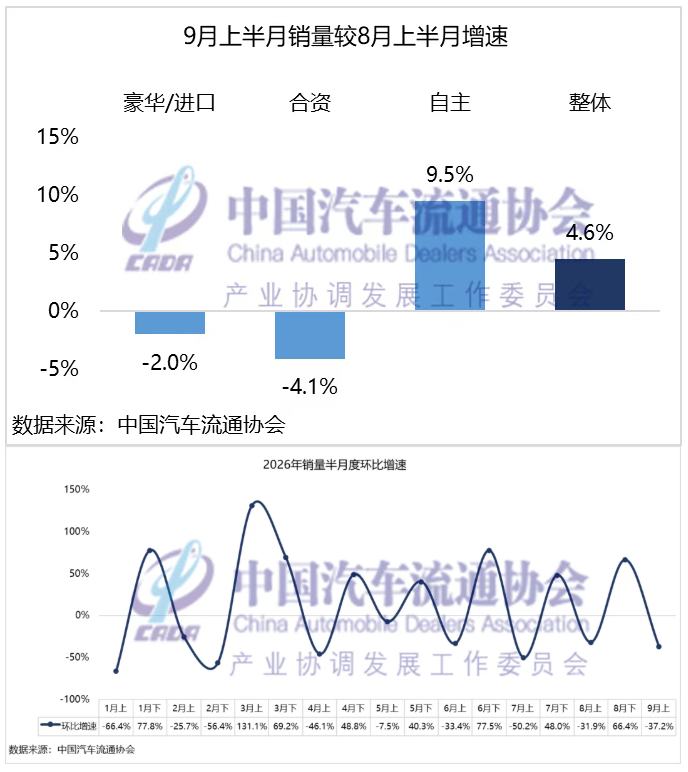
Sales in the first half of September increased 4.6% compared to the same period in August and decreased by 37.2% from the second half of August. Sales in the first half of September showed a slight increase compared to the same period in August. It is expected that by the second half of the month, the pace of dealers' tasks for the third quarter will accelerate, and the intended orders accumulated in the early stages will accelerate transformation; combined with the pre-release of demand for car purchases such as Mid-Autumn Festival and National Day trips and marriage, various fall car shows, local phased car purchase subsidies, and centralized concession promotions from car companies will drive sales to continue to increase in the second half of September.
Inventory for the first half of September increased slightly by 0.4% compared to the end of August. The July-August market was in an off-season operation period, and dealers were less willing to take the initiative to replenish stocks. Inventory at the end of August decreased by 2.8% compared to mid-August; the overall level of dealer inventory in the first half of September did not change much compared to the end of August.