


On September 18, the Hong Kong stock market experienced extreme changes again. Century Group International (02923) remained stable at around HK$9.4 at 9:50 in early trading. After only 9 minutes, the stock price experienced a cliff-style sell-off, reaching an intraday low of HK$1.37, a drop of 85.46%. At the close, the stock was trading at HK$1.26, a decrease of 86.62%.
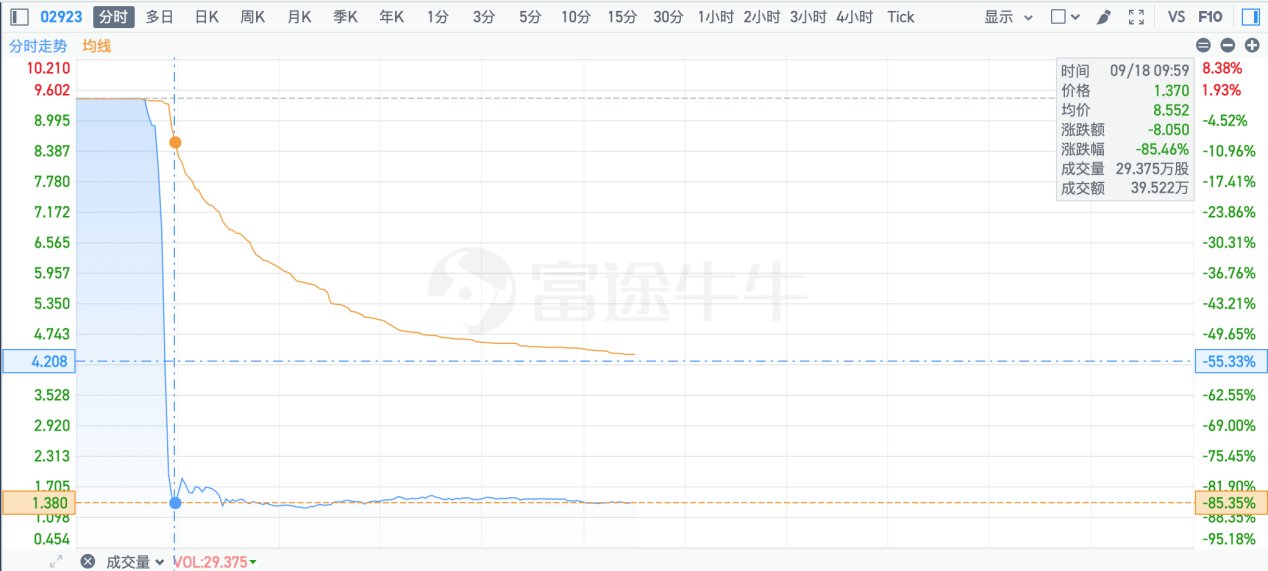
What is alarming is that as of 13:02, the net outflow of capital from the stock reached 606.681 million yuan, and the inflow for both oversized orders and large orders was zero. The main force has no protective plate, not even a symbolic undertaking. Retail investors, on the other hand, went all the way to “take over the knife” at HK$9, HK$6, HK$3, and HK$1.4.
From HK$9 to HK$1.37 in 9 minutes
Market data shows that at 9:50 in early trading on September 18, Century Group's international stock price was still reported at HK$9.39, trading 1.6075 million shares, a decrease of only -0.32%. There was no significant change in the market. However, just a minute later, the stock price was quickly suppressed to HK$910, and the trading volume suddenly increased to 4,413,500 shares. Since then, selling pressure has been released at an accelerated pace. By 09:59, the stock price had dropped to HK$1.37, and the decline widened to -85.46%. From HK$9.39 to HK$1.37, the cumulative decline was completed in less than 9 minutes.
The Zhitong Finance App believes that it is difficult to simply attribute such an extreme short-term sharp decline to retail panic selling. Behind this, it is more likely to correspond to the huge amount of chips that have been reserved in advance, and distributed centrally through a window with relatively abundant liquidity at the opening of the market. As for the source of chips, it is necessary to go back to the operation of capital before the collapse.
On September 14, Century Group International's share merger of every 20 shares to 1 share officially came into effect. The joint stock itself does not change the company's fundamentals, but it will significantly raise the nominal share price, making the original low-priced stock “look” close to HK$10 on the book. More importantly, on September 2, the company announced the placement of 160.95 million new shares to four independent third parties. The placement price was HK$0.27 per share, a discount of about 19.4% from the current market price, and the net proceeds were approximately HK$43.3 million. After the share merger came into effect, the total number of subscribed shares was adjusted to 8.047,500 shares, and the subscription price was adjusted accordingly to HK$5.40 per share.
This series of operations means that before the stock price plummeted, a large number of low-priced chips (HK$0.27/share) had already been “placed” in the hands of specific subscribers. Calculating HK$1.38 after today's sharp drop, the book yield of these placement chips is still about 4 times as high, and there is a strong incentive to sell. Therefore, a high sideways trade around HK$9.4 is not the result of natural market trading; it is more likely a window that the main players deliberately maintain for shipping. The narrow arrangement of about 20 minutes in early trading was intended to attract and follow the trend and provide liquidity for subsequent concentrated sell-offs.
In terms of market data, the active buy-sell ratio of the stock once reached 1:99, with a net active sale amount of 60.77 million yuan. This meant that there was almost only a “sell” voice in the market, and the power of buyers was completely destroyed. At the time, the largest net passive brokerage firm was Nagahashi Securities Hong Kong (amount of 12.14 million yuan), while the largest net passive seller was BOCI Securities. This shows that some retail investors were trying to “cut the bottom” in the midst of the sharp decline, but the main capital continued to escape.
The active buy-sell ratio and passive trading seats reflect a long and short comparison at a certain point in the intraday period. This is not enough to fully explain the full picture of the net outflow of about 60 million yuan. The time-sharing trend is only the result of price changes; capital flow and broker seat data are closer to the actual transaction structure of this sharp decline. To answer “who is paying”, it is necessary to further disassemble capital distribution, trading seats, and carrying capacity at the low sideways stage.
Who is paying for the net outflow of about 60 million?
It is said that capital operations in the early stages were “layout,” then the intraday capital flow and brokerage seat data completely revealed the essence of the “zero acceptance” escape of the main players and the “takeover knife” trap of retail investors.
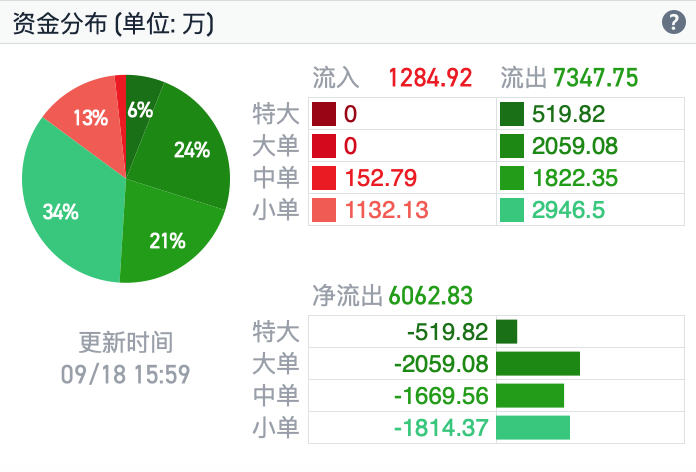
The capital distribution chart at the close shows that the stock had a total inflow of 128.492 million, while the total outflow reached 73.4775 million, and the net outflow reached an astonishing 606.283 million. Looking at the capital structure, the inflow of oversized orders was zero, with a net outflow of 5.198,200 yuan; the inflow of large orders was zero, with a net outflow of 205.908 million yuan. Compared to the data as of midday trading, there was no change in these two values in the afternoon. This means that after completing violent smashing and core distribution within 9 minutes of early trading, the main capital directly entered a “silent mode” in the afternoon, with no intention to protect the market or make up for it. This “zero inflow+huge outflow” pattern is proof that the main players are determined to clear their positions.
What is in stark contrast to the silence of the main forces is the continuous influx of retail capital. In the afternoon session, the inflow of small orders climbed from 7.885 million yuan in early trading to 11.3213 million yuan at the close. The net outflow of small orders reached 18.1437 million yuan throughout the day; there was also an inflow of 1,527,900 yuan for middle orders. This means that during the “low sideways trading” phase of HK$1.3 to HK$1.4 in the afternoon, a large number of retail investors were attracted by the illusion that “the decline is already deep” and are trying to get to the bottom of the market. However, these bottom-up funds did not support the stock price; instead, they became the ultimate rival to take over the remaining sell-off pressure from the main force and cut the ground in early morning trading.
Who is accurately escaping the top? Who is taking the knife like crazy? The data of the top ten net buying and net selling brokers provides the most minimal footnote to this game.
In the net sales list, the escape paths of the main players and high-ranking profit markets are clearly visible. Compared with early morning trading, the sales attendance in the afternoon showed obvious characteristics of speeding up the clean-up.
The sell-off strength of China Merchants Securities and Yuanta Securities increased significantly in the afternoon, and remained in the top two positions in the net sales list. China Merchants Securities's net sales reached 331.75K, with an average price of HK$1.89; Yuanta Securities had net sales of 281.25K, with an average price of HK$2.11. Continued shipments between the two seats in the HK$1.8 to HK$2.1 range indicate that the main players did not quit in the afternoon due to a sharp drop in stock prices, but instead accelerated the digestion of remaining chips.
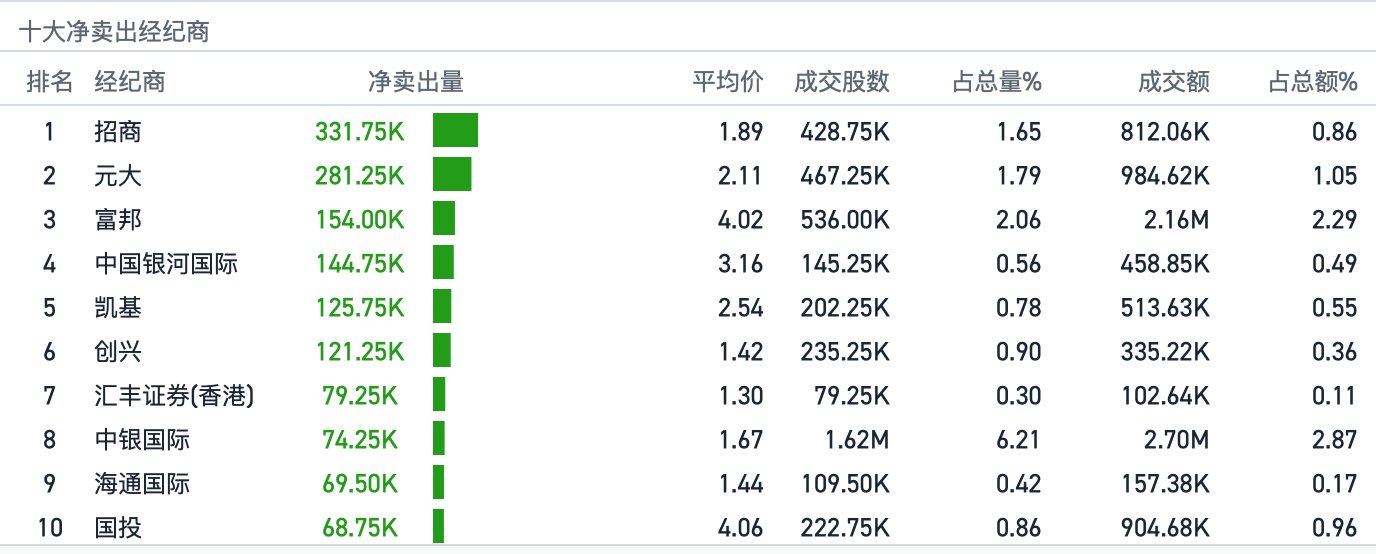
Meanwhile, Jinfeng, which accurately escaped the top at a high of HK$9.33 in early trading, disappeared from the closing list, indicating that its high-ranking chips have already been distributed. However, the selling pressure on other seats declined across the board: Fubon (net sale of 154.00K, average price of HK$4.02), China Galaxy International (net sale of 144.75K, average price of HK$3.16), China Investment (net sale of 68.75K, average price of HK$4.06) represented continued distribution during the tiered decline phase in early trading; while Bank of China International (net sale of 74.25K, average price of HK$1.67), Chong Hing (net sale of 121.25K, average price of HK$1.42), HSBC Securities Hong Kong (net sales of 79.25K, average price of HK$1.30) and Haitong International (net sales) (69.50K, average price of HK$1.44) continued net sales at a very low level of HK$1.3 to HK$1.7.
The average price range for sellers has been extended from HK$4.02 to HK$1.30, which also means that the cost of the main chip is extremely low, and shipping at any price can lock in huge profits.
The closing list of the top ten net buying brokers provided the ultimate answer to “who is paying”. Corresponding to the distribution range spanning HK$4.06 to HK$1.30 at the time of sale, the average price of seats bought also covered the full price range from HK$9.40 to HK$1.35, and the buyer structure showed very typical retail characteristics.
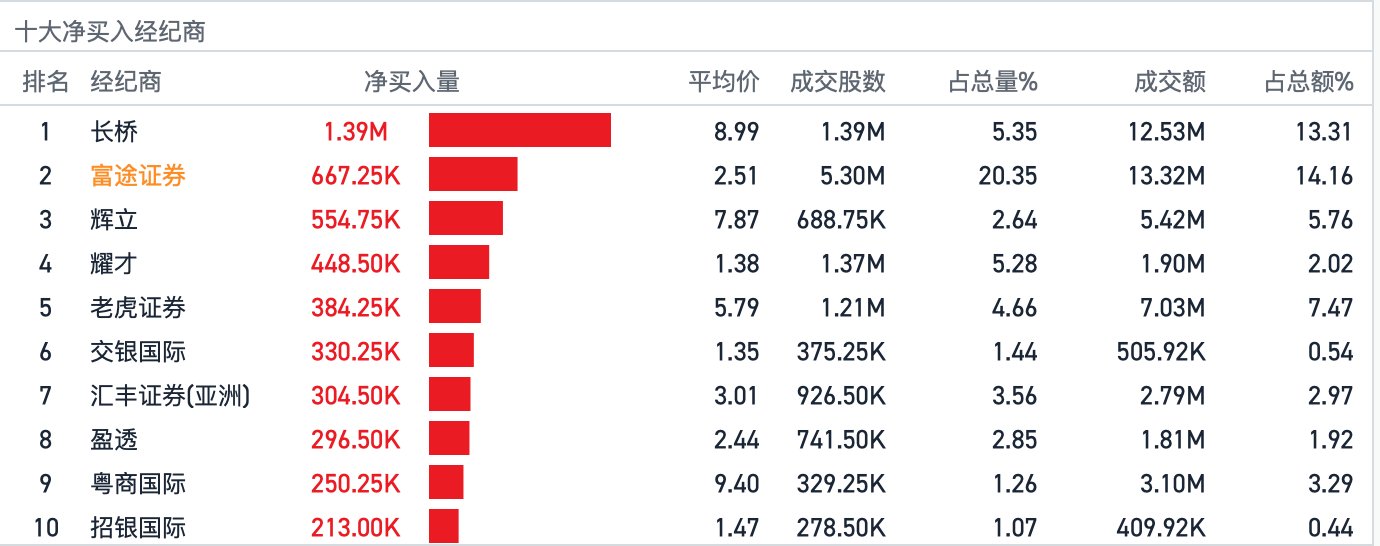
Nagahashi Securities topped the list with a net purchase volume of 1.39M, with an average price of HK$8.99 and a turnover of HK$12.53M, accounting for 13.31% of the total. This means that around HK$9 in early trading, there is a large amount of retail capital that is catching up. Follow-up was Futu Securities's net purchase of 667.25K, with an average price of HK$2.51. The number of traded shares reached 5.30M, accounting for 20.35% of the total volume, indicating that retail investors made intensive bottom-up positions when the stock price plummeted to the HK$2 to HK$3 range. Phillip Securities had a net purchase of 554.75K, with an average price of HK$7.87; Tiger Securities had a net purchase of 384.25K, with an average price of HK$5.79; Guangdong International's net purchase price was 250.25K, with an average price of HK$9.40 — these seats together outline the upward and bottoming trajectory of retail investors in high-ranking regions such as HK$9, HK$8, and HK$6.
Meanwhile, Yaocai Securities had a net purchase of 448.50K, with an average price of HK$1.38; BOC International's net purchase of 330.25K, with an average price of HK$1.35; and CMB International's net purchase of 213.00K, with an average price of HK$1.47. There are still significant net purchases of these seats at the extremely low of HK$1.3 to HK$1.5, which shows that even though the stock price has dropped 85% from HK$9.4, the “impulse to go bottom” is still strong.
From the entry into force of the joint stock exchange to placement adjustments, from high sideways trading to a nine-minute flash crash, Century Group International's market trajectory fully presents a complete set of capital distribution processes. The zero inflow of large orders and large orders is a clear sign that the main capital has been decided; retail investors are taking on layers between HK$9 and HK$1.4, or ultimately only provided liquidity for this “harvest.”