


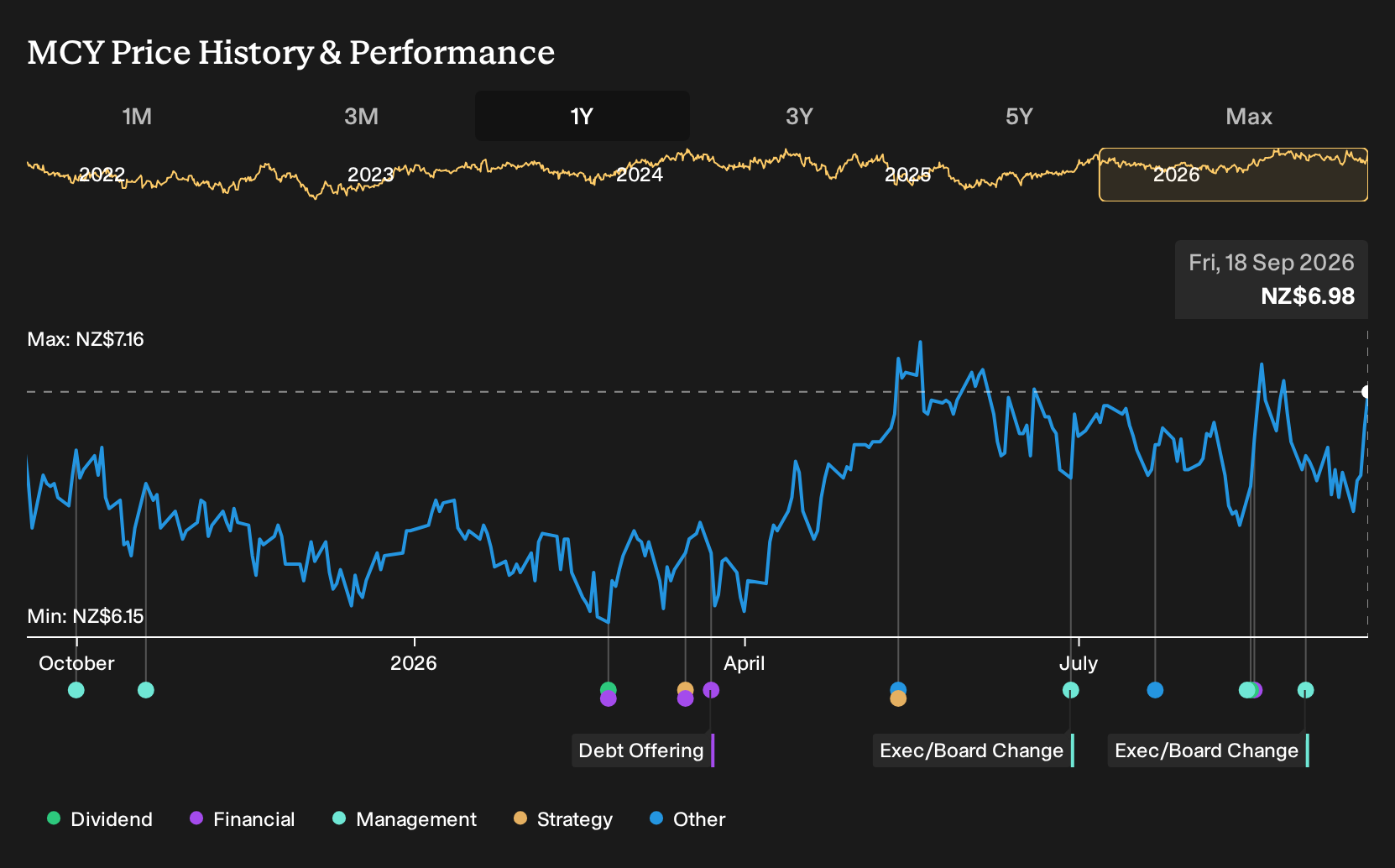
- Mercury NZ held its Annual Shareholders’ Meeting in Auckland and online on 18 September 2026, where Scott Scoullar was elected as a director and the board outlined dividend guidance of 29.0 cents per share for fiscal 2027.
- The updated dividend outlook gives investors a clearer view of Mercury NZ’s intended cash returns. This matters for a capital intensive renewables and retail electricity business managing hydrology risk and rising project spend.
- We will now assess how Mercury NZ’s upgraded 2027 dividend guidance could influence the existing investment narrative around renewables expansion.
Look beyond Mercury NZ and compare this dividend guidance with curated income ideas in renewables and infrastructure through the 158 dividend fortresses
Mercury NZ Investment Narrative Recap
To own Mercury NZ, you need to be comfortable with a capital heavy renewable generator that leans heavily on hydro, carries meaningful debt and faces demand for ongoing spend across wind, geothermal and grid assets. The 2027 dividend guidance of 29.0 cents per share signals an intention to keep cash returns visible, but it does not change the reality that funding needs remain material.
Hydrology volatility is still the swing factor in the near term. Dry conditions can quickly squeeze output and earnings. At the same time, higher capital expenditure and a dividend that analysts flag as not fully covered by earnings or free cash flow keep balance sheet pressure as the key short term risk, rather than this latest dividend update.
The most relevant piece of news for you is the fresh dividend guidance itself. Management now expects to pay 29.0 cents per share in fiscal 2027. That sits against commentary that the current 3.87% yield is not well covered by earnings or free cash flows. This puts the focus squarely on how project timing, debt costs and hydrology outcomes track over the next couple of years.
For income focused holders, the question becomes whether Mercury NZ can keep funding both its renewables build out and this level of distributions without stretching the balance sheet. Execution on the roughly NZ$1b capex pipeline, the pace of electrification gains and any shift in geothermal royalties or sector regulation now feed directly into how sustainable that dividend setting looks over time.
Mercury NZ's current analyst narrative points to NZ$3.6b in revenue and NZ$378.0m in earnings by 2029, based on an assumed 2.1% yearly increase in revenue and an earnings increase of NZ$290.0m from NZ$88.0m today.
Discover why Mercury NZ's fair value is closely aligned with its current price.
Exploring Other Perspectives
Four fair value estimates from the Simply Wall St Community span roughly NZ$4.47 to NZ$12.54 per share, so some retail investors see Mercury NZ as materially cheap while others view it as rich. In contrast, when you consider hydrology risk, rising capital requirements and evolving regulation, you get very different views on how the story could play out. Use these contrasting opinions to test your own thesis.
Explore 3 other Mercury NZ fair value estimates, including one that suggests as much as 36% downside from the current price.
Decide For Yourself
Don't just follow the ticker; dig into the data and build a conviction that's truly your own.
- A great starting point for your Mercury NZ research is our analysis highlighting 2 key rewards and 2 important warning signs that could impact your investment decision.
- See our latest analysis for Mercury NZ. The report includes a comprehensive fundamental analysis summarized in a single visual, the Snowflake, making it easy to evaluate Mercury NZ's overall financial health at a glance.
Looking For More Investment Ideas Beyond Mercury NZ?
Once you have a view on Mercury NZ, broaden your watchlist with other companies that fit different income, quality and risk profiles using the Simply Wall St Screener.
- If you want potential mispricing with quality fundamentals, scan for opportunities using the 171 high quality undervalued stocks.
- If capital preservation and steadier balance sheets matter most to you right now, focus on companies filtered through the list of solid balance sheet and fundamentals (196 results).
- If you are hunting for underfollowed opportunities with room to gain attention, cast a wider net using the 617 high quality undiscovered gems.
This article by Simply Wall St is general in nature. We provide commentary based on historical data and analyst forecasts only using an unbiased methodology and our articles are not intended to be financial advice. It does not constitute a recommendation to buy or sell any stock, and does not take account of your objectives, or your financial situation. We aim to bring you long-term focused analysis driven by fundamental data. Note that our analysis may not factor in the latest price-sensitive company announcements or qualitative material. Simply Wall St has no position in any stocks mentioned.
Have feedback on this article? Concerned about the content? Get in touch with us directly. Alternatively, email editorial-team@simplywallst.com