


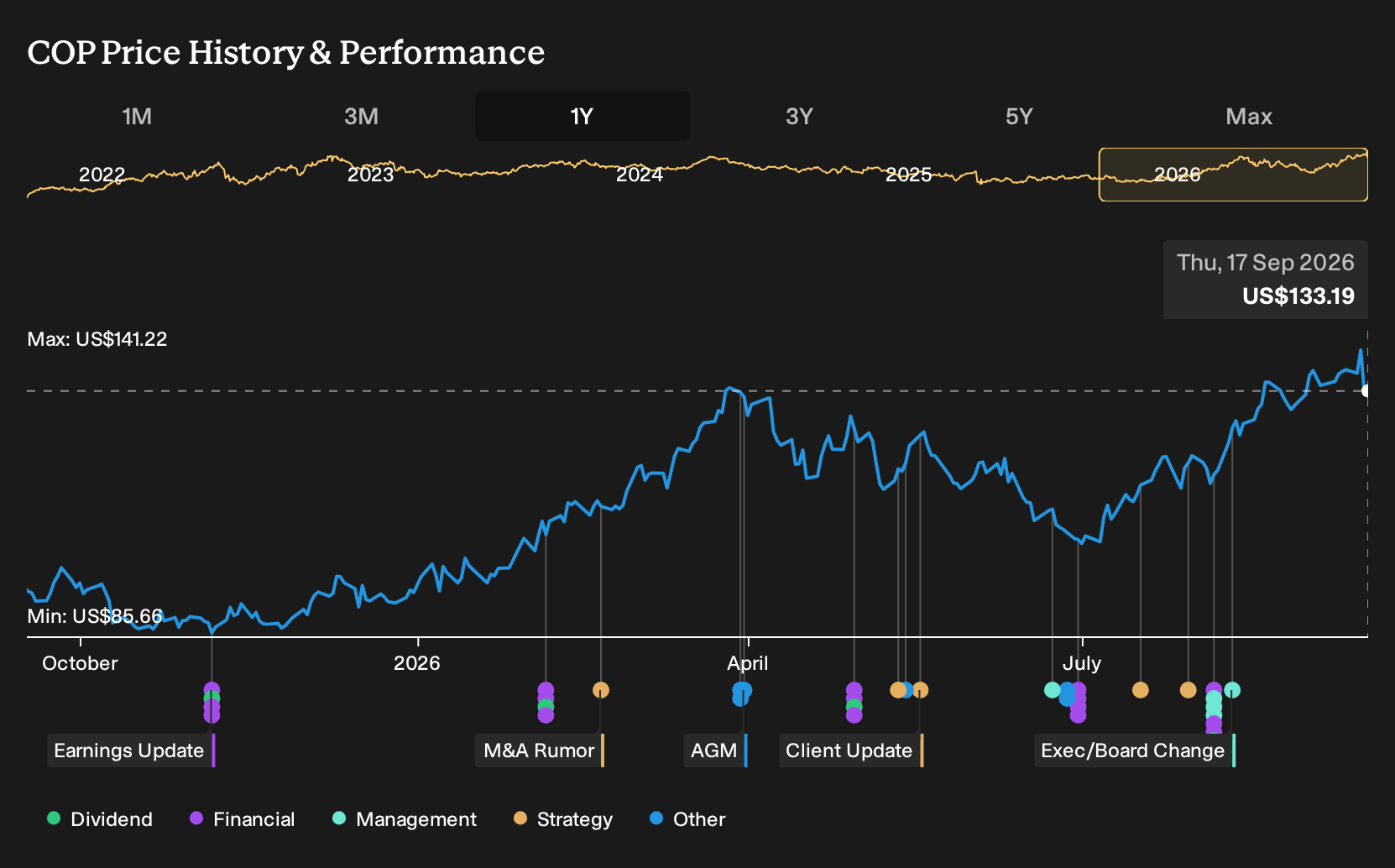
- ConocoPhillips recently saw its shares fall alongside other oil and gas producers after crude prices weakened, as supply concerns eased and U.S. inventory data pointed to softer market tightness.
- The pullback arrived even as earnings expectations for ConocoPhillips moved higher, with analysts projecting a 60.25% EPS uplift and 11.47% revenue expansion versus the same quarter last year.
- This development raises questions about how ConocoPhillips' investment narrative relates to softer crude prices and near term earnings optimism based on analyst upgrades.
Scan how ConocoPhillips compares with other energy plays reacting to the same crude price pressures by reviewing our hand picked 37 power grid technology and infrastructure stocks in one place.
ConocoPhillips Investment Narrative Recap
To own ConocoPhillips, you need to be comfortable with a pure play on oil and gas production and the cash flow that comes from big, long life projects like Willow in Alaska and LNG ventures in Qatar and Port Arthur. The sharp 6.15% drop, driven by softer crude prices, mostly affects near term sentiment rather than the longer term project pipeline.
The key short term swing factor is still the upcoming earnings release, where the market is watching how realized prices and volumes show up in actual cash generation. The biggest current risk is sustained weak pricing that could pressure returns on those capital intensive projects and slow planned portfolio high grading and asset sales.
The most relevant recent development is the combination of a 6.15% pullback in ConocoPhillips and higher near term EPS expectations, with analysts projecting a 60.25% increase and 11.47% revenue expansion versus the same quarter last year. That gap between weaker oil prices and stronger projected results is what traders are focusing on.
For you as a shareholder, the focus is whether upcoming earnings show that ConocoPhillips can convert its global asset base into profit and free cash flow in a softer crude tape. If results are close to those projections, it reinforces the LNG and mega project catalyst narrative. If pricing or costs are more challenging, it highlights how exposed the business is to commodity swings.
What The Current ConocoPhillips Forecasts Assume
Analysts building out the ConocoPhillips story are effectively asking you to underwrite slow and steady revenue expansion and a sizable uplift in profitability by the end of the decade. Their models point to revenue growing by 4.9% a year over the next 3 years, while profit margins are projected to move from 12.3% today to 15.9% by 2029. On the earnings line, the consensus view is for profit to reach US$10.9b, or US$10.51 per share, by around June 2029, compared with US$7.3b in earnings today.
ConocoPhillips' narrative projects US$68.5b revenue and US$10.9b earnings by 2029. This assumes 4.9% yearly revenue growth and implies roughly a US$3.6b earnings increase from the current US$7.3b level.
That earnings step up is not universally agreed. The most optimistic analysts on the stock see profit closer to US$12.9b by 2029, while the most cautious are closer to US$6.4b. The spread between those bookend views shows how sensitive the outlook is to commodity prices, project execution and cost control across the LNG and upstream portfolio. It also matters that these projections assume the share count shrinks by about 2.45% each year for the next 3 years, which can lift per share metrics even if operating results do not move in a straight line.
The valuation overlay builds on those same assumptions. For the current analyst price targets to hold, ConocoPhillips would need to generate about US$68.5b of sales and US$10.9b of earnings in 2029 and trade on a P/E of 18.3x, compared with 17.8x today and an industry level of 12.9x for US oil and gas producers. That implies investors would be paying a premium multiple for the stock relative to the broader sector if the scenario plays out as expected.
Uncover why ConocoPhillips' fair value indicates an 8% potential upside to its current price that may not last much longer.
Exploring Other Perspectives
One alternate lens on ConocoPhillips leans heavily on that planned US$7b free cash flow uplift by 2029, with bullish analysts previously pencilling in about US$70.3b of revenue and US$11.9b of earnings. You can see how that more optimistic story clashes with a 6.15% share drop on softer crude, and why fresh news could reset both narratives.
Explore 3 other ConocoPhillips fair value estimates, including one that suggests as much as 158% potential upside from the current price.
The Verdict Is Yours
Don't just follow the ticker, dig into the data and build a conviction that's truly your own.
- A great starting point for your ConocoPhillips research is our analysis highlighting 1 key reward and 2 important warning signs that could impact your investment decision.
- See our latest analysis for ConocoPhillips. The report includes a comprehensive fundamental analysis summarized in a single visual, the Snowflake, making it easy to evaluate ConocoPhillips' overall financial health at a glance.
Looking For More Investment Ideas Beyond ConocoPhillips?
Once you have a view on ConocoPhillips, it often helps to line it up against other opportunities with different risk and income profiles. The Simply Wall St Screener can surface stocks that match the type of balance sheet strength, value profile or income stream you want to research next.
- If capital preservation is high on your list, consider researching companies picked out for their resilience through the 30 resilient stocks with low risk scores.
- If you prefer to focus on financial strength and fundamentals, scan a list of solid balance sheet and fundamentals (23 results) that can help you compare against ConocoPhillips' profile.
- If you are hunting for mispriced opportunities, widen your watchlist with a 29 high quality undervalued stocks that may warrant a closer look.
This article by Simply Wall St is general in nature. We provide commentary based on historical data and analyst forecasts only using an unbiased methodology and our articles are not intended to be financial advice. It does not constitute a recommendation to buy or sell any stock, and does not take account of your objectives, or your financial situation. We aim to bring you long-term focused analysis driven by fundamental data. Note that our analysis may not factor in the latest price-sensitive company announcements or qualitative material. Simply Wall St has no position in any stocks mentioned.
Have feedback on this article? Concerned about the content? Get in touch with us directly. Alternatively, email editorial-team@simplywallst.com