


Mattel shares have fallen sharply over recent years, which puts fresh pressure on the question of whether today's stock price still lines up with the earnings the toy maker is producing. With the business also signing new content and licensing deals, investors are left weighing a weaker share chart against an evolving profit story.
- The stock is down 38.2% over the past 3 years, which puts the current valuation debate squarely on what the company's earnings can realistically support.
- Recent licensing moves around brands such as Bluey may support expectations for future revenue and profit contributions, which matter directly for how much investors are willing to pay per dollar of Mattel's earnings.
- There is a second opinion on Mattel worth weighing. See what analysts think Mattel's shares could be worth.
The issue now is whether the current share price is justified by Mattel's earnings when set against the Fair Ratio benchmark.
If you want to stress test Mattel's earnings question against a wider field of ideas, run the same lens across 29 high quality undervalued stocks.
Is Mattel Still Cheap on Earnings?
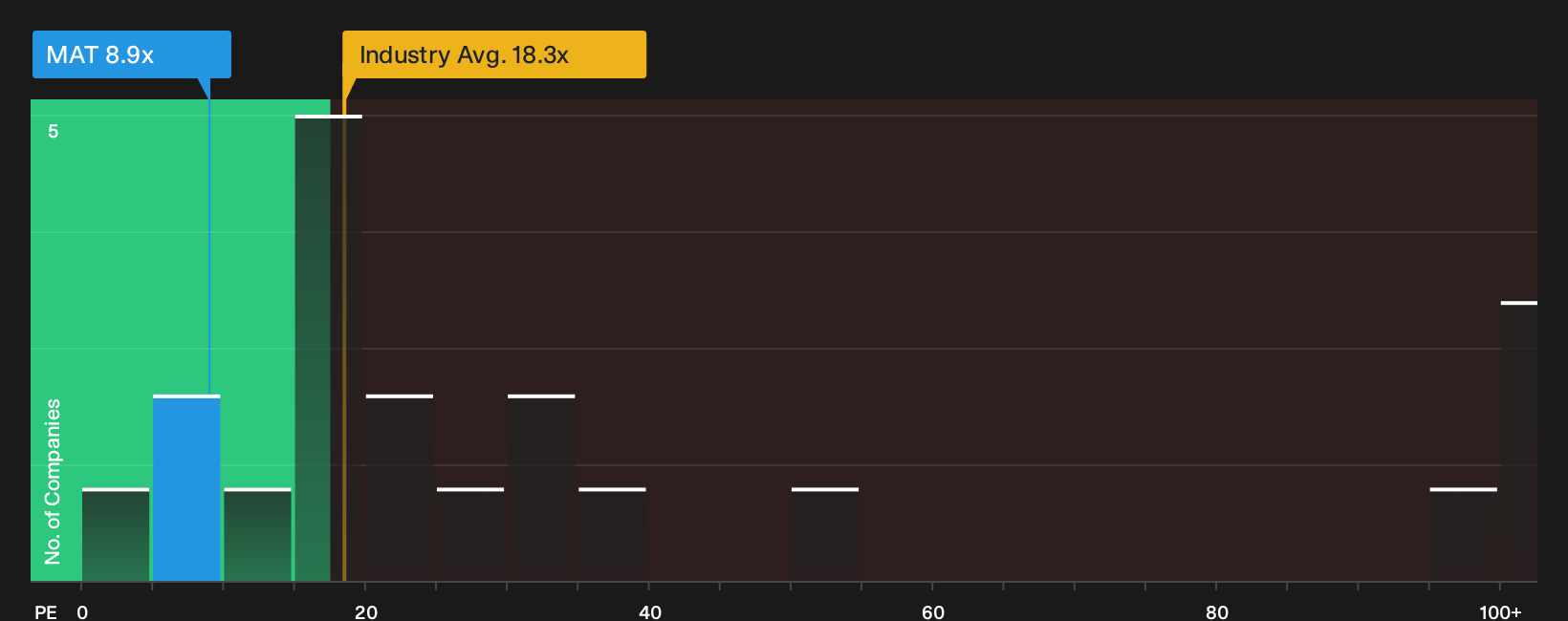
The P/E ratio is a useful lens for Mattel because earnings remain a central anchor for how the market values a consumer brands group like this. Mattel currently trades on a P/E of 8.9x, which is well below the broader Leisure industry on 18.3x and sits at a wide discount to a peer set closer to 26.3x.
The Fair Ratio model, which blends factors such as growth profile, profitability, size and sector norms into a tailored earnings multiple, also points to Mattel trading below the level that framework would typically imply. Because the recent Bluey licensing deal and Q2 revenue outcome are already visible to investors, this lower multiple suggests the market is still cautious about how consistently those earnings will translate into cash returns over time. Explore the numbers behind Mattel's P/E valuation.
The Mattel Narrative: What Would Justify Today's Price?
Mattel Narratives on Simply Wall St pick up where the valuation puzzle leaves off, by spelling out which assumptions on future growth, margins and earnings would need to hold for the stock to be worth meaningfully more or less than today’s price. Each scenario lays out its own fair value logic in terms of those inputs, so you can weigh the underlying expectations against Mattel's actual results as fresh numbers arrive.
Community views on Mattel are split between an IP rich entertainment upside and concern that legacy toys and execution risks keep a lid on the story.
Bull case: 27% undervalued
"Film and streaming releases based on Mattel franchises, such as Masters of the Universe and the upcoming Matchbox title, deepen brand awareness…"
Discover why this Narrative puts Mattel at 27% undervalued.
Bear case: 11% overvalued
"Mattel faces a secular decline in demand for traditional physical toys due to the accelerating shift among children toward digital entertainment and mobile devices…"
Explore why this Narrative puts Mattel at 11% overvalued.
One more Mattel check that sits beyond the share price
The people charting Mattel's course and how they are rewarded can strengthen or weaken any earnings story, so it pays to see how those incentives line up with your own. See who runs Mattel and how they are paid.
This article by Simply Wall St is general in nature. We provide commentary based on historical data and analyst forecasts only using an unbiased methodology and our articles are not intended to be financial advice. It does not constitute a recommendation to buy or sell any stock, and does not take account of your objectives, or your financial situation. We aim to bring you long-term focused analysis driven by fundamental data. Note that our analysis may not factor in the latest price-sensitive company announcements or qualitative material. Simply Wall St has no position in any stocks mentioned.
Have feedback on this article? Concerned about the content? Get in touch with us directly. Alternatively, email editorial-team@simplywallst.com