


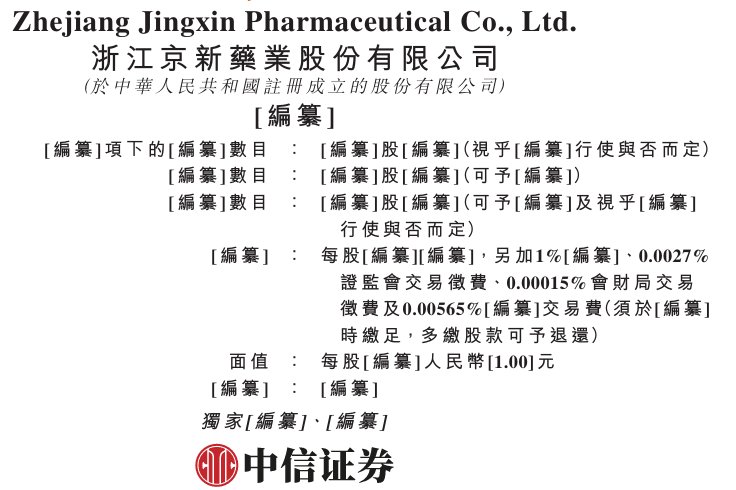
The Zhitong Finance App learned that according to the Hong Kong Stock Exchange's disclosure on September 18, Zhejiang Jingxin Pharmaceutical Co., Ltd. (abbreviation: Jingxin Pharmaceutical, 002020.SZ) has once again submitted a listing application to the main board of the Hong Kong Stock Exchange, and CITIC Securities is its sole sponsor.
Company profile
According to the prospectus, the company is a pharmaceutical group whose strategy focuses on two core treatment areas: (i) central nervous system (central nervous system) diseases; and (ii) cardiovascular and cerebrovascular diseases. As of the last practical date (September 10, 2026), didacinib (Gennonin®) was the only innovative drug approved by the company. In addition to didacinib, the company is promoting selected drugs under development in key treatment areas, including JX2201, a class 1 innovative drug under development to treat elevated levels of lipoprotein (a).
The company's revenue mainly comes from sales of marketed products, covering (i) pharmaceuticals (including generic drugs, innovative drugs (didacinib), traditional Chinese medicines (traditional Chinese medicines) and biologics); (ii) APIs (APIs); and (iii) medical devices. During the track record period, drug sales accounted for the majority of the company's revenue.
The company uses cash flow generated from marketed products to support the company's R&D, clinical development and commercialization activities. With in-house R&D, manufacturing and commercialization capabilities, the company promotes product lines focusing on central nervous system diseases and cardiovascular and cerebrovascular diseases.
The company's development trajectory has followed the evolution of China's pharmaceutical industry over the past 30 years. The company initially focused on intermediates and APIs, then expanded its business downstream to the pharmaceutical sector. Over time, the company has built a product portfolio spanning generic pharmaceuticals, traditional Chinese medicines and biologics, APIs, and medical devices. In recent years, the company has allocated R&D resources to selected drugs under development for central nervous system and cardiovascular and cerebrovascular diseases. In 2023, the company successfully launched a class 1 innovative drug, didacinib, which was approved for the treatment of insomnia in China.
Financial data
revenue
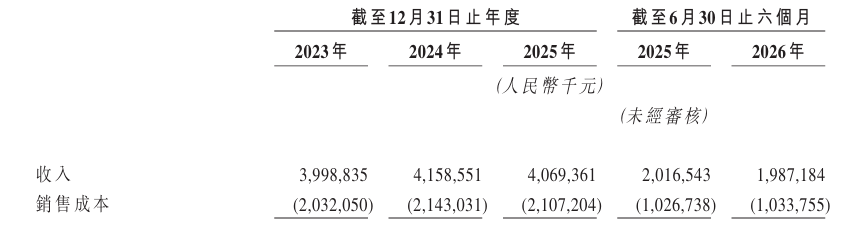
For the six months ended June 30 in 2023, 2024, 2025 and 2026, the company's revenue was approximately RMB 3,999 billion, RMB 4.159 billion, RMB 4,069 billion and RMB 1,987 billion, respectively.
profit
For the six months ended June 30 in 2023, 2024, 2025 and 2026, the company's annual/period profit was approximately RMB 623 million, RMB 719 million, RMB 772 million and RMB 358 million, respectively.

Industry Overview
In terms of drug sales revenue, the Chinese pharmaceutical market increased from RMB 1,591.1 billion in 2021 to RMB 1,654.6 billion in 2025, with a compound annual growth rate of 1.0% between 2021 and 2025. It is expected to further grow to RMB 2,079 billion by 2030, and the compound annual growth rate between 2026 and 2030 is 5.3%. The market share of patent-protected drugs is expected to increase from 45.8% (RMB 728.7 billion) in 2021 to 68.5% (RMB 1,4231 billion) in 2030.
In contrast, although the generic drug market is expected to grow moderately to RMB 655.9 billion in 2030, its market share will plummet from 54.2% in 2021 to 31.5% in 2030.
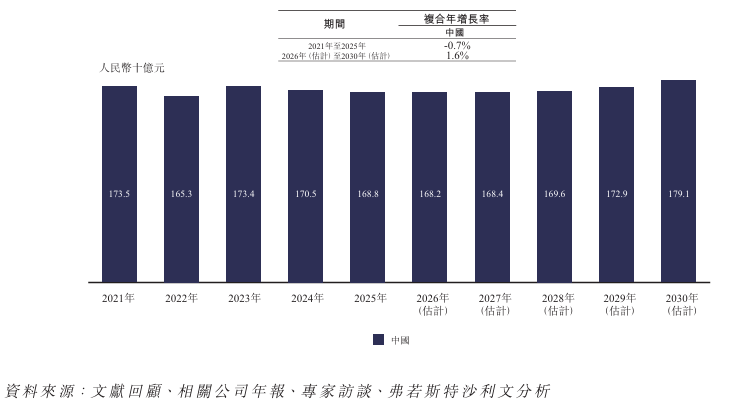
In terms of drug sales revenue, the global central nervous system drug market is huge and is entering a period of steady growth. Among them, China has become one of the fastest growing regions. According to the approval records published by the State Drug Administration, there are about 16,737 approved drug registrations in the field of central nervous system treatment in China. Of these, about 750 are classified as innovative (patented) drugs, about 14,622 are generic drugs, while the remaining 1,365 approved drugs cannot be clearly classified according to existing registration data. Between 2021 and 2025, the global central nervous system drug market increased from RMB 1,583.7 billion to RMB 1,898 billion, with a compound annual growth rate of 1.8% during this period. The size of the central nervous system drug market in China decreased from approximately RMB 173.5 billion in 2021 to RMB 168.8 billion in 2025, with a compound annual growth rate of — 0.7%. It is expected to expand at an accelerated CAGR of 1.6% between 2026 and 2030, and the market size will reach approximately RMB 179.1 billion by 2030.
China's epilepsy drug market has been expanding steadily. The growth trend is expected to continue until 2030, but the pace is relatively moderate compared to the rapid growth in the central nervous system (CNS) sector. From 2021 to 2025, China's epilepsy drug market expanded from RMB 6.6 billion to RMB 7.8 billion, with a compound annual growth rate of 4.3%. It is expected to reach RMB 9.1 billion in 2030, with a compound annual growth rate of 3.0% between 2026 and 2030. The market outlook is showing a steady trend of continuous expansion. The main driving force is the gradual narrowing of the treatment gap, and the gradual upgrading and renewal of treatments, and higher value.
In 2025, the market size of Parkinson's drugs in China reached RMB 3.3 billion, with a compound annual growth rate of 0.1% from 2021 to 2025. The market size is expected to reach RMB 6.4 billion by 2030, with a CAGR of 16.1% from 2026 to 2030.
Board Information
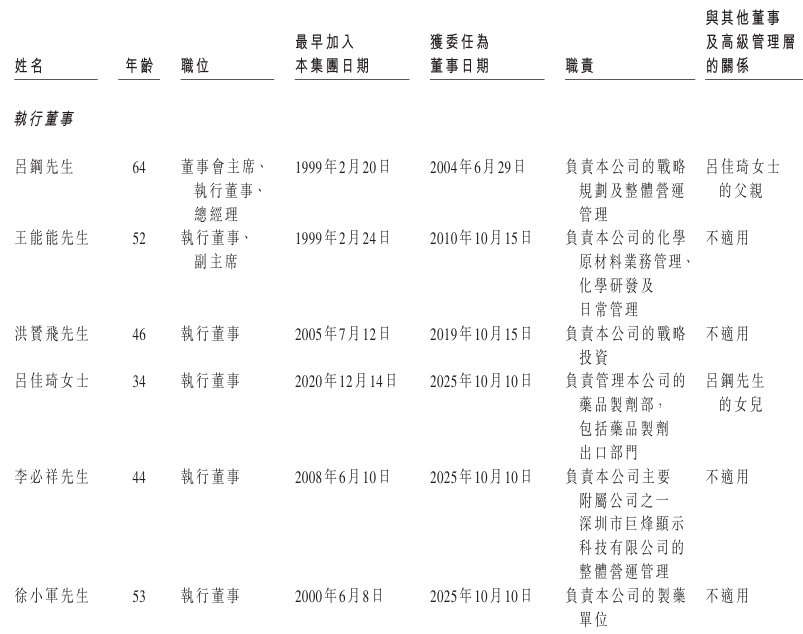
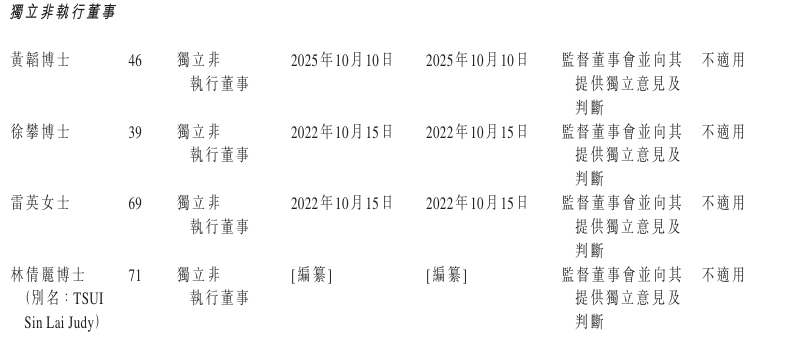
After codification, the board of directors will be composed of 10 directors, including 6 executive directors and 4 independent non-executive directors. The board of directors is responsible for the management and operation of the company and has overall authority over it.
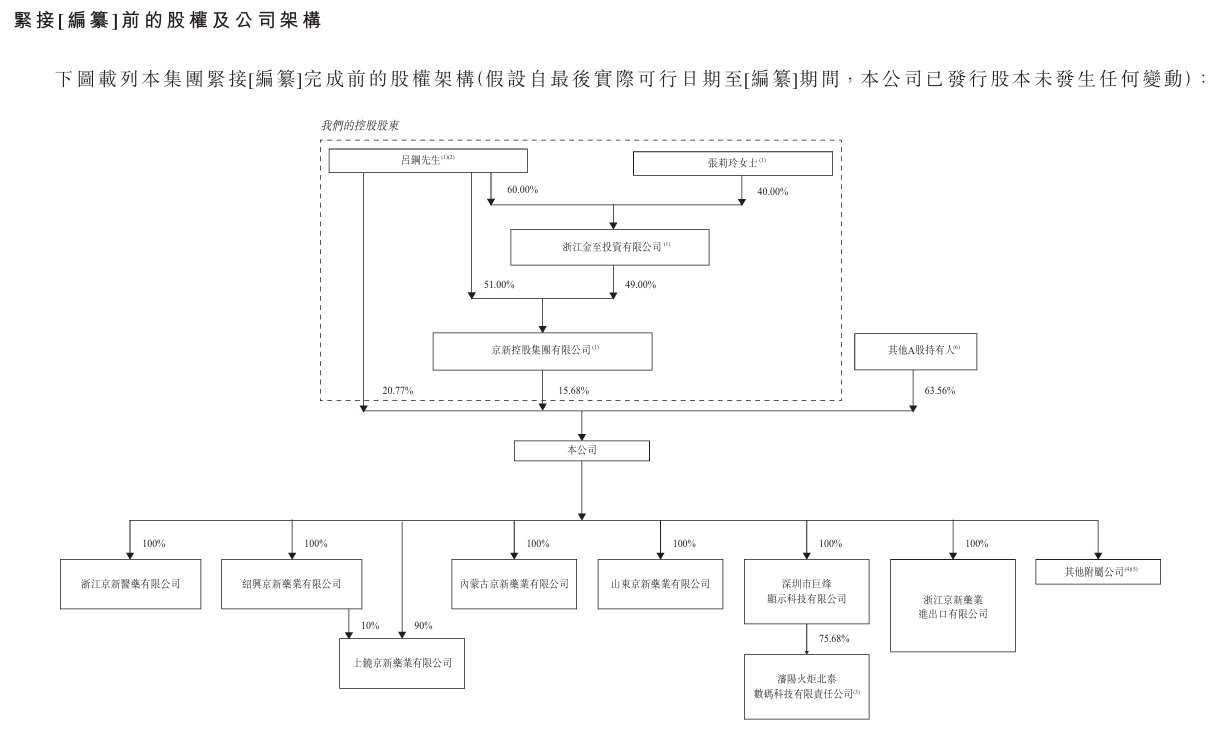
Shareholding structure
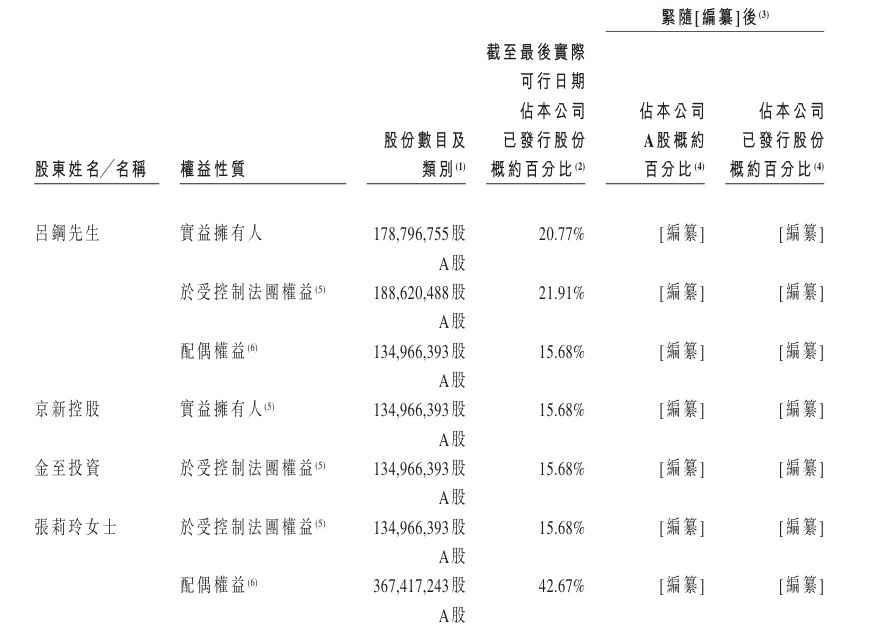
As of the last practical date, the company was controlled by a group of shareholders led by Mr. Lu Gang, executive director, chairman of the board of directors and general manager of the company. Specifically, the company directly holds approximately 20.77% and 15.68% of the interests of Mr. Lu Gang and Jingxin Holdings, respectively. Jingxin Holdings, compiled by Mr. Lu Gang and Jin Zhi, holds 51.00% and 49.00% interests respectively. Compiled by Jin Zhi, Mr. Lu Gang and Ms. Zhang Liling, the spouse of Mr. Lu Gang, own 60.00% and 40.00% of the rights respectively.
Intermediary team
Sole sponsor: CITIC Securities (Hong Kong) Limited;
Legal Advisors: Wilson Sansini Gucci Rosaldi Law Firm; Shanghai AllBright Law Firm; Bae, Kim & LeellC;
Sole sponsor's legal advisors: Luo Xiaxin Law Firm, Jingtian Gongcheng Law Firm;
Auditor and reporting accountant: Hong Kong Lixin Dehao Certified Public Accountants Limited;
Industry consultant: Frost & Sullivan (Beijing) Consulting Co., Ltd. Shanghai Branch.