


Washington’s move to allow tariffs of up to 500% on Russian goods has sharpened focus on energy security and reliable baseload power. That puts Australian nuclear related stocks in the spotlight for investors who want exposure to fuel supply, technology and long term power generation themes tied to this global reset. This article highlights three nuclear energy stocks from our screener that merit closer attention.
The three nuclear energy stocks outlined below are only a starting sample, and the full screen surfaced 23 more companies with equally detailed narratives that are not covered here.
To identify and analyze the highest conviction opportunities across uranium miners, fuel cycle players and reactor operators, head straight to the Nuclear Energy Stocks screener.
Worley (ASX:WOR)
Overview: Worley is a global engineering and project services group that helps design, build, run, and retire large energy and resources infrastructure, including nuclear power assets.
Operations: Worley generates A$6.2b of business revenue from the Americas, A$4.5b from EMEA, and A$1.3b from APAC, with smaller unallocated items.
Market Cap: A$4.8b
Worley gives nuclear energy investors a way to focus on the nuts and bolts of plant design, construction oversight and long term operations, rather than just fuel supply or utilities, which makes its project work an important piece of this theme.
"The accelerating global push for decarbonisation and energy transition is expanding Worley's addressable market, as evidenced by 60% of FY25 revenue coming from sustainability-related work (up from 52% in FY24); further investment and government policies towards net zero are likely to boost revenue streams, especially in renewables, hydrogen, and carbon capture."
The real swing factor for Worley within nuclear will be how one unseen pressure ultimately plays through to margins on complex projects.
That pressure point is where Worley’s story gets interesting, and the full narrative for Worley unpacks how project complexity, risk sharing and energy transition work are all intersecting here.

Boss Energy (ASX:BOE)
Overview: Boss Energy is a uranium producer focused on its 100% owned Honeymoon project in South Australia, supplying fuel for nuclear reactors.
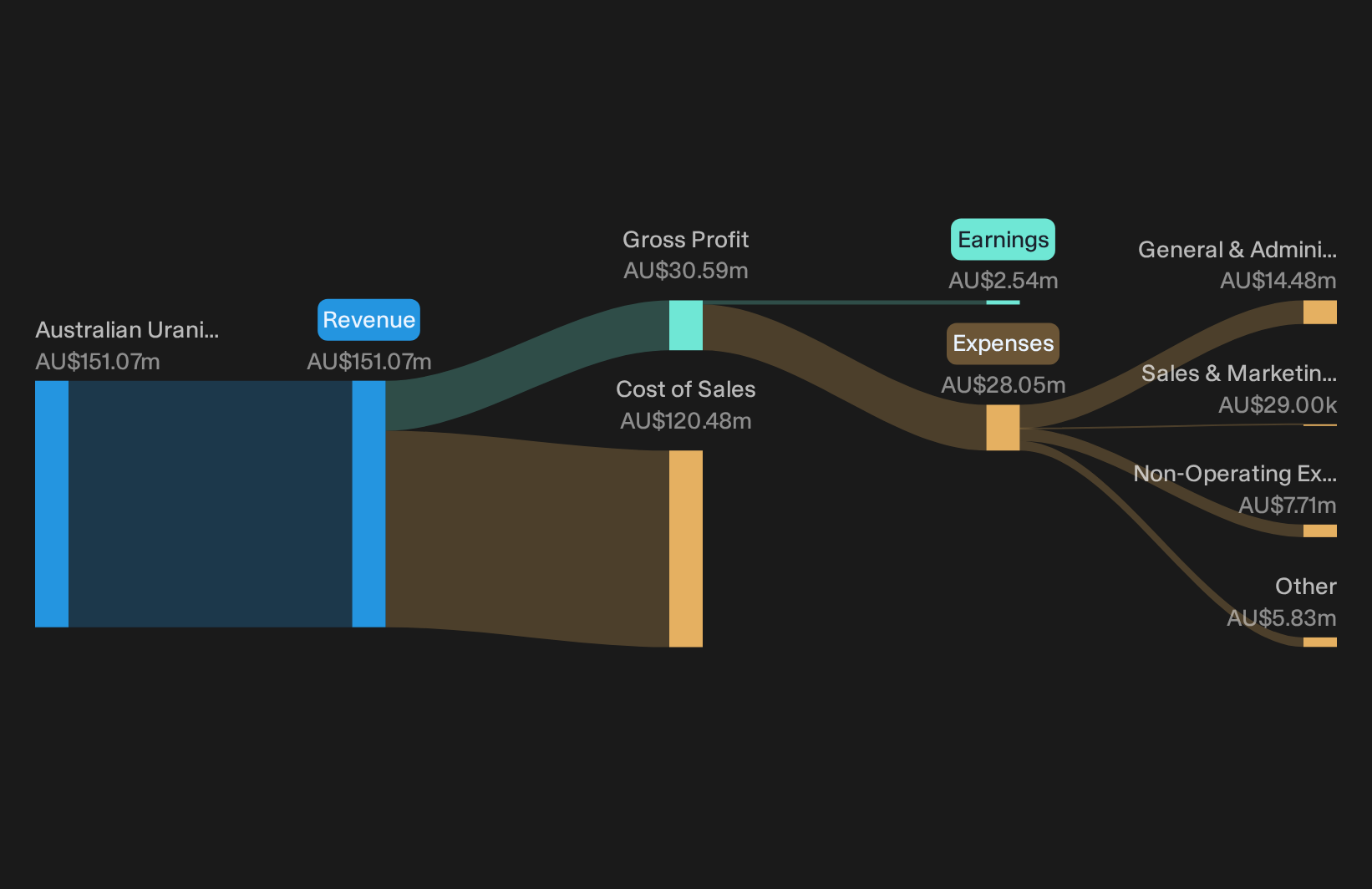
Operations: The business currently generates A$151 million in revenue from Australian Uranium Operations, reflecting its single asset production focus.
Market Cap: A$668 million
Boss Energy gives you direct exposure to uranium feedstock for the Nuclear Energy Stocks theme, with Honeymoon moving deeper into its production phase and proving out its role in the fuel supply chain.
"Record quarterly Honeymoon output of 456,000 pounds of uranium drummed, alongside guidance for 1.6 million pounds in FY26 production, outlines a larger volume base that may influence revenue outcomes depending on future operating performance and market conditions."
The key consideration for Boss Energy is how the changing relationship between costs and pricing shapes the profitability of its growing output base.
That profitability question is exactly what the full narrative for Boss Energy tackles, revealing where Boss Energy’s cost curve could accelerate, stall, or quietly outpace expectations.
Paladin Energy (ASX:PDN)
Overview: Paladin Energy develops and operates uranium mining projects in Namibia and Canada, supplying raw fuel for global nuclear power generation.
Operations: Paladin Energy generates US$304 million from Namibia, with uranium sales flowing to Asia, North America, and Europe customers.
Market Cap: A$4.4b
Paladin Energy matters for this Nuclear Energy Stocks screener because its uranium output directly feeds reactors that utilities rely on for long term, steady baseload power.
"Paladin committed US$125 million to restart it, above the original estimate, largely due to supply chain inflation and processing plant upgrades. First production resumed in early 2024."
The real test now is how one quietly shifting balance between future uranium pricing and project funding costs shapes shareholder outcomes.
If that balance is what you care about, the full narrative for Paladin Energy maps how Paladin Energy’s restart spending, funding mix and uranium exposure could be quietly decoupling.

Seeking Alternatives Before Momentum Flies
Fresh ideas move first. By the time every investor spots the breakout, the best entry can be gone. Scan these under the radar pools now and evaluate them early.
- Identify fast moving small caps before broader attention builds by scanning the curated 15 elite penny stocks with strong financials and judging which stories may warrant closer monitoring.
- Observe where significant capital may be allocated to infrastructure for AI by reviewing the filtered 89 AI infrastructure stocks and noting which tickers appear to be gaining interest.
- Review potential developments in precious metals by examining the handpicked 36 elite gold producer stocks and determining which producers may still be overlooked by many investors.
This article by Simply Wall St is general in nature. We provide commentary based on historical data and analyst forecasts only using an unbiased methodology and our articles are not intended to be financial advice. It does not constitute a recommendation to buy or sell any stock, and does not take account of your objectives, or your financial situation. We aim to bring you long-term focused analysis driven by fundamental data. Note that our analysis may not factor in the latest price-sensitive company announcements or qualitative material. Simply Wall St has no position in any stocks mentioned.
Have feedback on this article? Concerned about the content? Get in touch with us directly. Alternatively, email editorial-team@simplywallst.com