


- HP Inc. has launched the ZBook Ultra G3a mobile workstation and the ZGX Fury AI infrastructure, both focused on running large AI workloads locally for professional users.
- The push toward on-device AI and hybrid deployments, supported by partnerships such as Red Hat and Perplexity, highlights HP's effort to anchor demand in higher value premium systems and workflows rather than commodity PCs.
- The next area of focus will be how HP's AI focused premium hardware push, especially the ZBook Ultra G3a, may reshape its investment narrative.
HP Investment Narrative Recap
To own HP today, you need to believe the AI PC and premium workstation push can offset slow structural demand in traditional PCs and a shrinking print market. The key near term swing factor is whether AI focused Personal Systems revenue and margins stay strong enough to keep overall earnings moving, even as print volumes face pressure.
The biggest risk is that premium AI hardware becomes commoditized quickly, pushing HP back into heavier price competition just as print declines and high debt and negative equity limit flexibility. The ZBook Ultra G3a launch is important for the story, but by itself does not remove these structural pressures.
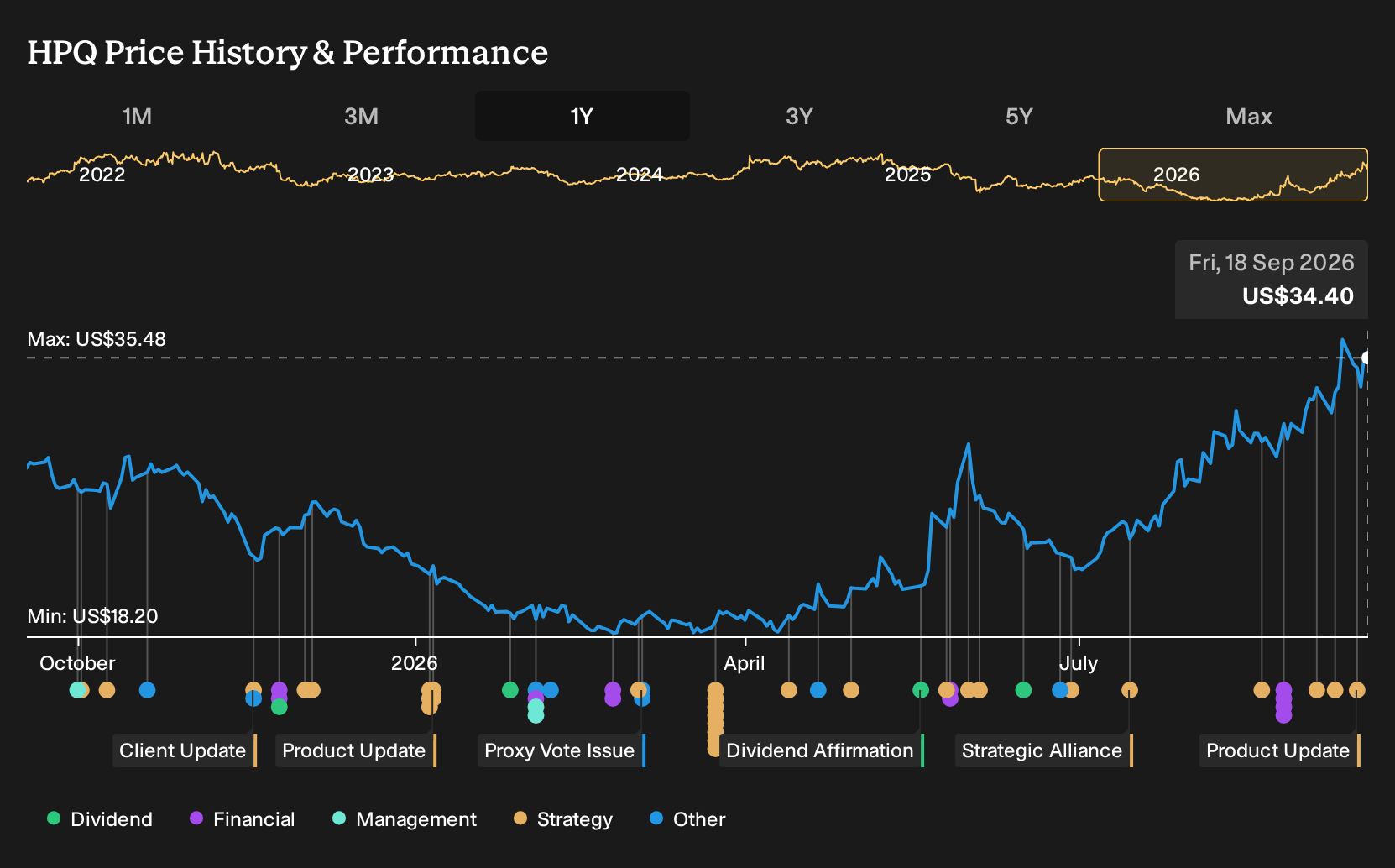
The ZBook Ultra G3a announcement matters because it ties directly into HP's current AI PC momentum and recent Q3 2026 rally that has pushed HPQ well above the average analyst price target. This workstation is engineered for large local models and multi agent workflows, which speaks directly to the higher value segment HP is leaning on.
If adoption of devices like the ZBook Ultra G3a and ZGX Fury holds up, that can support higher mix quality, pricing power and recurring AI centric workflows, including services and managed offerings. Weak appetite from architects, engineers and designers for such premium hardware, or rapid competitive responses, would leave HP more exposed to cyclical refresh cycles and structural print headwinds.
What HP's AI Push Assumes About Future Earnings
HP's AI workstation push, including the ZBook Ultra G3a and ZGX Fury, only really matters for investors if the numbers behind the story hold together. Analysts currently expect HP's revenue to stay fairly flat over the next three years, so the on-device AI push is being treated more as a mix and margin story rather than a top-line expansion story.
On earnings, the consensus view points to profit margins rising from 4.4% today to 4.6% in about three years. That might sound small, but for a hardware heavy business even a modest margin lift can matter if higher priced AI focused PCs and workstations take a greater share of sales.
Analysts expect HP's earnings to move from US$2.6b today to US$2.7b by 2029, which works out to roughly a US$0.1b increase over that period. The forecasts are not tight. The most optimistic analysts are looking for US$3.2b of earnings and the most cautious are closer to US$2.3b, which indicates there is still real debate about how much profit the AI PC cycle and premium devices can support.
The earnings path sits alongside an assumption that HP reduces its share count by about 2.16% a year over the next three years. If that occurs, the company would be leaning on buybacks to help earnings per share, while the AI workstation push and related services aim to support overall profitability.
HP's narrative projects US$58.3b revenue and US$2.7b earnings by 2029. This implies fairly flat yearly revenue trends and about a US$0.1b earnings increase from US$2.6b today.
For these estimates to anchor current analyst models, HP would also need to trade on a P/E of 9.8x those 2029 earnings, down from about 10.2x today and well below the current US tech sector multiple of 32.3x. That combination of modest earnings growth, some mix shift toward AI rich devices and a lower future valuation multiple forms the backbone of the HP story behind the AI PC momentum.
Discover why HP's fair value indicates a 32% potential downside to its current price, leaving little room for error.
Exploring Other Perspectives
You see a different angle when looking at the most pessimistic analysts. They worry HP's AI hardware push, including the ZBook Ultra G3a, might not stand out enough. This is why they had been modeling revenue drifting to about US$55.3b and earnings easing toward US$2.3b by 2029. Those figures were set before this AI workstation news, so it is worth asking whether their story still fits.
Explore 6 other HP fair value estimates, including one that suggests as much as 48% downside from the current price.
Form Your Own Verdict
Don't just follow the ticker. Dig into the data and build a conviction that's truly your own.
- A great starting point for your HP research is our analysis highlighting 4 key rewards and 2 important warning signs that could impact your investment decision.
- See our latest analysis for HP. The report includes a comprehensive fundamental analysis summarized in a single visual, the Snowflake, making it easy to evaluate HP's overall financial health at a glance.
Looking For More Investment Ideas Beyond HP?
Once you have a handle on HP, it can help to widen the lens and compare its setup with other opportunities that fit different risk and return profiles.
- If you want a shot at higher upside from smaller companies with cleaner financials, scan our 9 elite penny stocks with strong financials and see which ones line up with your risk appetite.
- For investors who care most about quality and price discipline, work through the 35 high quality undervalued stocks and compare their valuations with HP's current P/E and earnings profile.
- If capital preservation sits higher on your priority list, filter for companies in the 30 resilient stocks with low risk scores and weigh their risk scores against HP's own risk and reward mix.
This article by Simply Wall St is general in nature. We provide commentary based on historical data and analyst forecasts only using an unbiased methodology and our articles are not intended to be financial advice. It does not constitute a recommendation to buy or sell any stock, and does not take account of your objectives, or your financial situation. We aim to bring you long-term focused analysis driven by fundamental data. Note that our analysis may not factor in the latest price-sensitive company announcements or qualitative material. Simply Wall St has no position in any stocks mentioned.
Have feedback on this article? Concerned about the content? Get in touch with us directly. Alternatively, email editorial-team@simplywallst.com