


THE expansion of the FBM KLCI from 30 to 50 stocks is unlikely to cause a broad market shake-up.
However, for the 20 incoming stocks, the index revamp could become a meaningful liquidity catalyst as passive funds reposition ahead of its phased implementation.
While existing heavyweights such as Malayan Banking Bhd (Maybank), CIMB Group Holdings Bhd, Public Bank Bhd and Tenaga Nasional Bhd (TNB) will see their index weightings trimmed, market watchers say the level of passive funds tracking the benchmark is too small to trigger significant selling pressure.
Instead, the more meaningful impact could be felt among smaller companies entering the benchmark, where index-related buying may represent a much larger share of normal trading volumes.
SPI Asset Management managing partner Stephen Innes says the impact of the rebalancing is likely to be felt more at the individual stock level than across the broader market.
“The existing heavyweights will see some mechanical selling as their weights are diluted, but the amount of passive money tracking the FBM KLCI is relatively small, and names like Maybank, CIMB and TNB are liquid enough to absorb it,” he tells StarBiz 7.
Based on available research, Innes estimates passive assets tracking the KLCI at around US$1bil.
This, he says, is at least four times smaller than assets tracking Singapore’s Straits Times Index and remains “small potatoes” compared with larger developed markets such as Japan.
His view is largely in line with CIMB Research, which also expects the effects to be more stock-specific than market-wide.
“With passive FBM KLCI-tracking assets under management relatively small, and inclusion phased at 50% in December 2026 and 100% in June 2027, we expect the near-term flow impact to be more stock-specific than market- wide,” the research house notes in a recent report following industry dialogue on the index changes.
“The absence of a 10% company-level cap also removes an additional source of forced selling among existing heavyweights.”
This means the existing 30 constituents will collectively see their weighting fall from 100% currently to about 84.4%.
The 20 additional securities will initially enter the index at 50% of their eventual weights on Dec 21, 2026, with the remaining 50% added on June 21, 2027.
For passive funds tracking the FBM KLCI, this means portfolios will have to be adjusted to reflect the new index weightings – reducing holdings in the existing 30 constituents while allocating to the incoming stocks.
For existing heavyweights, the dilution in index weightings will be spread across two phases. Innes expects the impact to be manageable given their size and liquidity.
“A few percentage points of weight reduction spread across Maybank, Public Bank, CIMB, TNB and other very liquid incumbents should be readily absorbed.
“But index buying can be much more material relative to average daily volume and free float for some of the incoming names,” he says.
The impact may be more pronounced for the new constituents.
“For some smaller names, index buying could be meaningful relative to normal daily turnover and free float, especially as investors front-run the December and June implementation dates,” he adds.
Innes describes this as an “asymmetry” in the rebalancing, where relatively modest selling pressure on large, liquid stocks contrasts with potentially more meaningful buying demand for smaller incoming constituents.
“The Western sell side is not suggesting a major FBM KLCI-wide rebalance shock,” he says. “I see this less as a sustained negative for the current heavyweights and more as a potential liquidity catalyst for selected new constituents.”
In its frequently asked questions on the index “enhancement”, FTSE Russell says the phased approach is intended to ensure an “orderly” transition, “helping to reduce concentrated trading flows and support efficient portfolio rebalancing by market participants”.
It also clarified that full market capitalisation will determine final stock selection, while free float will determine index weightings.
The index expansion will nevertheless result in a less concentrated benchmark.
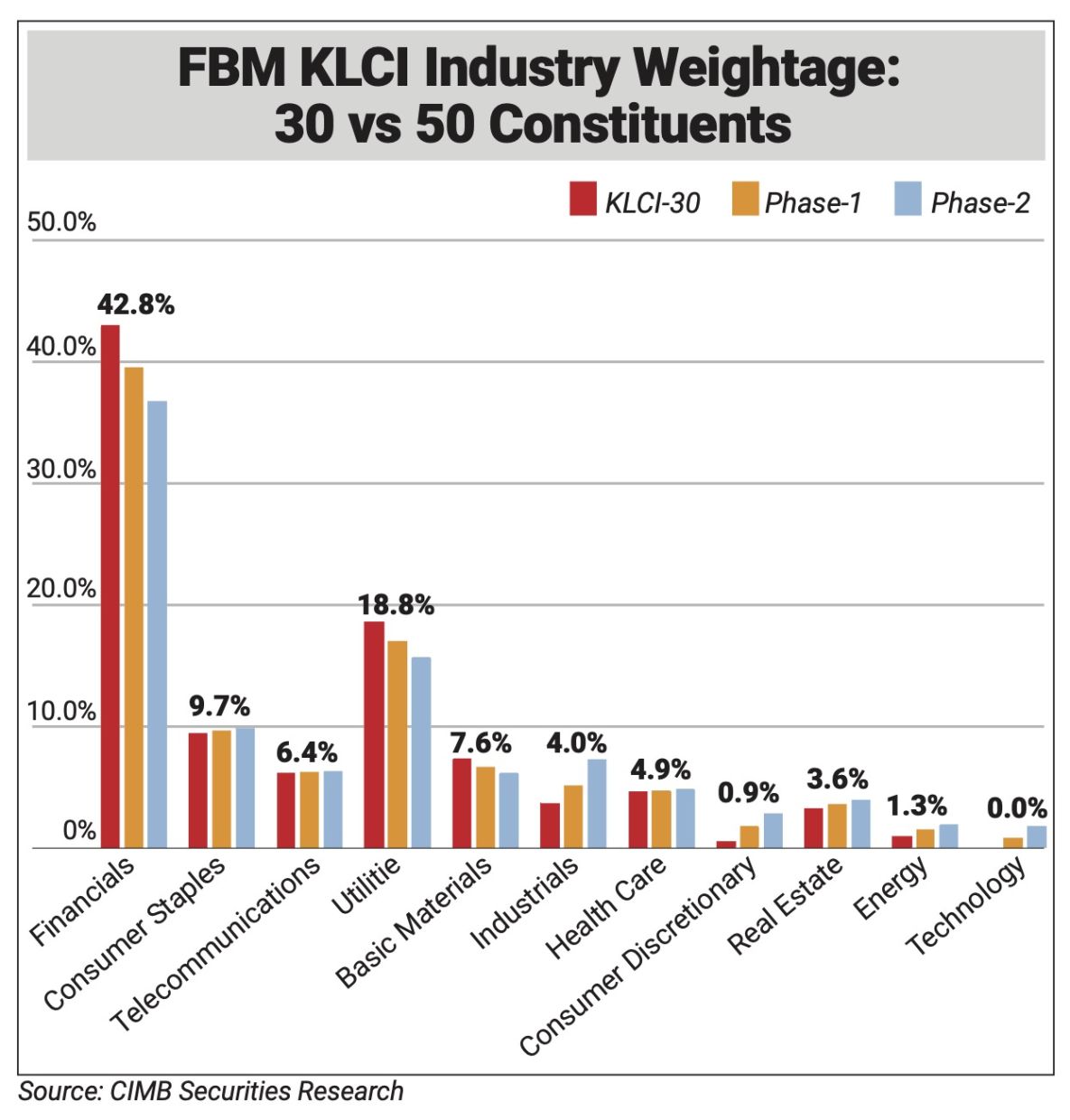
Based on data as at June 30, CIMB Research estimates that the financial services sector’s weight could fall from 42.7% currently to 39.4% in the first phase and 36.6% in the second phase.
Utilities will see their weightage decline from 16.8% to 15.3%, and then to 14.1%, respectively.
Technology, which currently has no representation, is expected to account for 1.3% of the index in the first phase and 2.4% after the second.
Industrials could rise from 6.2% currently to 7.8% and then 9.1%, while consumer discretionary is projected to increase from 0.9% to 2% and 2.9%.
More notably, the combined weight of the FBM KLCI’s four largest constituents is set to decline from 44.9% currently to 41.1% in the first phase and 37.9% in the second, reflecting a less concentrated benchmark.
The expanded index is also expected to better capture newer segments of the Malaysian economy that have had limited or no representation in the 30-stock benchmark.
An observer notes that the current top 30 is dominated by government-linked companies, banks and utilities.
“By expanding to 50 constituents, sectors such as property, construction, technology and companies linked to the data centre boom could be represented. It gives investors a broader picture of Malaysia’s economy,” he tells StarBiz 7.
The final composition of the expanded FBM KLCI will be determined at the Nov 23 cut-off, with the 20 new constituents to be announced on Dec 3.