


Xizhi Technology-P (01879) on the Hong Kong Stock Exchange has taken the ultimate stock price roller coaster to teach newcomers the most vivid lesson with the “first AI light chip” halo above the head.
On the first day of listing on April 28, Xizhi Technology, which had an issue price of HK$183.2, surged 445% in the intraday period and still recorded an astonishing increase of 383.62% at the close, unquestionably topping the 2026 IPO first-day increase list.
The carnival did not stop there — after only two trading days of pullback, the stock price rose again. On the sixth trading day of listing, it hit a record high of HK$1,050, up more than 473% from the issue price, and the total market value of the company once exceeded HK$90 billion.
But the feast came fast and went faster. From a high of HK$1,050 to a low of HK$228.40, it took less than three months for Heizhi Technology's stock price to almost “cut an ankle” in the midst of an unrelayed slump, retreating nearly 80% from the highest point. At one point, the premium over the issue price was reduced to only 24.67%.
Although the stock price has rebounded since then, it remained low and fluctuated widely until September 7, when the inclusion of the Hong Kong Stock Connect officially came into effect — however, the benefits were unfavorable. After inclusion, it fell 35% in just 9 trading days, reaching around HK$260.
From a sharp rise of 383% on the first day to a high drop of nearly 80%, from the “first AI chip share” to the exhaustion of advantages after being included in the Hong Kong Stock Connect, Xizhi Technology's “roller coaster” stock price performance after listing can be called a microcapital revelation.
But the real test may be yet to come: on October 28, the 20 Cornerstone investors will hold a total of about 8.9746 million shares (9.76% of the total share capital after the overallotment exercise) will be lifted. Based on the closing price of HK$323.2 on September 18, the market value is about 2.9 billion yuan. Once this group of scattered shares is concentrated in the market, the already weak liquidity may face a new round of shocks — the sword of Damocles hanging over Xizhi Technology's head is about to fall.
From a sharp rise of 473% to an “ankle slash”: a big chip drama of “speculation on thin markets - overdraft valuations - return of value”
The “spectacle” of Xizhi Technology's sharp rise of 473% in the six trading days of the Hong Kong stock listing is the result of “scarce track expectations, well-known cornerstone lock-up funding+high bid sentiment, and thin market issuance” forces that were compounded and amplified in the early stages of listing, and were bombarded with capital.
From an industrial perspective, optical computing power itself is on the cusp of AI infrastructure shifting from a “GPU stack” to “solving interconnection power consumption and bandwidth bottlenecks,” and the market is willing to price the optoelectronic hybrid route according to the long-term space.
Meanwhile, Xizhi Technology also uses OMac photonic matrix calculation, OnoC on-chip optical network, and OneT inter-chip optical network to build two lines of optical computing and optical interconnection, superimposing labels such as scale-up optical interconnection, GPU supernode, CPO, and silicon light. It is one of the few pure optical computing power targets in the 2026 AI hardware market.
At the same time, Xizhi Technology is the first company in the world to achieve large-scale deployment of optoelectronic hybrid computing power. In 2025, optical interconnect has contributed most of its revenue, and the cumulative shipment of optical computing chips is the highest. This “revenue verification but still early” state can easily be valued by capital according to the weight of the track period rather than according to current PE constraints.
This scarcity of the racetrack quickly turned into high popularity during the offering stage, and the most intuitive reflection of this was the Cornerstone Investors' “Luxury Team” lineup. Xizhi Technology brought in 20 cornerstone investors, spending a total of about US$210 million to subscribe for about 8.9774,600 shares. The lineup spans international sovereign funds, top long-term asset managers, and domestic internet and communications giants — not only national capital such as GIC and Temasek, but also global long-term giants such as BlackRock, Fidelity, Schroder, and Baillie Gifford. There is no shortage of industrial capital such as Alibaba, Lenovo, and ZTE, and leading local institutions such as Gao Yi and Jinglin.
The significance of this list is far more than just “getting a credit”. It is essentially an “endorsement of trust”. When industrial capital uses real money to bet on the prospects of implementing optical interconnection and optical computing, and when long-term institutions are willing to lock in chips during the 18C loss stage, it shows that the long-term value of Xizhi Technology is recognized.
The high subscription ratio is another aspect of Xizhi Technology's high popularity during the IPO stage. As an 18C special technology channel issuer, Xizhi Technology overallocated a total of about 13.7952 million H shares, with an initial allocation of 5% of the public offering and 95% of the international placement. Due to the overpurchase of 5784.7 times, the public sale triggered a rebate, the public sale was refunded to 20%, the international placement was 80%, and the international placement also recorded 53.83 times oversubscription. Retail investors and institutions were all scrambling to raise funds.
It is worth noting that Cornerstone investors locked in most of the international placement chips, causing Xizhi Technology to show obvious “thin market” characteristics. This is also one of the key reasons why Xizhi Technology's stock price skyrocketed after listing.
Prior to the exercise of the over-allocation authorization, Xizhi Technology issued a total of 13.7952 million H shares, accounting for 15% of the company's total share capital. Of these, the 11.0362 million H shares placed internationally were subscribed by 20 cornerstone investors, accounting for about 81.32% of the international placement, accounting for about 65.06% of the total issued shares, that is, the actual tradable chip value after listing was about 4.82 million shares. At a price of HK$183.2, the actual marketable market value was only HK$880 million.
The free circulation market of only about HK$880 million provided an extremely thin chip base for capital speculation at the beginning of the listing, but after the stock price rose by more than 473%, it began a long downward path because the valuation was already extremely inflated at this time. Based on the highest price of HK$1,050, the highest market value of Heizhi Technology reached HK$96.566 billion, while the company's revenue in 2025 was only RMB 106 million, and the corresponding PS valuation was as high as 818 times, which is already exaggerated.
As a comparison, the last round of financing of Xizhi Technology before listing was the C4 round of financing on April 24, 2025. The post-investment valuation was only about 7.8 billion yuan. After just one year, Xizhi Technology's market value soared to HK$96.566 billion in the secondary market, an increase of more than 11 times. This is clearly too crazy. Precisely because of this, after hitting a historically high price of HK$1,050, Heizhi Technology continued to decline by about 80%, close to “breaking the ankle.” It can be seen from this that in the half year that Xizhi Technology went public, a wave of “speculation on thin plates - overdraft valuations - return to value” has been staged.
Fundamentals are in the early stages of growth: commercialization continues to accelerate and high R&D investment coexists
As of the close of trading on September 18, the price per share of Heizhi Technology was HK$323.2, which is more than 76.42% higher than the issue price of HK$183.2. This indicates that the cornerstone investors have had some floating profits, and the key to deciding whether these cornerstones will be sold after the ban is lifted is not only the current level of floating profit, but more importantly, whether the company's future growth expectations can bring more definite returns. This makes it necessary to further explore the fundamentals of Xizhi Technology.
According to the financial report for the first half of 2026, Xizhi Technology's revenue during the reporting period was 797.79 million yuan, an increase of 284% over the previous year; of these, the optical interconnection business achieved revenue of 606.99 million yuan, an increase of 275% over the previous year, accounting for 76%. The revenue from the optical computing business was 19.08 million yuan, an increase of 313% over the previous year.
It is worth noting that the growth in the optical interconnection business revenue is mainly driven by scale-up products. Thanks to the launch of the “LightSphere X” supernode solution, and after more than a year of cooperation and optimization with some leading partners, the “LightSphere X” supernode solution has now been successfully commercialized, establishing the first distributed optical interconnection and optical switching GPU supernode solution independently developed in China. At the same time, the company has received OCS product orders from other customers, and the pricing of OCS products has increased. It drove the revenue growth of Scale-Up products by 412% to 55.9707 million yuan, becoming the core engine of the company's revenue.
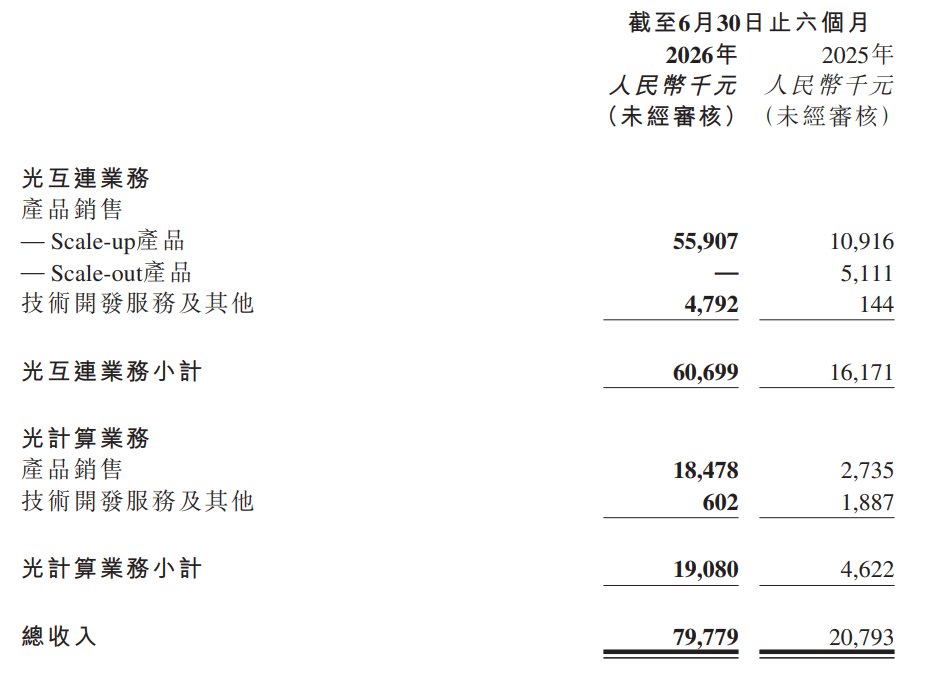
The revenue of the optical computing business surged 313% to 19.08 million yuan during the reporting period, mainly because PACE 2 achieved continuous sales, including the PACE series and GAZelle, under the single-card sales model after more than a year of commercialization efforts since its launch in March 2025.
At the same time as overall revenue increased, thanks to the large-scale distribution of products, Xizhi Technology achieved a 25.8 percentage point increase in gross margin to 65.8%, which led to a sharp increase in gross profit of 532% over the same period last year to 52.523 million yuan.
It is worth noting that Xizhi Technology continued to increase R&D investment during the reporting period. R&D expenditure surged 126% to 360 million yuan over the same period. With R&D investment of nearly 200 million yuan higher, Xizhi Technology's adjusted net loss during the reporting period was 147 million yuan, an increase of only 12.21% over the loss of 131 million yuan in the same period in 2025. Obviously, Xizhi Technology is still in the early stages of “continuous acceleration of commercialization+high investment in R&D”.
Optimistic expectations are directly “filled”, and the fault tolerance rate for future development is low
Based on current fundamentals and looking forward to the future, Xizhi Technology has the conditions to accelerate development, but the more reasonable expectation is “optical interconnection first, light calculation and then implementation”, rather than the two lines increase linearly at the same time.
Currently, the bottleneck in AI clusters is shifting from simple heap GPUs to solving bandwidth, power consumption, and latency within supernodes. Demand for scale-up optical interconnect, NPO, CPO, and silicon optical PIC is on the rise.
Xizhi Technology's sharp increase in optical interconnection and optical computing product revenue in the first half of 2026 shows that the price and gross profit of the company's products are supported from prototype to deployment, while Guangyue LightSphere X has implemented multi-card GPU clusters and simultaneous mass production of OCS silicon optical PICs, which means that the original “commercialization of optical interconnection” has begun to have a delivery base.
On this basis, as long as supernode customers expand from demonstration to multi-cluster procurement, revenue flexibility will be significantly greater than 106 million yuan for the full year of 2025. Because optical interconnection orders are usually purchased based on node size, number of optical exchange modules, and subsequent expansion and repurchase, the revenue volume of a single customer is naturally higher than early research sales.
However, one of the key variables of acceleration is whether the product route can continue. The prospectus defines optical interconnection as the main axis of short-term commercialization, focusing on scale-up EPS, scale-up OCS, and then extending to NPO and scale-out PIC. According to the 2026 interim report, the company's 3.2T NPO has passed testing and completed joint development with the customer in the terminal customer scenario, while the CPO and Senke Communications presented a 51.2T optoelectronics co-package prototype. Optical Expo information also called its NPO full link verification, supports 53/106 GBaud, and is compatible with OIF 3.2T and OPEN NPO.
This means that Xizhi Technology not only sells “optical chip samples,” but is also stuck in the three stages of OCS supernode, NPO near packaging, and CPO co-packaging: OCS solves cabinet/supernode optical circuit switching, NPO undertakes near-package upgrades that are easier to implement in the next 2-3 years, and the CPO layout is more long-term and deeply sealed with the exchange ASIC.
At present, the focus of industry-side customers has shifted from simple interconnection speed to efficient multi-chip interconnection, reduced latency, and engineering verification. The number of scale-up connections is also significantly higher than traditional scale-out, and market space for interconnect devices and solution providers will be opened up. As an independent solution provider, Xizhi Technology has the opportunity to obtain design introduction in the ecosystem of domestic GPUs, switches, operators, and intelligent computing centers.
The optical computing product line is the second growth pole of Xizhi Technology's accelerated performance, but it is unrealistic to use it as a short-term profit engine. Although the PACE 2 “Tianshu” optical computing product line in the first half of 2026 has driven a significant year-on-year increase in revenue of 313% to 19.08 million yuan after entering EDA, quantization, banking, and edge intelligence scenarios, and currently PACE 3's PIC and EIC dividers target 256 x 256 level matrices and are natively introduced into ONet; WAIC Caliber claims that it is oriented towards low-latency large model reasoning and can support up to 256 x 768 matrices.
However, the ecological shortcomings of Xizhi Technology's optical computing are also quite obvious: the compiler, operator library, task scheduling with GPU, and customer model adaptation take time, and the prospectus also determines that large-scale optical computing may coexist with electrical computing for a longer period of time. Therefore, if it accelerates in the future, optical computing is more likely to contribute revenue by means of inference acceleration cards, intelligent computing all-in-one machines, scientific research and vertical industry penetration, and only then will a steeper revenue curve occur until the PACE 3 engineering prototype and customer PoC are repurchased. Therefore, it is unrealistic for Xizhi Technology's optical computing products to explode rapidly in the short term.
Based on the above judgment on the fundamentals of Xizhi Technology, the benchmark scenario for the accelerated development of LightSphere/OCS over the next 2-3 years is that LightSphere/OCS will expand from 3 clusters to multiple operators and intelligent computing centers in domestic kilocalories and thousands of calories. NPO will form small-batch to large-scale customer deliveries from 2026 to 2027, CPO will maintain engineering verification, and PACE 3 will move from edge and reasoning small scenarios in 2027.
If all of these nodes are realized, Xizhi Technology's revenue growth rate may rise from 100 million in 2025 to hundreds of millions or even higher, but it is still far from the valuation story of “optical computing power to completely replace electric computing”, and if any supernode delivery is delayed in the middle, self-research by major customers, yield, or PACE ecology lags behind, the development of Xizhi Technology will fall into the quagmire of “high R&D and low conversion”.
Overall, the future development of Xizhi Technology, which is on a scarce track, is highly certain. Guohai Securities expects the company's revenue from 2026-2028 to be 240 million, 653 million yuan, and 1,804 billion yuan respectively, but the market gave this certainty a sufficiently high valuation premium in the short term. The current market value corresponding to 2026 to 2028 PS valuation is 108.2 times, 39.8 times, and 14.4 times, respectively.
This set of figures shows that the market has “filled” Xizhi Technology's optimistic expectations for the future. The current valuation is typical of “strong logic, high premium”, and the fault tolerance for fundamentals is extremely low. To maintain the current market value, the company must hand over continued high performance; conversely, if there is any delay in the release of performance, the overhanging valuation bubble will face the risk of being “bursting”, and a new round of “killing valuations” may be unavoidable.