


The Zhitong Finance App learned that Bitcoin once rose to 82,078 US dollars during the Asian trading session on Monday, continuing its increase of more than 6% last Friday, and only less than $200 from the four-month high. The US spot Bitcoin ETF attracted a total of about 593 million US dollars on Thursday and Friday trading days, offsetting heavy redemptions in the previous two days, pulling the entire week's capital account back to a positive value from the edge of net outflow, and barely recorded a net increase of about 6 million US dollars throughout the week.
This round of emotional healing comes after a week of “serious injury” to digital assets — the landmark crypto bill collapsed in the Senate and the Federal Reserve raised interest rates for the first time in more than three years. The turning point came last Thursday: The US Securities and Exchange Commission (SEC) gave the green light for “digital securities” to begin trading in the US.
If Bitcoin can rise above the $82,266 it hit on September 4, Bitcoin will hit a four-month high. The shift in sentiment came after a rough weekend: a landmark US crypto bill failed to pass, and the Federal Reserve raised interest rates for the first time in more than three years. On Thursday, the SEC released digital securities for trading in the US, helping to pick up market sentiment.
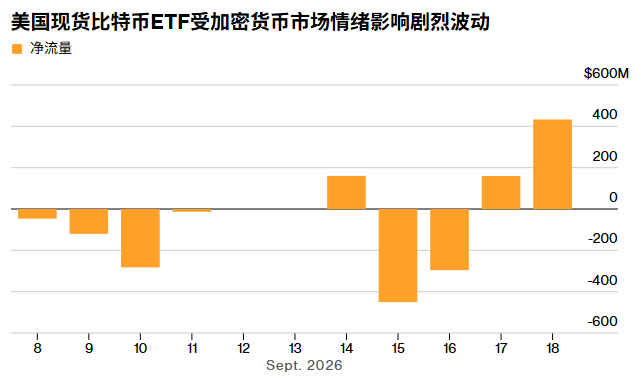
Looking at this set of figures, the migration of funds is more informative than the total amount. According to Farside Investors data, the net inflow of a single-day spot Bitcoin ETF on September 18 was US$433 million, of which Fidelity FBTC monopolized US$310.7 million, accounting for 72% of the day's total volume, and BlackRock IBIT received US$108.4 million — the two companies together took about 97% of the net inflow, and none of the products recorded outflows on the same day.
This week's funding path was quite bumpy: a net outflow of $450.4 million on September 15, an outflow of $295.9 million on the 16th, and a combined return of $592.5 million on the 17th and 18th. The week ended on a weak positive value of only about $6.2 million. On a monthly basis, the net inflow for September 18 was US$313.4 million, less than one-tenth of August's US$3,539 million (one of the strongest months of the year) — in other words, the net outflow pattern for the first half of the month depended on the reversal of the last two trading days.
Coinotag's statistics also show that since its launch in January 2024, the cumulative net inflow of spot Bitcoin ETFs has reached $55.23 billion, with total product assets of about US$102.53 billion; capital has not left this asset class, but has been concentrated in the two largest funds with the lowest rates.
The rebound on the price side also had “technical fuel.” According to CoinGlass and TradingView data, Bitcoin traded around $81,174 on September 19, up about 5% in 24 hours, and fell below $77,000 for a while earlier last week. The recovery from bears — the shorters were forced to buy back and close their positions — added fuel to the rally; according to Blockonomi, there was an intensive liquidation liquidity cluster around $82,000, while Glassnode labeled $83,000-86,000 as Bitcoin's main upper supply band through holding costs and derivatives data. According to CoinGlass statistics, the trading volume of futures contracts is about US$81.5 billion, and unliquidated contracts are about US$56.6 billion, and leveraged positions are not light.
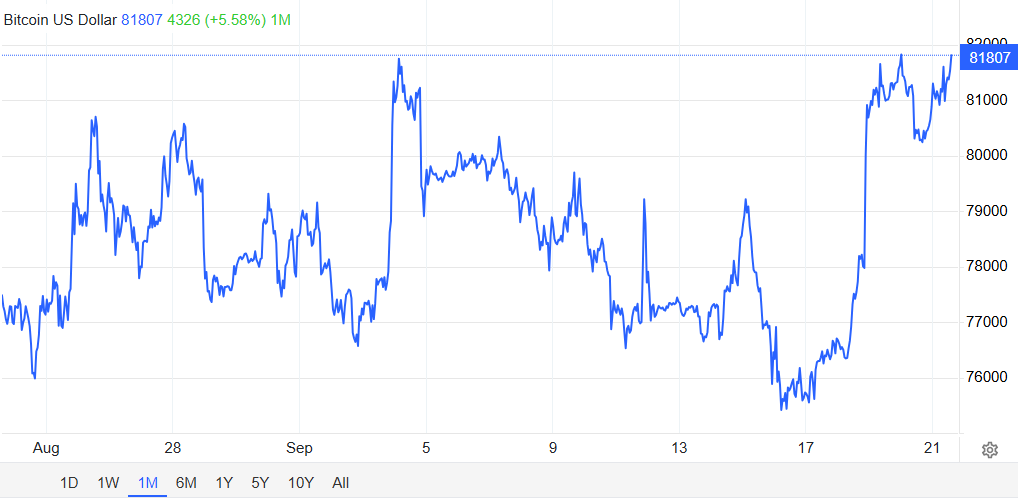
The starting point of this round of rebound was a rather unsightly period of decline. On September 15, the US Senate's procedural vote on the Clarity Act (H.R. 3633) fell short of the 60-vote threshold needed to end the debate. This bill, which aims to separate the right to regulate digital assets between the Commodity Futures Trading Commission (CFTC) and the SEC, was temporarily suspended. The voting results caused Bitcoin to drop nearly 4% below $76,000; data showed that in 24 hours, more than 115,000 people around the world closed their positions, Circle (CRCL.US) fell more than 11%, and Coinbase (COIN.US) fell more than 10%.
Wyoming Republican Senator Cynthia Lummis, who has dominated crypto legislation for many years, said bluntly after the vote: “I think we're done, it's over.” What's more troublesome is the time window: the US midterm elections are only seven weeks away, the Senate is scheduled to adjourn in early October, the House of Representatives adjourns even earlier, and there is little hope that the bill will return to the agenda in the short term — the industry will not be able to wait until next year for clear rules at the congressional level.
Legislation is closed, and regulators are opening—the key to the reversal of market sentiment last Thursday. On September 17, the SEC issued an order granting temporary, conditional exemptions to “tokenized securities establishments” (TSV): when using a licensed automated market maker (AMM) liquidity pool to match tokenized NMS stock transactions, such places can be temporarily exempted from being recognized as an “exchange” under the Securities and Exchange Act; some market makers that use their own funds to provide liquidity within the pool are also subject to conditional exemptions as “traders”. The exemption expires five years after publication, and public comments are sought. Additional conditions draw a clear boundary: you can only trade 1:1 tokenized stocks with full rights (clearly excluding synthetic tokens that only provide price exposure), the issuer has the right to object to trading its own shares on TSV. TSV must be a US entity and comply with OFAC sanctions; smart contracts must be open, auditable, and deployed on a publicly unlicensed distributed ledger; and trading must be stopped simultaneously when the underlying stock is suspended.
SEC Chairman Paul Atkins said in a statement that the move was an important step “to bring the US capital market into the digital age within the legal authority”; Jamie Selway, director of the Department of Trading and Markets, called it “an important milestone in the Commission's work to open up capital markets for tokenized securities.”
According to Morgan Stanley research, Robinhood (HOOD.US), Coinbase (COIN.US), and Gemini are most likely to get the first piece of the cake — but the report also points out a structural contradiction: Robinhood's current overseas stock token products only provide economic exposure and not complete shareholder rights, which is fundamentally different from compliance requirements in the US, and the product structure needs to be adjusted before implementation. Markets are already voting with their feet: According to the Associated Press, Coinbase rose 11.7% on Friday, the biggest rising component of the S&P 500 index of the day, and Robinhood rose 9.1%.
Going back to the macro level, there are still questions about whether Bitcoin's momentum can continue. Crude oil is still above $100 per barrel, and US bond yields remain high — 10-year US Treasury yields returned to 5% last Friday; the Federal Reserve raised interest rates by 25 basis points on September 16, raising the federal funds rate target range to 3.75% — 4.00%, for the first time since July 2023.” As far as this week is concerned, there are no major catalysts worth paying particular attention to, but any hawkish or dovish statement by Federal Reserve officials could affect the market,” said Jeff Mei, chief operating officer of crypto exchange BTSE.