


The Zhitong Finance App notes that the market has a clearer understanding of the Fed's determination to fight inflation, which gives investors reason to be optimistic; however, the risks associated with oil prices and AI still prevent investors from fully investing.
The Federal Reserve successfully reshaped its credibility last week, sending hawkish signals that it is not lagging behind the situation, while at the same time stopping at releasing a signal of aggressive interest rate hikes. Although this was enough to calm the market at first, the market was tense last Friday — the 10-year US Treasury yield tested 5% again, and the S&P 500 fluctuated repeatedly between ups and downs. Although oil prices have declined somewhat, Brent crude oil is still trading above $100 per barrel.
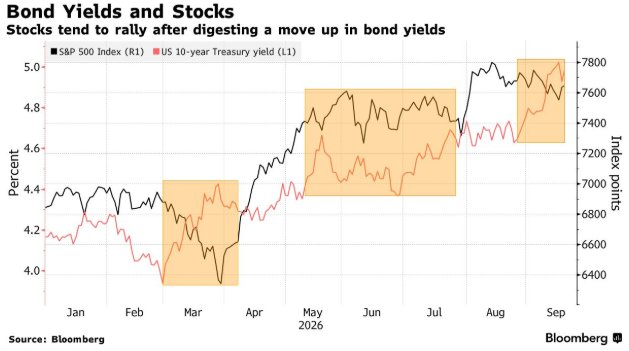
A team of Barclays strategists led by Emmanuel Cau said: “Until energy-related inflationary pressures ease, it is difficult to see full stabilization of interest rates and the stock market. The positive development, however, is that the independence and credibility of the Federal Reserve has been reaffirmed, which provides clarity on its policy response function.”
The Federal Reserve's decision can be viewed as a “clearing the fog” event. Investors' cautious turn ahead of policy meetings suggests they are far from complacent — there are clear signs that they have lowered their exposure while increasing their hedging. The expiration of large-scale quarterly options on Friday also largely reset options positions.
Société Générale strategist Manish Kabra said, “In the face of strong profit growth, controlled credit spreads, and a weak VIX, the fundamentals of US stocks are still supportive, which allows us to maintain a constructive view of the S&P 500 outside of short-term fluctuations.” The yield curve is still a key sign. As long as the inversion is avoided, Kabra expects the benchmark index to hit 8,000 points by the end of the year, although there will be some fluctuations in the process.
Although there are still plenty of prospects for a rebound at the end of the year, the path to this goal may not be easy. Diesel prices are predicting higher inflation in the future; unless the war in Iran is resolved quickly, thereby significantly reducing oil prices, the central bank may have no choice but to turn more hawkish.
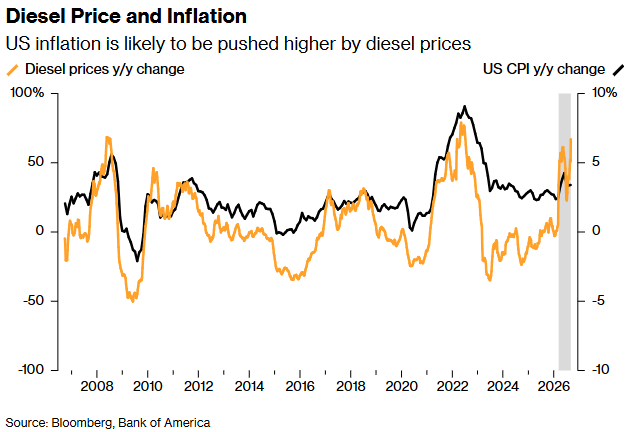
Diesel prices and inflation
According to swap market pricing, there will be three more rate hikes until the end of July. Everyone's eyes will be on the potential “bond shock” — 10-year yields above 5% are making US bonds more and more attractive. However, as long as the economy and profit growth remain resilient, investors may still be reluctant to leave the stock market; instead, they will continue to broaden their risk exposure.
The Bank of America strategist team led by Jared Woodard has become more cautious, saying that given the slowdown in earnings growth expectations next year, current positions are still too bullish. They said that the expected growth of 10% to 15% in 2027 means that the ISM manufacturing index will continue to stand at 53. They said, “Now is not the time to move to the defensive sector, but quality, value, and yield assets seem more cautious”.
The market has become more skeptical about AI spending and the future return on that investment. This casts a shadow over the profit prospects of the entire AI benefit chain. At the same time, there has been rotation within the technology sector — software has strengthened again, while semiconductors have generally stagnated and become more volatile over the past two months.
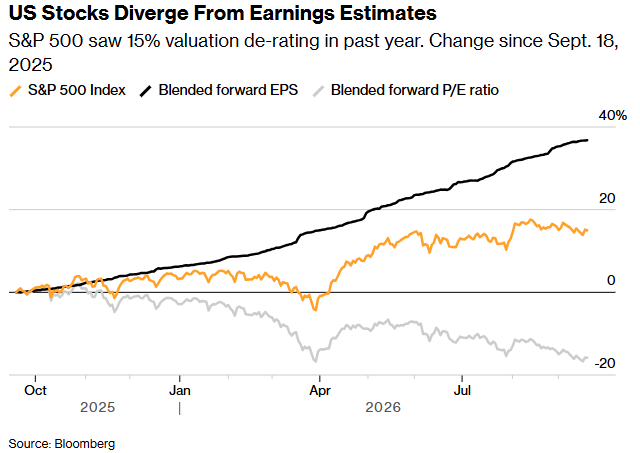
The US stock market diverged from earnings expectations
The S&P 500's valuation has declined sharply, and the benchmark index is currently trading just slightly above its long-term average. Although this “devaluation” is due more to a sharp rise in profit expectations, the recent pullback shows that investors are unwilling to pay a premium for growth — both at the index level and at the sector level.
If caution continues in the short term, an earnings season that exceeds expectations in a few weeks is expected to revive market sentiment and risk appetite.
Daniela Hathorn, senior market analyst at Capital.com, said: “This resilience shows that investors are distinguishing between 'high interest rates driven by continued inflation' and 'growth prospects with deteriorating fundamentals'. So far, the latter is not the dominant concern.”