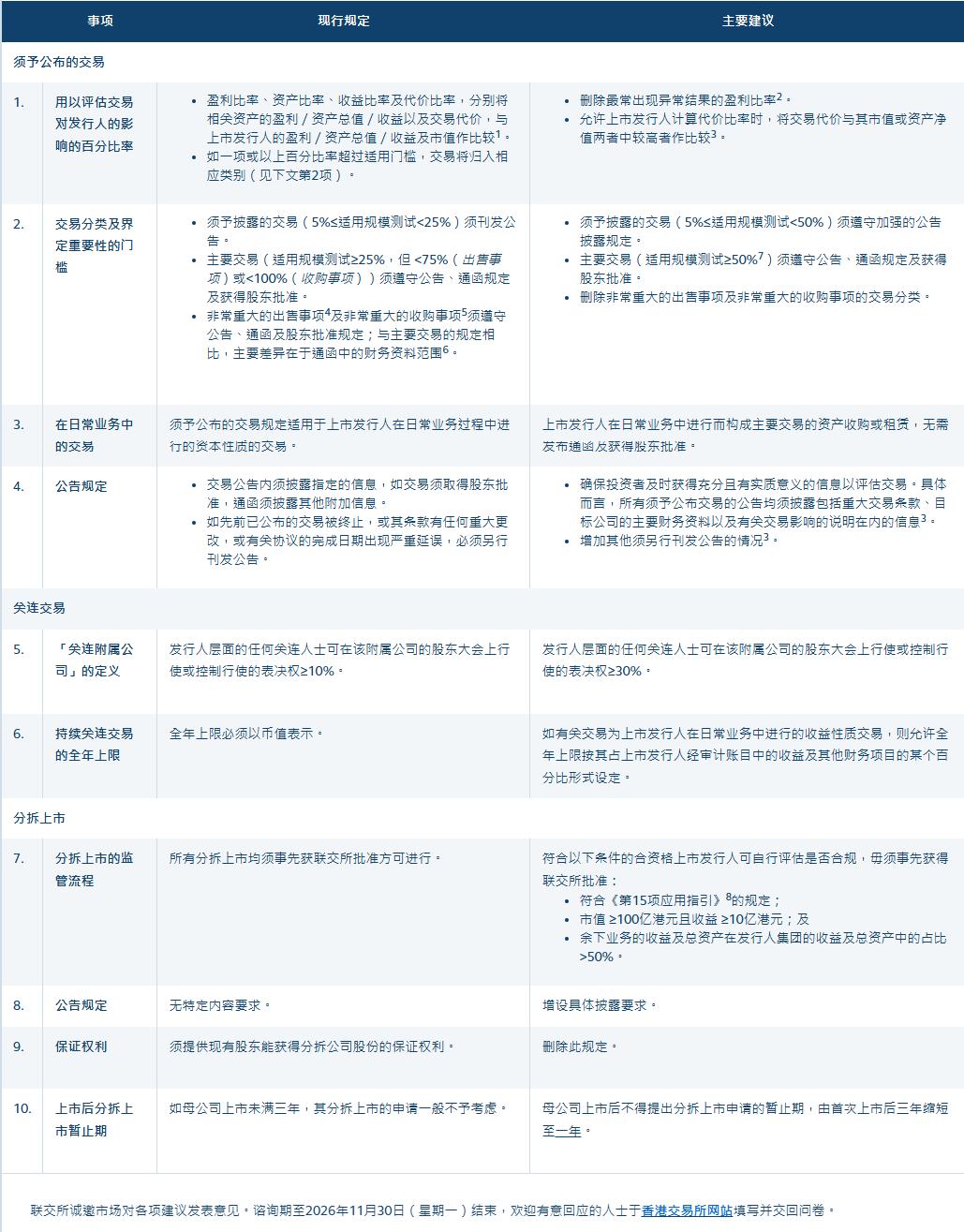
The Zhitong Finance App learned that on September 21, the Hong Kong Stock Exchange published a consultation document to seek market opinions on the second phase of proposals to enhance the competitiveness of Hong Kong's listing mechanism. The consultation period lasts for 10 weeks and ends on November 30, 2026. This consultation is the second phase of the review of the competitiveness of the Stock Exchange's listing mechanism. It focuses on the regulation of corporate transactions of listed issuers, covering transactions to be announced, connected transactions and spin-off listing requirements. The aim is to enable listed issuers to conduct corporate transactions more flexibly, while maintaining proper investor protection through enhanced disclosure requirements and effective board accountability mechanisms.
Wu Jieyi, head of listing at the Hong Kong Stock Exchange, said that the purpose of this reform is to provide issuers with greater flexibility and certainty, reduce corporate transaction costs and time, and maintain investor protection through timely and meaningful disclosure and strong board accountability mechanisms.
Key recommendations include:
In terms of transaction classification and threshold, the Stock Exchange suggests removing the “profit ratio” which is most likely to produce abnormal results, and allowing listed issuers to compare the cost ratio with the higher of their market value or net asset value. At the same time, the disclosure threshold for transactions was drastically relaxed from the current 5% to 25% to 5% to 50%, while the threshold for major transactions was raised from 25% to 50%. Additionally, it is recommended that very significant sales and very significant acquisitions be declassified.
In terms of daily business transactions, it is recommended that listed issuers acquire or lease assets that constitute major transactions in their daily business without issuing a circular or obtaining shareholders' approval.
In terms of disclosure of announcements, ensure that investors obtain sufficient and meaningful information in a timely manner to evaluate transactions. Specifically, all announcements requiring disclosure of transactions must disclose information including the terms of the significant transaction, key financial information of the target company, and a description of the impact of the transaction. Other situations requiring separate announcements have also been added.
In terms of connected transactions, it is proposed to raise the threshold for defining a “connected subsidiary” from 10% of the voting rights of connected persons to be raised to 30%; at the same time, allow the annual upper limit of continuing connected transactions to be expressed as a percentage of revenue or other financial items, rather than limited to monetary amounts.