


The Zhitong Finance App learned that Nvidia (NVDA.US) stock is sending a warning signal about whether its profit growth can continue. However, the strange thing is that this signal does not come from the company's performance itself, but rather from the pricing method of the market.
As of mid-September, the price-earnings ratio of Nvidia's stock price corresponding to the expected profit for the next 12 months was less than 17 times, close to its lowest level in more than a decade. This multiple is only half of the 2025 level, and far below the May valuation, which is still more than 25 times. Considering that Nvidia's revenue and profit have successively exceeded expectations over the past few quarters, this valuation contraction is particularly impressive.
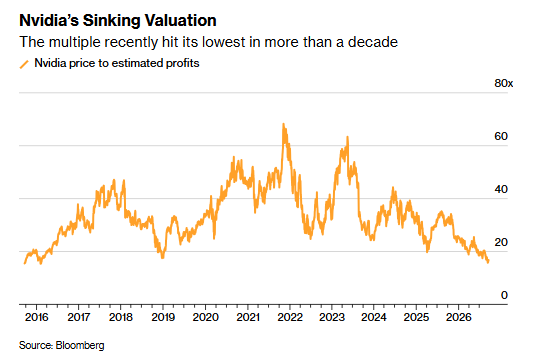
Eli Horton, senior portfolio manager at TCW, said that the magnitude of the “bubble bubble” of this valuation reveals a significant degree of doubt about the sustainability of the company's current profitability — “The performance of the stock price is surprising given the incredibly strong background of fundamentals, but it tells you that market expectations fall short of current analysts' general expectations.”
In fiscal year 2026 (ending January 2026), Nvidia's annual revenue reached US$215.9 billion, an increase of 65% over the previous year, and GAAP net profit of US$120.7 billion. Fourth-quarter revenue of 68.1 billion US dollars, and the data center business contributed 62.3 billion US dollars, an increase of 75% over the previous year. Entering fiscal year 2027, growth accelerated further — revenue for the second fiscal quarter reached US$96.2 billion, surging 106% year on year, net profit doubled to US$59.7 billion, and gross margin remained high at 75%.
For the third fiscal quarter, management gave revenue guidance of US$108 billion, up 18.7% from the previous quarter's guidance of US$91 billion. This is also the first time that Nvidia has predicted revenue exceeding 100 billion US dollars in a single quarter. Looking at the full year, the company expects revenue growth of about 70% for the 2028 fiscal year, far exceeding the market's consensus forecast of 44%.
As of mid-September, Nvidia's stock price increase in 2026 was only 22%, ranking second among the “Big Seven” US stocks, after 25% of Apple (AAPL.US). However, the Philadelphia Semiconductor Index rose as much as 76% over the same period, and Micron (MU.US), Intel (INTC.US), and AMD (AMD.US) all rose more than 180%. Nvidia is fifth to last in the semiconductor index.
This divergence made Hwang In-hoon quite unhappy. At the Goldman Sachs Technology Conference in early September, he claimed that Nvidia was “the world's first and only growth value stock” and that the company was “seriously misunderstood.” The logic he has repeatedly emphasized is that the company is not only growing, but also gaining more value as it grows.
The question is, why isn't the market buying it?
Gross profit margin: a variable that is being repriced in the light of growth
Nvidia's profitability is under pressure, due in large part to rising costs for key components, particularly memory chips.
In its financial report for the second fiscal quarter, Nvidia revealed that gross margin will gradually decline from 75%, and is expected to bottom out at 71% to 72% in the fourth fiscal quarter, then stabilize at 72% to 73% in the 2028 fiscal year. Hwang In-hoon is quite open about this. He said that the company “decided to tear off band-aids and reset the market's gross margin expectations,” admitting that it has absorbed the pressure of rising costs and is also repricing the product.
Behind this gross margin reduction, there is an easily overlooked transmission chain: the AI construction boom led by Nvidia itself is driving up its own costs. According to the bill of materials previously disclosed by UBS, the memory cost of Nvidia's next-generation Vera Rubin AI platform has exploded, and the share of internal memory costs in the entire machine has soared from 53% of the previous generation Grace Blackwell system to 62%, making it the most expensive component of the entire platform. DRAM contract prices increased 58% to 63% month-on-month in the second quarter of 2026, and pricing rights are being transferred from Nvidia to memory chip vendors.
David Russell, head of global market strategy at TradeStation, has more profound concerns. He believes that as Nvidia's largest customers develop self-developed chips, competition will only intensify — “Companies want to reduce their dependence on Nvidia, so it is very conceivable that their market position weakens over time, which means gross margins are more likely to decline rather than improve, which is a big problem for investors,” Russell said. “When the company is in an advantageous position and has the potential to improve, the valuation multiplier will only expand, and Nvidia doesn't have that.”
Russell wasn't hypothetical. Google's (GOOGL.US) TPU has gone from an internal project to a real commercial weapon. Thomas Kurian, head of Google's cloud business, revealed at the Goldman Sachs conference that the TPU business is already more than double the size of the similar business of the second-largest hyperscale cloud service provider, and the payback period for servers equipped with self-developed chips is less than a year. Google has begun delivering TPU systems directly to customer data centers and has signed contracts with customers such as Anthropic. On the Meta (META.US) side, the self-developed AI chip codenamed “Iris” is scheduled to be mass-produced in September. The test took only six weeks and no major problems were found. Meta aims to increase overall AI computing power to 14 gigawatts next year.
These self-developed chips will not disrupt Nvidia's approximately 90% share of the AI accelerator market in the short term. But they are changing the bargaining structure in perceptible ways. J.P. Morgan analyst Harlan Sur predicts that the market share between Nvidia GPUs and custom chips such as ASIC and XPU will gradually approach in the next few years.
The “tree won't grow to the sky” of capital expenditure
Nvidia's current growth story is essentially tied to an assumption: the capital expenses of hyperscale cloud service providers will continue to rise.
This assumption seems to hold true in the short term. The four largest hyperscale companies — Amazon, Alphabet, Microsoft, and Meta — collectively have capital expenditure plans of around $750 billion in 2026, an increase of about 70% over 2025. Wedbush's analysis has pointed out that about 60% of the capital in this round of investment went to Nvidia's GPUs and supporting hardware, and large technology companies are increasingly becoming one of the world's largest issuers of corporate bonds.
But that is exactly where the problem lies.
TCW's Horton said, “It's prudent to step back and think about whether all of this spending is sustainable because the tree won't grow to the sky.” He further analyzed that Nvidia's current valuation actually already implied expectations of a slowdown in AI capital spending — whether it was hyperscale manufacturers actively cutting investment or the regulatory framework delaying or suspending projects. However, Horton believes that these two scenarios are currently unlikely to occur, which makes Nvidia's valuation look relatively attractive.
This misalignment of “valuation implied pessimistic expectations, but reality did not necessarily materialize” is at the core of the current long and empty differences. Research by Morgan Stanley and Bank of America Securities indicates that Nvidia's forward price-earnings ratio of around 18 times corresponds to the implicit assumption that the company will hardly grow after 2027. Analysts' actual expectations are: revenue for the 2027 fiscal year will reach about 394 billion US dollars, an increase of 82% year on year; further increase to about 561 billion US dollars in fiscal year 2028.
Bank of America maintains Nvidia's “buy” rating, with a target price of $350, based on earnings per share of 26 times the price-earnings ratio for the 2027 calendar year. The bank pointed out that Nvidia's compound sales growth rate from 2025 to 2028 can reach 48%, and the compound earnings growth rate per share will reach 52%. Instead of Nvidia's large technology peers, the compound sales and EPS growth rates for the same period were only 16% and 15%, respectively. Based on this calculation, Nvidia's 2027 PEG was only 0.3 times, far below the peer average of 1.6 times.
The current situation Nvidia is facing is not so much that fundamentals are deteriorating, but rather that the market is repricing the long-term risks of AI transactions. Rising storage costs are eroding gross profit margins, customer-developed chips are shaking bargaining power, and the sustainability of capital expenditure cannot be proven — these are all real risks, but the market is clearly divided as to whether they are sufficient to prove a price-earnings ratio of less than 17 times.
Horton said that no one knows how this stock will go, “but the current risk-return structure is very attractive, and I like this probability distribution. If the question is whether the valuation will repair upward or continue to decline, I would definitely choose the former. As an entry point, this price-earnings ratio level looks quite favorable.”