


- Canadian National Railway recently reached an eight year operating agreement with Amtrak that settles a long running regulatory dispute and sets new rules for shared U.S. routes, including safety upgrades like Onboard Shunt Enhancers and schedule review processes.
- The refreshed Amtrak partnership, paired with CN’s Mexico growth plans and truck to rail conversion focus, indicates management is emphasizing network quality and operational efficiency rather than heavier capital spending.
- The focus now turns to how Canadian National Railway’s investment narrative could be reshaped by the extended Amtrak operating agreement framework.
Canadian National Railway Investment Narrative Recap
For Canadian National Railway, the core belief is that a high quality, tri coastal network and disciplined operating model can turn modest volume trends into steady earnings and cash flow. The Amtrak deal fits that story, since it tightens up passenger performance standards while preserving freight fluidity. The near term swing factor still appears to be how quickly intermodal, Mexico related flows and bulk demand actually appear on the network.
The main risk remains weak industrial volumes and supply chain rerouting that could leave recent productivity gains underused, especially with a meaningful debt load already in place. The Amtrak announcement itself does not materially change that risk reward balance. It primarily reduces regulatory noise and helps keep attention on execution in intermodal, energy and grain.
The refreshed Amtrak operating agreement is the announcement that ties most directly to the current catalyst debate. Better schedule discipline, a performance payment system tied to Federal Railroad Administration on time standards, and shared processes to resolve disputes all point to a cleaner operating runway for Canadian National Railway on key U.S. corridors.
Installation of Onboard Shunt Enhancers, backed by Federal Railroad Administration funding, reflects a practical safety and reliability upgrade rather than heavier capital intensity for shareholders. If CN pairs that with its Mexico growth push and truck to rail conversion focus, the key watchpoints become train speed, dwell time and how much intermodal volume the network can absorb without eroding service quality.
Canadian National Railway Forecasts Behind the Amtrak Reset
Canadian National Railway now has a clearer operating playbook on key U.S. tracks, while analyst models sketch out how that could translate into the financials over the next few years. The consensus view ties a steadier corridor with Amtrak to a moderate ramp in revenue and profit, rather than a step change. For you as an investor, the interest lies in how those assumptions line up with your own expectations for freight demand, capital needs and regulatory friction.
Analysts currently see Canadian National Railway’s top line rising at 5.5% a year over the next three years. On the bottom line, they expect earnings to move from CA$4.8b today to CA$5.9b by 2029. That is an increase of CA$1.1b, which implies CN would be generating more profit on a relatively measured revenue trajectory if the margin uplift to 28.1% materializes.
Canadian National Railway's narrative projects CA$20.9b revenue and CA$5.9b earnings by 2029. This requires 5.5% yearly revenue growth and an earnings increase of CA$1.1b from CA$4.8b today.
Those consensus numbers also hinge on the multiple the stock might support in a few years. Analysts are using a P/E of 22.2x on the projected 2029 earnings, slightly below the current 22.6x they quote for CN and below the 27.0x level they highlight for the broader U.S. transportation peer group. That gap means the models do not assume a richer valuation multiple later on. They rely instead on earnings progress plus a modest P/E step down.
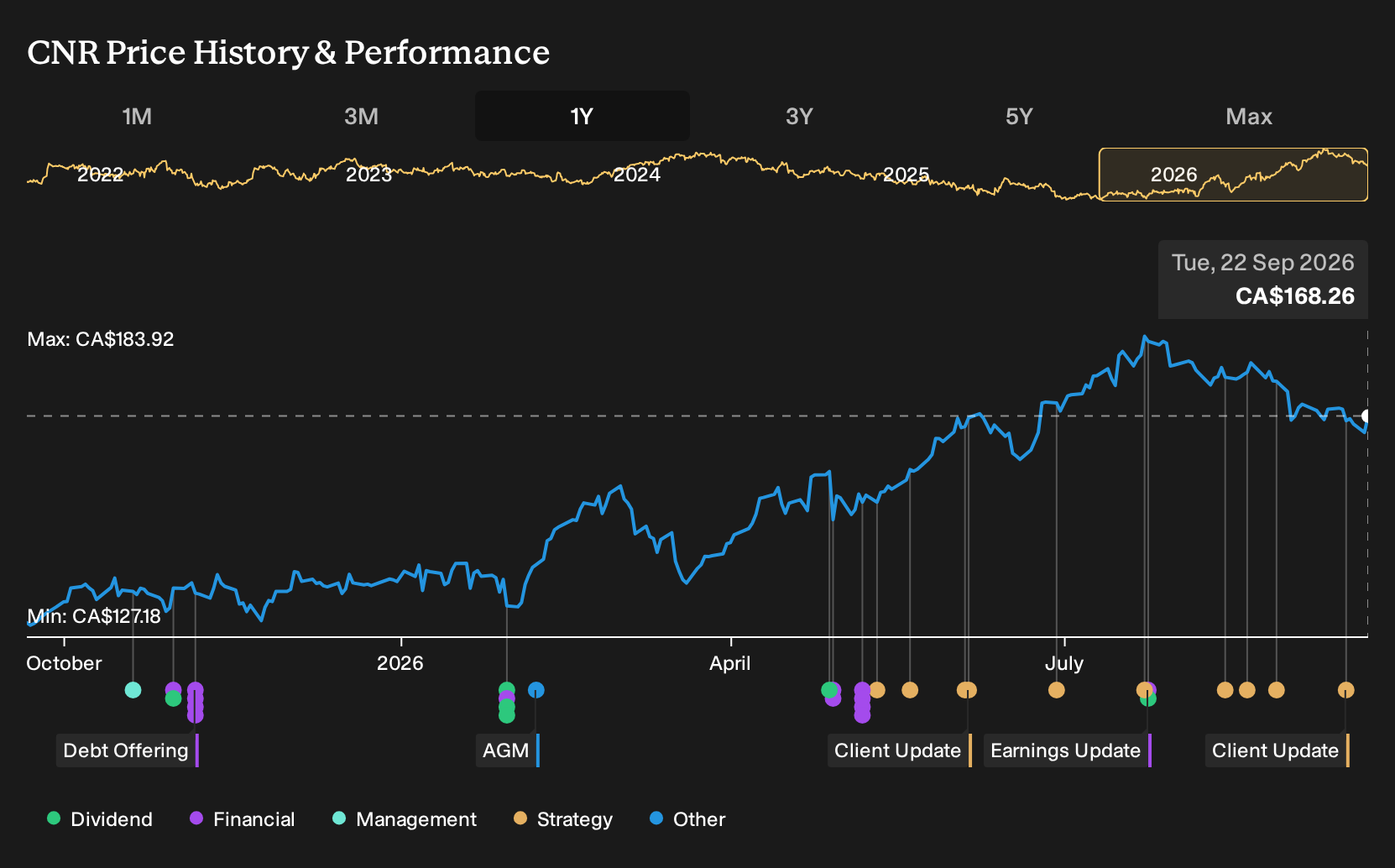
On this framework, the implied fair value comes out to a price target of CA$190.11, only 6.0% above the recent CA$178.71 share price cited in the report. That narrow spread suggests analysts see Canadian National Railway as roughly in line with their estimates rather than clearly mispriced. For anyone assessing the Amtrak agreement, the key question becomes whether a slightly cleaner operating setup and safety upgrades can help CN deliver on the revenue and earnings profile that underpins those valuation assumptions.
Uncover why Canadian National Railway's fair value indicates a 13% potential upside to its current price that could narrow quickly.
Exploring Other Perspectives
Five fair value estimates from the Simply Wall St Community span roughly CA$132.87 to CA$190.21, so some members see Canadian National Railway as meaningfully undervalued while others are near or above recent analyst targets. Those opinions pre date the Amtrak reset and upcoming conference circuit, so you are weighing them against fresh catalysts and the ongoing risk of softer freight demand. That range of views shows how widely investor opinions can differ, which is exactly why it can help to explore several alternative perspectives before forming your own stance.
Explore 4 other Canadian National Railway fair value estimates, including one that suggests there could be as much as 21% downside from the current price.
Form Your Own Verdict
Disagree with existing narratives? Extraordinary investment returns rarely come from following the herd, so trust your own analysis and judgment.
- A great starting point for your Canadian National Railway research is our analysis highlighting 5 key rewards and 1 important warning sign that could impact your investment decision.
- See our latest analysis for Canadian National Railway. The report includes a comprehensive fundamental analysis summarized in a single visual, the Snowflake, making it easy to evaluate Canadian National Railway's overall financial health at a glance.
Looking For More Investment Ideas Beyond Canadian National Railway?
If the Canadian National Railway story has sharpened your sense of what a resilient infrastructure business looks like, it can help to line it up against a wider bench of candidates that match your risk tolerance, income needs, and return goals.
- If capital preservation and smoother ride quality matter most to you, start with a basket of companies that screen as relatively resilient using our 8 resilient stocks with low risk scores.
- If you are hunting for quality at a measured price, compare Canadian National Railway with a broader group of businesses highlighted in our 7 high quality undervalued stocks that pair fundamentals with more modest expectations baked into the share price.
- If reliable cash distributions appeal to you, round out your watchlist with income ideas from the 1 dividend fortresses focused on higher yielding payers.
This article by Simply Wall St is general in nature. We provide commentary based on historical data and analyst forecasts only using an unbiased methodology and our articles are not intended to be financial advice. It does not constitute a recommendation to buy or sell any stock, and does not take account of your objectives, or your financial situation. We aim to bring you long-term focused analysis driven by fundamental data. Note that our analysis may not factor in the latest price-sensitive company announcements or qualitative material. Simply Wall St has no position in any stocks mentioned.
Have feedback on this article? Concerned about the content? Get in touch with us directly. Alternatively, email editorial-team@simplywallst.com