


Since this year, the market value has dropped by more than 30%. Jingxin Pharmaceutical (002020.SZ), which has a market value of 10 billion A-shares, submitted to the Hong Kong Stock Exchange twice. Can it use AH linkage to reshape the valuation?
The Zhitong Finance App learned that recently, Jingxin Pharmaceutical once again submitted a listing application to the main board of the Hong Kong Stock Exchange, with CITIC Securities as its sole sponsor. The company is a pharmaceutical group that focuses on the two core treatment areas of central nervous system and cardiovascular and cerebrovascular diseases. Didacinib (Gennonin®) is the only approved innovative drug, and the company is promoting selected drugs under development in key treatment areas.
The company's products are in a leading position in the industry. According to Frost & Sullivan, in terms of sales revenue in 2025, its levetiracetam (one of the common drugs for treating epilepsy) ranked second in the Chinese levetiracetam market with 19.2% market share; praxol hydrochloride (one of the drugs for treating brain disease Parkinson's disease) also ranked second in the Chinese Praxol hydrochloride market with a market share of 12.2%, and ranked first in the generic drug market with a market share of 32.4%.
The performance of Jingxin Pharmaceutical fluctuated slightly. In the first half of 2023-2026, revenue growth was 5.79%, 3.99%, -2.14% and -1.46%, respectively, and net profit growth was -6.66%, 15.32%, 7.37% and -10%, respectively, and the net interest rate for the first half of 2026 was 18%. The company has abundant cash flow. As of July 2026, it had cash equivalents and time deposits of more than three months totaling $1,568 billion.
The company was listed on the Shenzhen Stock Exchange in 2004. Currently, the market value is about 10 billion yuan, and the PE value is 13 times higher. This visit to Hong Kong is expected to achieve a dual AH listing platform and promote capital globalization.
Driven by the three major businesses, profitability is relatively stable
The Zhitong Finance App learned that the main business of Jingxin Pharmaceutical includes pharmaceuticals, APIs and medical devices. Among them, pharmaceuticals are the core revenue source, including generic drugs, innovative medicines, traditional Chinese medicines and biological agents, covering central nervous system diseases, cardiovascular and cerebrovascular diseases, digestive diseases, and infectious diseases. As of June 2026, the company had 40 listed products included in national or provincial alliance volume procurement plans.
In terms of revenue composition, the revenue contribution of pharmaceuticals, APIs, and medical equipment remains dynamic and stable. Among them, drug revenue fluctuates little, business share is stable, Chinese medical equipment revenue is growing year by year, and revenue share is showing an upward trend, while revenue share of APIs has declined year by year, and revenue share has declined. In the first half of 2026, the above three businesses contributed 58.5%, 21%, and 18.9%, respectively, and the revenue share of other businesses was 1.6%.
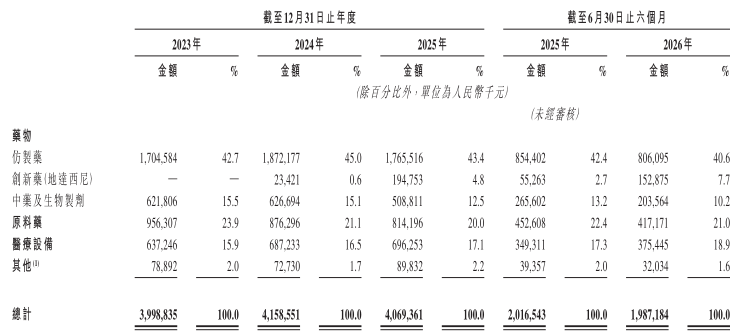
Photo source: Company hearing materials
In the pharmaceutical business, Jingxin Pharmaceutical's marketed product portfolio includes more than 60 approved drugs. Central nervous system diseases and cardiovascular and cerebrovascular diseases are the two core product areas, accounting for nearly 70% of total drug revenue. Generic drugs are the majority of the product portfolio. In the first half of 2026, generic drugs accounted for 40.6% of generic drug revenue. Levetiracetam, rosuvastatin calcium tablets, amlodipine benzenesulfonate tablets, and cefuroxime tablet generic drugs all ranked in the top ten commercial products, while levetiracetam showed strong performance, driving a steady increase in revenue from central nervous system diseases.
Innovative drugs have high potential for growth. In the central nervous system sector, didacinil (Gennonin®) was launched in Q4 of 2023 and was included in the medical insurance catalogue. The business revenue share was 7.7% in the first half of 2026. Since its launch, didacinib has covered more than 3,000 hospitals; in the field of cardiovascular and cerebrovascular diseases, the innovative product JX2201 has successfully completed phase I clinical trials in the first quarter of 2026, and is expected to release results after commercialization. In addition, the revenue share of traditional Chinese medicine and biological agents is 10.2%. The main products are Jingxin® Rehabilitation Liquid, etc., and revenue performance is relatively weak.
In the API business, Jingxin Pharmaceutical mainly established a production layout for APIs and intermediates through Jingxin in Shaoxing and Jingxin in Shandong. The core API products include quinolone anti-infective APIs, cardiovascular APIs, and central nervous system APIs; the medical equipment business entered the medical display resolution field through the acquisition of Shenzhen Jufeng in 2015. The products include clinical displays, diagnostic displays, consultation display centers, and endoscopic surgical displays.
The sales models for the three major business products are not the same. Generic drugs are mainly distributors, medical devices are mainly sold directly, and there is a mixed sales model for APIs. In the first half of 2026, the company's distribution and direct sales accounted for 66.9% and 33.1%, respectively. Distribution is the core business model. Up to now, the company's distribution network has covered more than 21 provinces in China and selected overseas markets, and has more than 1,500 distributors.
Jingxin Pharmaceutical's customer concentration is low. In the first half of 2023-2026, the top five customers contributed 29.1%, 33.5%, 34.5% and 34.2% respectively, while the largest customer revenue contributions were 15.2%, 15.9%, 16.8%, and 17.2%, respectively. Furthermore, the company's market covers the world. In the first half of 2026, domestic and overseas revenue accounted for 78.8% and 21.2% respectively. Among them, overseas regions were mainly distributed in Europe, Asia and America, contributing 99% of overseas revenue in total.
It is worth noting that the company's profitability is stable. In the first half of 2023-2026, gross margins were 49.2%, 48.5%, 48.2% and 48%, respectively. Among them, the gross margin for pharmaceuticals was high, stable at 63-65%, medical equipment stabilized at 34-35%, and APIs showed a downward trend, but the contribution was low. Narrow fluctuations in various expense ratios were offset and remained stable overall. Net interest rates for the period were 15.6%, 17.3%, 18.97% and 18.02%, respectively.
The industry has structural opportunities and still has growth expectations
From an industry perspective, Jingxin Pharmaceutical faces the risk of slowing growth in the industry's growth rate, but there are also structural opportunities. According to Frost & Sullivan, in central nervous system drugs, the global market size was 1.9 trillion yuan in 2025, and the compound growth rate in the past five years was only 1.8%. Among them, the Chinese market was 168.8 billion yuan, a compound growth rate of -0.7%. It is expected to be 179.1 billion yuan by 2030, with a compound growth rate of only 1.6%. In cardiovascular medicine, China's market size is 178.9 billion yuan in 2025, with a compound growth rate of -1.5% in the past five years. It is estimated to be 1998 billion yuan by 2030, a compound growth rate of 2.7%.
These two major pharmaceutical fields are the core of Jingxin Pharmaceutical's product portfolio. Industry demand is growing slowly, and the overall capacity utilization rate of Jingxin Pharmaceutical's products is low. In the first half of 2026, the production capacity utilization rates of generic drugs, didacinib, APIs, traditional Chinese medicines, biologics and medical equipment were 61.3%, 90%, 80.7%, 24.9%, 75%, and 79.9%, respectively. However, structural opportunities have brought room to increase the company's production capacity.
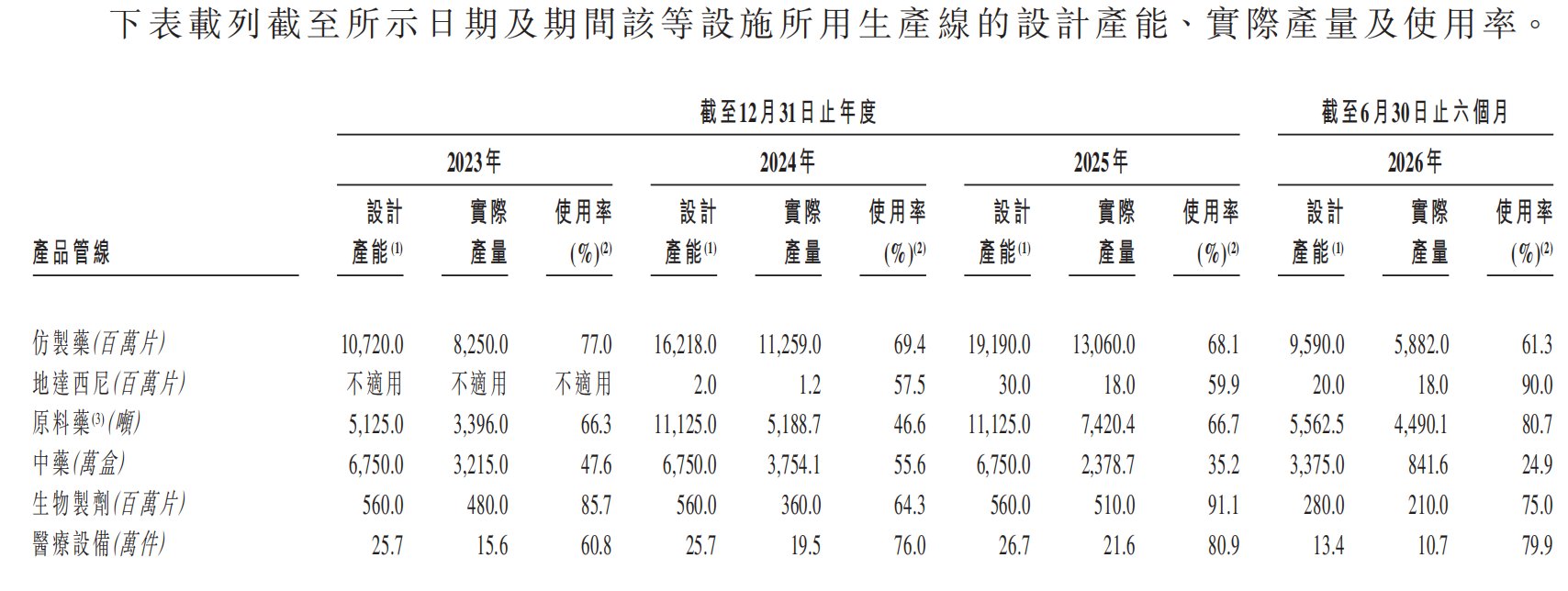
Photo source: Company hearing materials
On the one hand, many of the company's products occupy a central position in segments, such as levetiracetam drugs, with a market share of 19.2% of sales revenue, a market share of 12.2% of praxol hydrochloride, and a market share of 8.8%, ranking second, second, and third in the industry, respectively; on the other hand, the growth rate of various market segments is impressive, such as the lipid-lowering drug market, and the scale of the industry maintains a double-digit compound growth rate.
Jingxin Pharmaceutical is also actively increasing investment in R&D and enriching its pipeline product portfolio. In the first half of 2026, R&D expenses were 165 million yuan, and the R&D cost rate was 8.3%. The company has a number of key pipelines. Among them, in addition to the commercialized Didacinib, a number of drugs under development, including JX2201 and JX6001, have entered phase II and phase III clinical trials respectively. The medical device JXYY-JJU will also enter the registration stage, and commercialization will release results.
Overall, there are two core tracks plus three major businesses+domestic and overseas joint efforts. Despite current weak growth, Jingxin Pharmaceutical still has growth expectations: first, diversified businesses drive performance growth resilience; second, structural opportunities add leading positions in core products, and there is room for improvement in capacity utilization; third, there is an upward trend in profitability, with high profit margins, abundant cash flow, and a low share of interest and debt, which can meet pipeline development and global market development needs.
Jingxin Pharmaceutical's listing in Hong Kong this time may mainly cover the company's business globally, prepare for capital globalization, and achieve AH's dual listing status. If it goes well in Hong Kong, the Hong Kong stock listing valuation is not high compared to the A-share valuation, and the company has stable fundamentals, abundant pipeline resources, and growth expectations, which is worth focusing on.