


The Zhitong Finance App noticed that the euro fell to a new low in nearly two months against the US dollar. Previously, after the latest interest rate hike by the Federal Reserve, options traders increased their bets on the further weakening of the euro.
The euro fell for the third consecutive trading day on Wednesday, depreciating 0.2% to €1 against $1.1426. Options indicators show that market sentiment is increasingly bearish, and the position layout at the end of the year was close to the level since mid-August.
This trend comes at a time when market pricing takes into account the Federal Reserve's further policy tightening, eroding the “policy polarization” theme that supported the euro throughout the summer. Continued high energy prices added another headwind, dragging down the Eurozone's growth prospects — even as oil prices move towards a sixth straight trading day of decline.
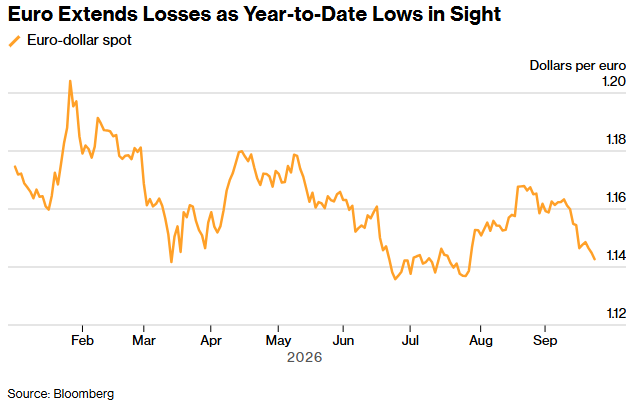
The decline of the euro has widened, and the low of the year is imminent
According to data from the American Depository Trust and Clearing Corporation (DTCC), this shift accelerated after the Federal Reserve's decision last week. After the ECB's latest rate hike, options exposure was almost half full, but since the Federal Reserve meeting, about 60% of the total nominal principal amount is betting that the euro will weaken.
ECB Governing Council member Joachim Nagel said that if high energy prices continue, officials may have to raise interest rates to a level that inhibits economic growth. They may “have to enter a mildly tight range of monetary policy,” he said.
The contrast with the US economy still supports the US dollar. Although the tightening of other major central banks may limit the space for the dollar to hit a new cycle high, Elias Haddad, head of global market strategy at Brown Brothers Harriman in London, said, “America's growth advantage over other major economies has biased the dollar's risk upward.”
DTCC data also shows that the euro hedging is extending further to the far end of the curve. Since the Federal Reserve meeting, the weighted average maturity period for bearish exposure to the euro has been extended by more than 10%, and lower exercise prices have attracted more interest.
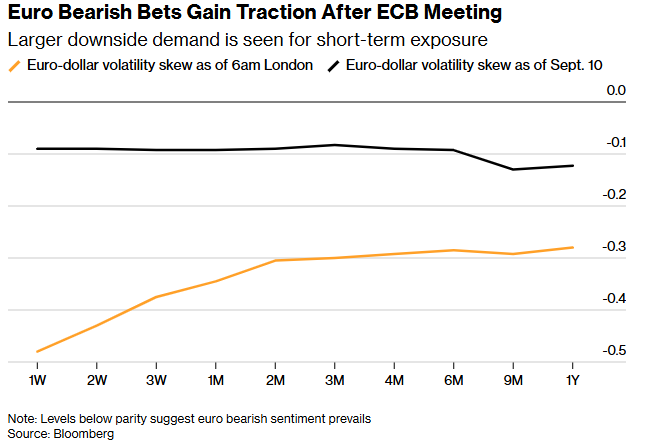
Bearish bets on the euro increased after the ECB meeting
Political uncertainty is also putting pressure on. France is facing another difficult budget battle in a divided parliament, and the CDU (CDU), led by Chancellor Friedrich Mertz, is dealing with the aftermath of its worst outcome in history in a German state election.
Matthew Hornbach, head of global macro strategy at Morgan Stanley, said that higher US interest rates and unfavorable political risk premiums against the euro make it more difficult for the euro to rise against the dollar.
Deutsche Bank, on the other hand, believes that there is limited room for the euro to continue to decline. Its analysts expect the EUR/USD to remain range-bound, on the grounds that resilient global growth and the dollar's significant tail risk should limit the weakening of the euro, while the Fed's interest rate hike and high energy prices have sealed the upward space.