


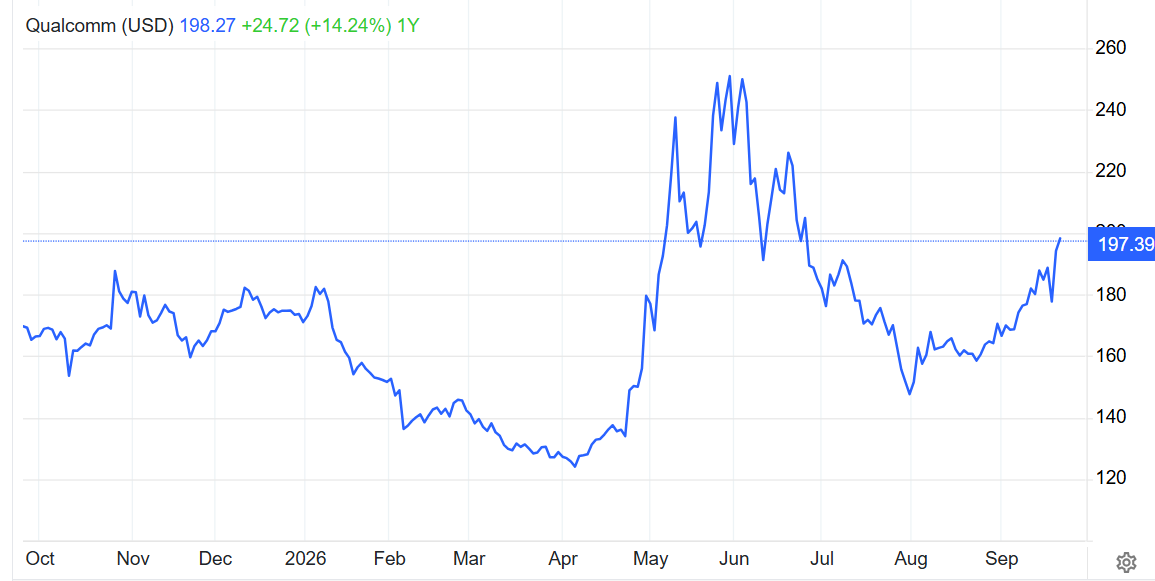
The Zhitong Finance App learned that semiconductor giant Qualcomm (QCOM.US), which has been focusing on smartphone chips for a long time, is actively betting on developing its own AI inference chips and data center CPUs. The underlying logic of Qualcomm's recent strong stock price is no longer just a single logic of “smart phone chip cycle bottoming out,” but the market is beginning to reprice its potential core position in the two main AI computing power investment lines of data center CPU/self-developed AI inference chip+endside AI smart device. By the close of the US stock market on Monday, Qualcomm's stock price had risen by 35% since August, and the market value hovered around US$210 billion, which is enough to show that the market has clearly begun to position a strong premium on its “AI computing power infrastructure up-and-coming forces”, not just according to traditional smartphone SoC chip companies.
Qualcomm management is actively seeking to grasp the growing demand for computing power resources in the era of large-scale penetration of end-side AI and AI agents. After Qualcomm released its latest flagship Snapdragon processor, it is receiving active attention from retail traders. Some Wall Street analysts pointed out that as the chip industry increasingly shifts to AI intelligent computing demands/capacity, these chips focusing on large-scale AI data centers are expected to become another growth engine for the company.
As cutting-edge AI intelligent work systems such as Muse and Astra expand the scope of commercial tasks that can be automatically completed, and also extend computing power requirements from a single question and answer to extremely complex intelligent workflows that continue to operate efficiently, global AI computing power demand is expected to usher in a new round of expansion. Qualcomm's AI chip data center CPU demand expectations are also showing a two-line expansion trend of AI computing power, driving Qualcomm's stock price to rise more than 10% since this week.
Qualcomm's entry into data center AI chips is focused on targeting heavyweight AI inference workloads. The technological breakthrough was to reduce data handling costs and the cost of each effective output token. The server CPU business allows Qualcomm to participate in another key aspect of intelligent computing. The Dragonfly C1000, which uses a self-developed Oryon core, is aimed at task orchestration, general computing, and AI host nodes. Qualcomm has reached multi-generation CPU cooperation with Meta. Mass production of the first-generation product is scheduled to begin in the second half of 2028, providing a customer base for medium- to long-term demand expectations. According to reports, mass production of the first-generation C1000 CPU in collaboration with Qualcomm and Meta is scheduled to begin in the second half of 2028.
Seize the growth opportunities in the AI era! Qualcomm's stock price is expected to hit the best monthly performance since May
Qualcomm management is actively seeking to grasp the growing demand for computing power resources in the era of large-scale penetration of end-side AI and AI agent technology focusing on complex proxy workflows. The company's stock price fell slightly by 0.4% in pre-market trading in the US stock market on Wednesday, but is still very likely to record its best monthly performance since May.
Daniel Newman, CEO of Futurum Group, said that Qualcomm's data center business, which covers AI inference chips and data center CPU capacity planning, has benefited from the smart AI boom, which may drive the market to adjust expectations for businesses such as high-performance data center CPUs, high-performance Ethernet network equipment, and AI computing core accelerators. However, he said investors should not ignore opportunities in the smartphone and other device sectors.
Newman said in a post on the X platform: “It's hard to overlook this: Qualcomm is also expected to benefit from the rapid rise of Muse, Grok Bot, and Instinct.” He added that “devices with smart functions will be boosted” and that no matter which application eventually wins the end-side smart AI competition, it will create another growth engine for Qualcomm.
Meta's newly launched Muse AI agent and Instinct, a personal AI agent, are prominent examples of the industry's transformation to autonomous AI. Instinct is known for handling real-world tasks such as emails, and the company is reportedly seeking financing at a $10 billion valuation; at the same time, Muse has received praise from users and analysts.
Meanwhile, Neil Shah is focusing on Qualcomm's decision to launch two flagship tiers. He said on the X platform: “Qualcomm Snapdragon's product positioning and classification are quite interesting.” He added that as OEMs, particularly Chinese smartphone makers, consider how to differentiate their devices, this strategy may make more sense.
The two Snapdragon chips can be described as fully targeting the era of end-side AI and AI agents. Qualcomm unveiled the Snapdragon 8 Elite Extreme Gen 6 and Snapdragon 8 Elite Gen 6 at the Snapdragon Summit this week. Both chips use a 2 nm process and support end-side AI, gaming, video, and connectivity functions.
The Snapdragon 8 Elite Extreme Gen 6 is Qualcomm's top chip. Equipped with a 5GHz Oryon CPU, it has faster AI and graphics processing performance, as well as advanced gaming and imaging capabilities. The standard Gen 6 also has a frequency of 5 GHz. Compared with the previous generation, CPU performance is increased by 10%, GPU performance is increased by 35%, and NPU performance is increased by 14%.
Shah said these differences “may not seem big on the spec sheet,” but he believes that advanced smart AI and gaming features may be a meaningful performance differentiator.
Additionally, it is worth noting that Qualcomm said it has hired Sergio Bugnac, the former president of Motorola's equipment business, to be responsible for the company's mobile, computing and extended reality (XR) business. Bunyak has been with Motorola for over 30 years and became the president of Motorola's equipment business in 2018.
His responsibilities also cover Qualcomm's next generation AI devices. At a time when Qualcomm is trying to expand the scope of application of Snapdragon beyond smartphones and go deeper into the AI ecosystem of emerging smart devices, the appointment brought the company an executive with rich experience in driving consumer devices from design to commercialization.
As of Wednesday morning EST, Qualcomm retail sentiment on the Stocktwits platform was “bullish,” with no change from the beginning of this week. At press time, the stock was in the top ten of the platform's popularity list.
A senior retail trader said on the Stocktwits platform: “Samsung is expected to be the first major partner to launch a device equipped with a standard chip. Related reports list the Galaxy S27 and Galaxy Z Fold 9 as the first models.” “In addition to Samsung, it is rumored that Xiaomi, OnePlus, and iQOO are also expected to get these new chips sooner.”
Intelligent devices drive the expansion of computing power: Qualcomm ushered in dual opportunities on the end side and in the cloud
The core change brought about by cutting-edge agents such as Muse and Astra is the expansion of a question-and-answer session into a complete workflow including continuous reasoning, tool call, code execution, and result verification. Derived from the system architecture, as more tasks are handed over to agents, the accelerator needs to undertake model calculation, the CPU needs to handle task orchestration, browser operation, software tools, and execution environments, and the memory and network are responsible for storing context and transmitting data. This increased demand for AI infrastructure to cover more chip types, and also opened up market space for Qualcomm's inference accelerators and server CPUs.
Therefore, as far as the trend of data center CPU demand expansion will be brought about by the popularity of AI agents around the world, the key to Qualcomm's bullish investment logic is to increase the capacity of agents to expand the scope of commercializable tasks, more users, higher frequency of use, and longer task processes to jointly drive the growth in demand for computing resources. The Dragonfly roadmap announced by Qualcomm already lists intelligent processing, inference acceleration, and high-speed interconnection as the core direction of data center business.
On the terminal side, smart devices need to continuously sense personal context, respond quickly, and call applications while meeting the phone's strict battery life and cooling restrictions. Therefore, per-watt performance, heterogeneous computing scheduling, and local processing capacity directly affect the user experience. Qualcomm's Oryon CPU, Adreno GPU, and Hexagon NPU can share control, graphics, and adaptive AI computing tasks: lightweight inference and personal data processing are done on the device side, and more complex tasks are called on the cloud model through the network. This cloud-to-cloud collaboration adds new product value to the Snapdragon platform. According to the generational comparison announced by Qualcomm, the flagship Extreme model's NPU performance is increased by 35%, and the performance per watt is increased by up to 33%. Its commercial significance is to enable more complex AI functions to operate continuously within limited power and cooling space.
Furthermore, compared to the AI chip aspect of the Nvidia/AMD AI GPU computing power system and Google's TPU computing power system, Qualcomm's entry into data centers focused on reasoning. The technical breakthrough was to reduce data handling expenses and the cost of each effective output token. The world's most advanced AI models and AI agents that focus on agent-based workload workflows need to read model weights repeatedly and access key-value caches that grow with context; especially in low-volume, low-latency decoding scenarios, memory bandwidth and capacity can easily become bottlenecks.
This is why the Qualcomm AI200 AI chip uses a high-capacity, low-power memory route. The AI250 further introduces HBC near-memory computing. Through 3D integration, computing and memory are more closely integrated to reduce energy consumption in data handling. Its core potential competitiveness lies in increasing the amount of inference services that can be delivered per unit of electricity on the premise of meeting output quality, latency, and throughput requirements, thereby improving the total cost of ownership of data centers. According to the official roadmap, the AI250 equipped with the first-generation HBC is expected to be delivered commercially in mid-2027.
The data center server CPU business allows Qualcomm to participate in another key aspect of intelligent computing. The Dragonfly C1000, which uses a self-developed Oryon core, is aimed at task orchestration, general computing, and AI host nodes. Qualcomm has reached multi-generation CPU cooperation with Meta. Mass production of the first-generation product is scheduled to begin in the second half of 2028, providing a customer base for medium- to long-term demand expectations.
In addition, in September, Qualcomm announced a multi-generation custom chip collaboration with Amazon, focusing on AI inference and covering up to 1.6T and subsequent optical interconnection solutions. The investment transmission of leaders in the AI computing power industry chain, such as Qualcomm, formed from these latest developments — end-side agents enhance the value of high-end Snapdragon platforms, and cloud-based agents broaden the market space for inference accelerators, server CPUs, and interconnect products; as customer projects are gradually mass-produced, Qualcomm has the opportunity to transform the low power design capabilities accumulated in the mobile computing field into data center revenue and expand its long-term growth sources.
On Wall Street, some analysts have given Qualcomm a target price of 400 US dollars for the next 12 months, corresponding to a potential increase of about 101.75%. This target price is also the highest target price on Wall Street. Analyst Tristan Gerra from Baird recently raised Qualcomm's target price from $300 to $400 to maintain an “outperform” (Outperform) rating. The analyst's $400 target price bet is profit growth and valuation revaluation brought about by “data centers opening up new markets+diversification of revenue structures+smart phone upgrades”. Gerra expects Qualcomm's data center revenue to reach $5 billion in fiscal year 2027, accounting for about 11% of its total revenue forecast, which means that the AI infrastructure business is about to begin to have a substantial impact on overall performance.