


Textron Inc. (TXT) is a global multi-industry company operating across aviation, defense, industrial and finance businesses. The Providence, Rhode Island-based company owns brands including Bell, Cessna, Beechcraft and Textron Systems, providing aircraft, defense equipment, industrial products and related services worldwide. The company has a market capitalization of approximately $13.7 billion.
Companies valued between $10 billion and $200 billion are generally classified as “large-cap stocks,” and Textron comfortably fits this category. Its substantial market capitalization reflects its size, influence and established position within the aerospace and defense industry. From business aircraft to military helicopters, Textron combines a broad aerospace and defense portfolio with strong brands. Its diverse products serve both commercial and government customers, reducing reliance on any single market. A reputation for innovation, supported by research and development and emerging technologies, further strengthens its competitive position.
Despite these strengths, TXT has slipped 23.3% from its 52-week high of $101.57, reached on February 18, 2026. Over the past three months, TXT shares have declined 10.4%, contrasting with a 6.5% gain for the Nasdaq Composite ($NASX) over the same period.
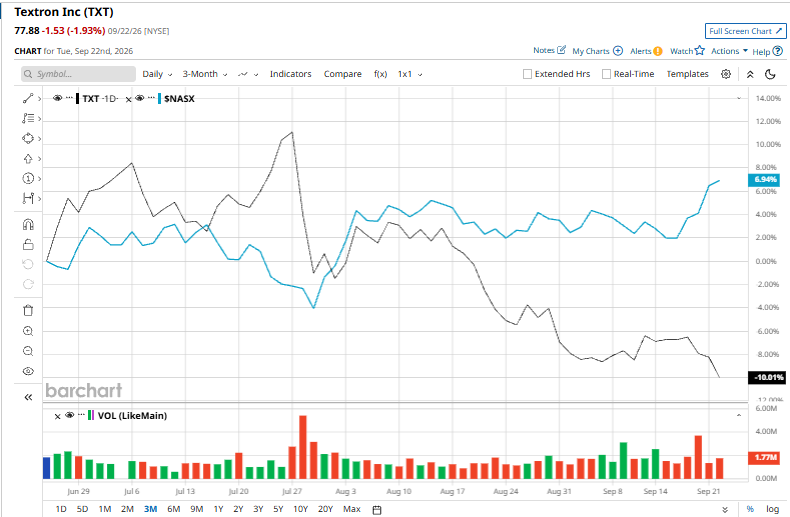
TXT shares have declined 10.7% year-to-date and 6.7% over the past 52 weeks, trailing the Nasdaq Composite’s 17.2% year-to-date gain and 20.7% return over the same period.
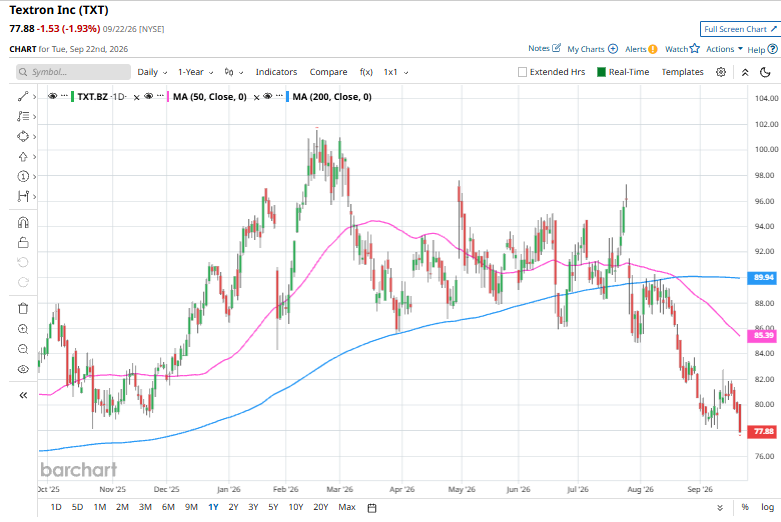
The stock has traded below both its 200-day and 50-day moving averages since late July, pointing to weakening momentum in recent months.
Textron’s weaker performance may reflect concerns about slowing growth, rising capital intensity and ongoing operational challenges. Revenue has grown at an annual rate of 4.2% over the past five years, trailing other industrial companies, while Wall Street expects growth of just 3.8% over the next 12 months. Meanwhile, its free cash flow margin has declined by 3.6 percentage points over the past five years, potentially reducing financial flexibility.
More recently, Textron’s second-quarter results, reported on July 28, 2026, highlighted persistent supply chain disruptions and inefficiencies tied to a less experienced aviation workforce, weighing on productivity and margins despite healthy demand. Uncertainty around funding for the MV-75 Cheyenne program also pressured Bell’s margins and could affect future earnings and free cash flow if funding is delayed. While adjusted EPS of $1.62 exceeded the $1.55 analyst estimate, revenue rose just 3% year over year to $3.83 billion, and management reiterated its full-year adjusted EPS guidance.
GE Aerospace (GE), one of TXT’s key competitors in the aerospace and defense industry, has gained 3.6% year-to-date and 6.1% over the past 52 weeks, significantly outperforming TXT over both periods.
Wall Street analysts remain moderately bullish on TXT’s prospects. The stock carries a consensus “Moderate Buy” rating among the 16 analysts covering it, while the mean price target of $101.13 implies 29.9% upside from its current price.
On the date of publication, Kritika Sarmah did not have (either directly or indirectly) positions in any of the securities mentioned in this article. All information and data in this article is solely for informational purposes. For more information please view the Barchart Disclosure Policy here.