


Memory stocks are no longer trading based on the traditional semiconductor cycle. In the AI era, memory makers like SanDisk (SNDK) and Micron Technology (MU) have become critical as an enormous amount of data has to be stored, retrieved, and moved as AI models become larger and more complicated. That shift has helped send both MU and SNDK stocks soaring triple digits in 2026. But the rally isn’t over yet. Wall Street expects both companies to post another year of explosive earnings growth.
But which stock has the stronger long-term runway from here?
The Case for SanDisk (SNDK)
SanDisk is a vertically integrated NAND flash and storage manufacturer. Its portfolio includes enterprise SSDs, client SSDs, embedded storage, automotive storage, and consumer flash products.
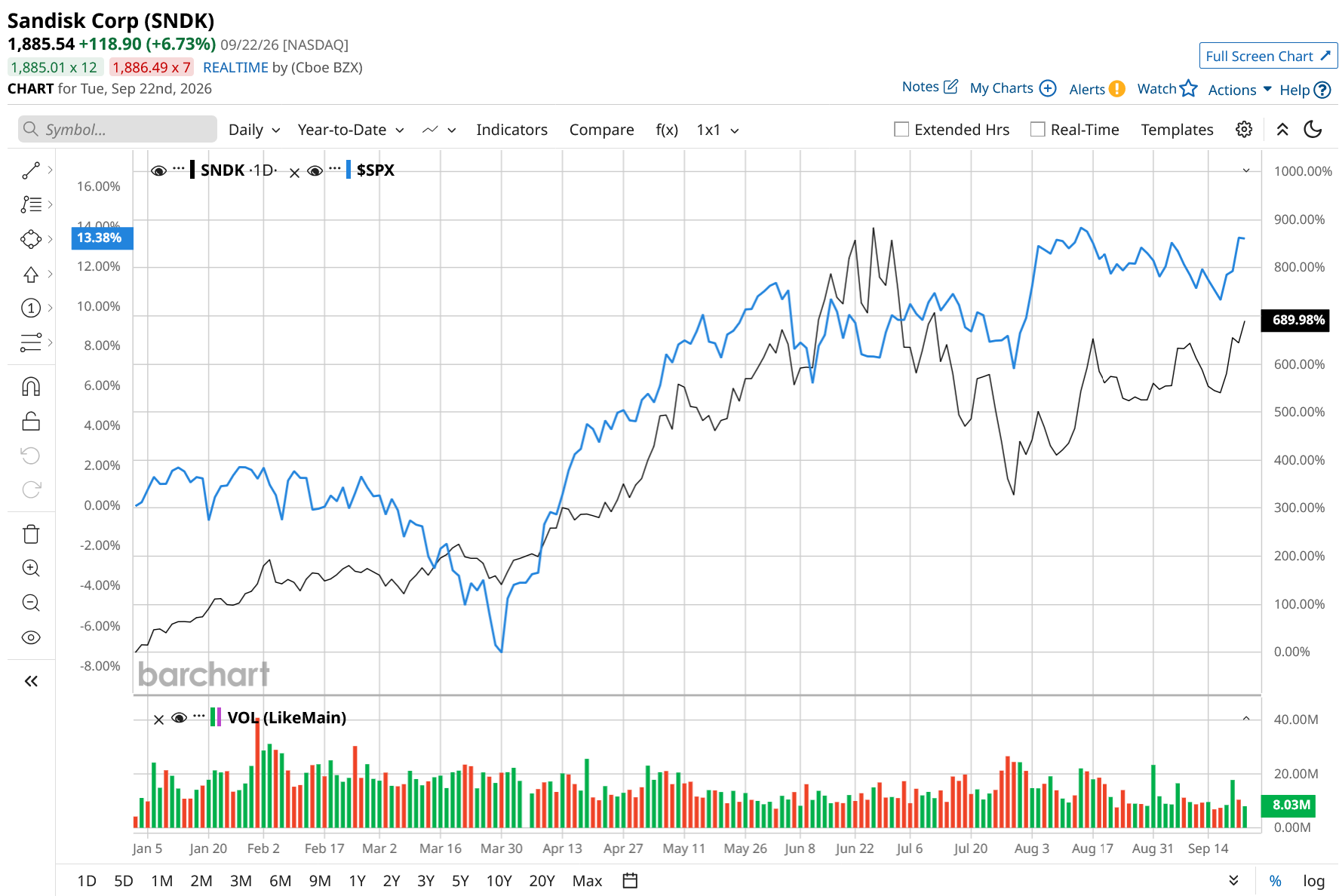
SNDK stock has soared a staggering 684% year-to-date (YTD), vastly outperforming the broader market.
In its fiscal fourth quarter, revenue soared 372% year-over-year (YoY) to $8.9 billion. Data center revenue reached $2.9 billion, up 103% sequentially, while Edge revenue rose 48% to $5.4 billion. However, consumer revenue fell 32% sequentially to $556 million. Profitability numbers were unusual for a NAND company. Adjusted gross margin rose to 84.6%, with EPS up to $39.25 compared to just $0.29 a year earlier. For the full fiscal year, SanDisk’s revenue increased 175% YoY to $20 billion. Data Center revenue climbed 437% to $5.153 billion, Edge revenue rose 195% to $12.16 billion, and consumer revenue increased 29% to $2.935 billion. Importantly, the Data Center segment accounted for only about 12% of SanDisk's bits a year earlier but had grown to 38% of the portfolio by the end of fiscal 2026.
For NAND, SanDisk now has eight new business model agreements with major Data Center and Edge customers. SanDisk’s customer agreements can run for up to five years, with the average contract lasting more than four years. They are expected to lock in over half of the company’s bit shipments in fiscal 2027 and approximately two-thirds in fiscal 2028. Notably, remaining performance obligation (RPO), which measures revenue not yet recognized, stood at $59.8 billion. These contracts also come with $16.5 billion of financial guarantees through cash deposits and other financial instruments, giving SanDisk more protection if customers fail to meet their commitments. Management expects the company’s data center share of the total NAND addressable market to increase from roughly 30% in calendar 2025 to around 50% in 2026.
Analysts expect SNDK's EPS to jump 202.06% to $214.10 in fiscal 2027, followed by another 23.64% increase in fiscal 2028. Trading at 6.7x forward earnings, SanDisk is reasonably valued as investors still view memory as a cyclical industry. While the growth numbers makes SNDK a fascinating long-term AI storage play, but it also comes with greater concentration with NAND as the company doesn’t participate in the DRAM and HBM market.
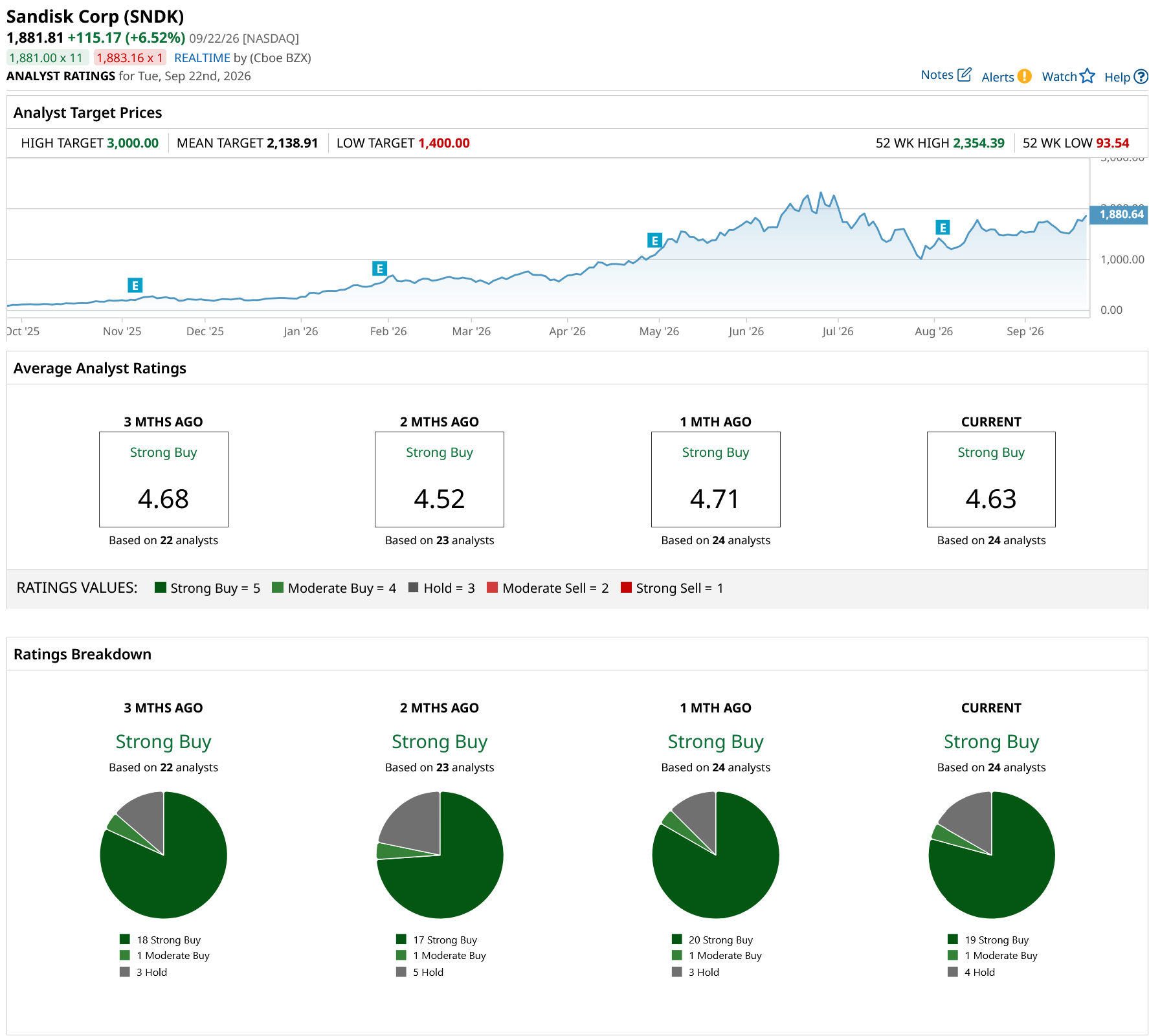
Overall, SNDK stock holds a consensus “Strong Buy” rating on Wall Street. Of the 24 analysts covering the stock, 19 recommend a “Strong Buy” rating, one has a “Moderate Buy,” and four suggest a “Hold” rating. Based on its average target price of $2,138.91, analysts expect the stock to rise 14% from current levels. But its high price estimate of $3000 suggests the stock could more than double over the next 12 months.
The Case for Micron (MU)
While Micron runs the same business as SanDisk, it is the more diversified of the two. It manufactures DRAM, NAND, and high-bandwidth memory (HBM), along with memory modules, graphics memory, and solid-state drives. And this matters because AI servers do not just rely on a single type of memory.
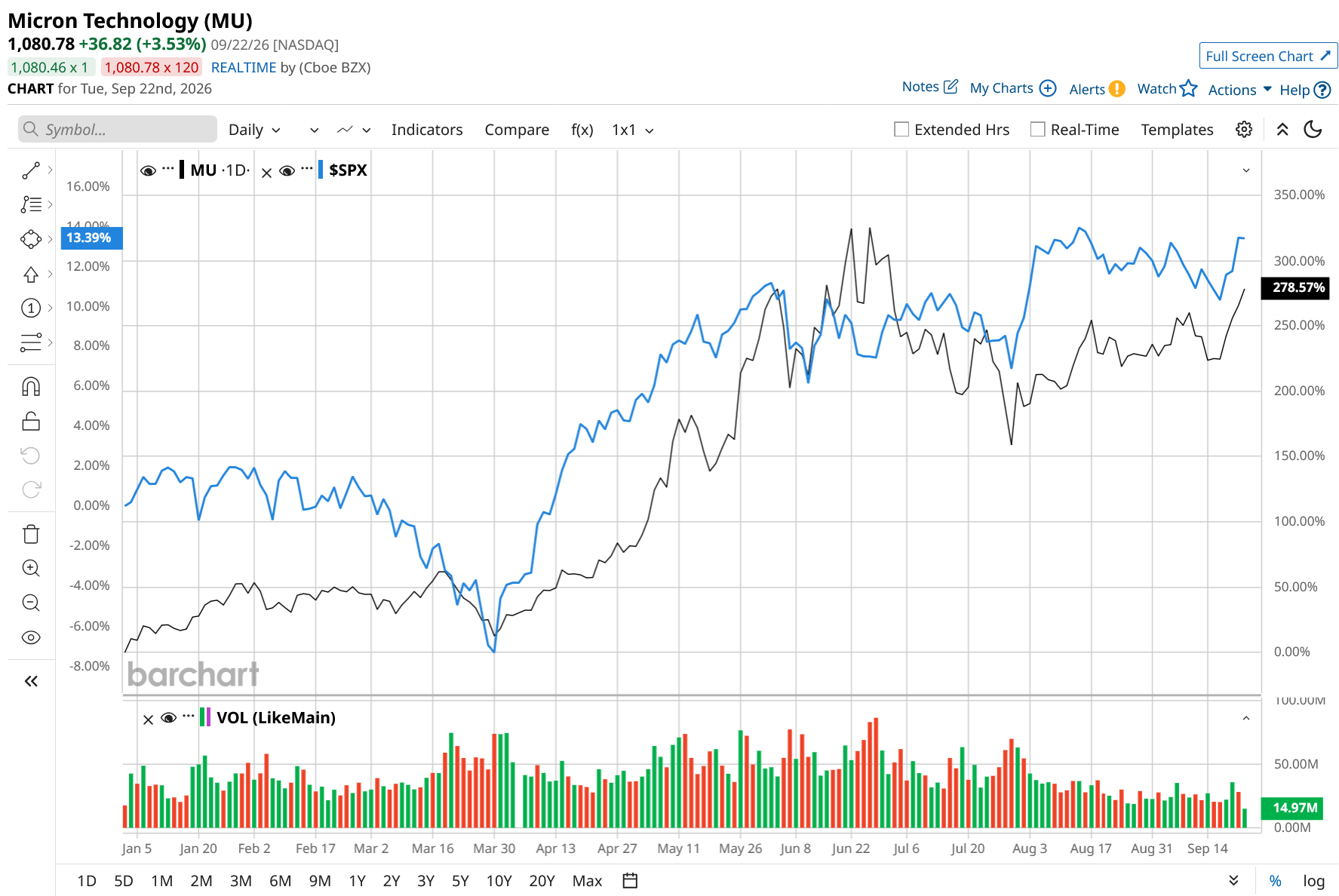
The importance of this vast portfolio was evident in its fiscal Q3 results. MU stock has climbed a whopping 222% so far this year, even as investors have grown more selective about AI stocks.
Revenue soared 346% YoY to $41.5 billion, while rising 74% sequentially. DRAM generated $31.3 billion, up 343%, while NAND contributed another $9.9 billion, up 361% YoY. Adjusted diluted EPS reached $25.11, up 106% sequentially and drastically above the $1.91 EPS in the year-ago quarter. Its Cloud Memory Business Unit generated $13.8 billion, or 33% of revenue, while Core Data Center and Mobile and Client each generated $11.5 billion, or 28%. Meanwhile, Automotive and Embedded generated $4.6 billion in revenue.
Cash generation was equally impressive, with the company holding $18.3 billion in free cash flow despite spending $7.1 billion in capital expenditures. Micron ended Q3 with $30.2 billion of cash investments and $24.4 billion of net cash after reducing debt by $4.4 billion.
Micron has already secured 16 long-term commitments from major customers, with most of the deals spanning 2026 to 2030. Its automotive contracts are shorter, typically lasting three years. Together, the agreements currently account for around one-fifth of DRAM shipments and about 33% of NAND volumes. As more of these deals are finalized, Micron expects roughly 40% of its total revenue to come from contracts that include fixed pricing or price limits set close to market levels.
This in particular reveals that memory is no longer cyclical. While prices can still fall and margins can still compress, customers are now willing to commit to supply several years ahead because AI infrastructure needs predictable access to advanced memory. Furthermore, Micron is targeting its HBM market share close to its overall DRAM share and said HBM commands a higher price per bit than conventional memory.
Micron is scheduled to report its fiscal fourth quarter earnings on Sept. 30. Analysts forecast a 350% increase in revenue to $51 billion, followed by EPS climbing to $31.47, compared to just $3.03 in the year-ago quarter.
For the full fiscal year, revenue is expected to climb 247.6% YoY to $129.92 billion, followed by another 90.6% to $247.6 billion in fiscal 2027. Over the past three months, analysts have revised their revenue estimates higher at least 37 times and EPS estimates at least 32 times. This suggests that analysts are continuing to raise their assumptions for AI-driven memory demand. Nonetheless, MU stock is trading at a forward P/E of just 6.39. Despite its gigantic rally this year, MU stock still appears reasonable relative to the pace of expected earnings growth.
Which Is the Better Buy for the Long Term?
While SanDisk is a fascinating long-term AI storage play, it is more concentrated in NAND and storage. Meanwhile, Micron offers the more balanced combination of diversification, contracted demand, HBM exposure, cash generation, and valuation. All in all, for a long-term investor looking for a memory stock that can participate in multiple layers of the AI infrastructure stack, MU looks like the better buy now.
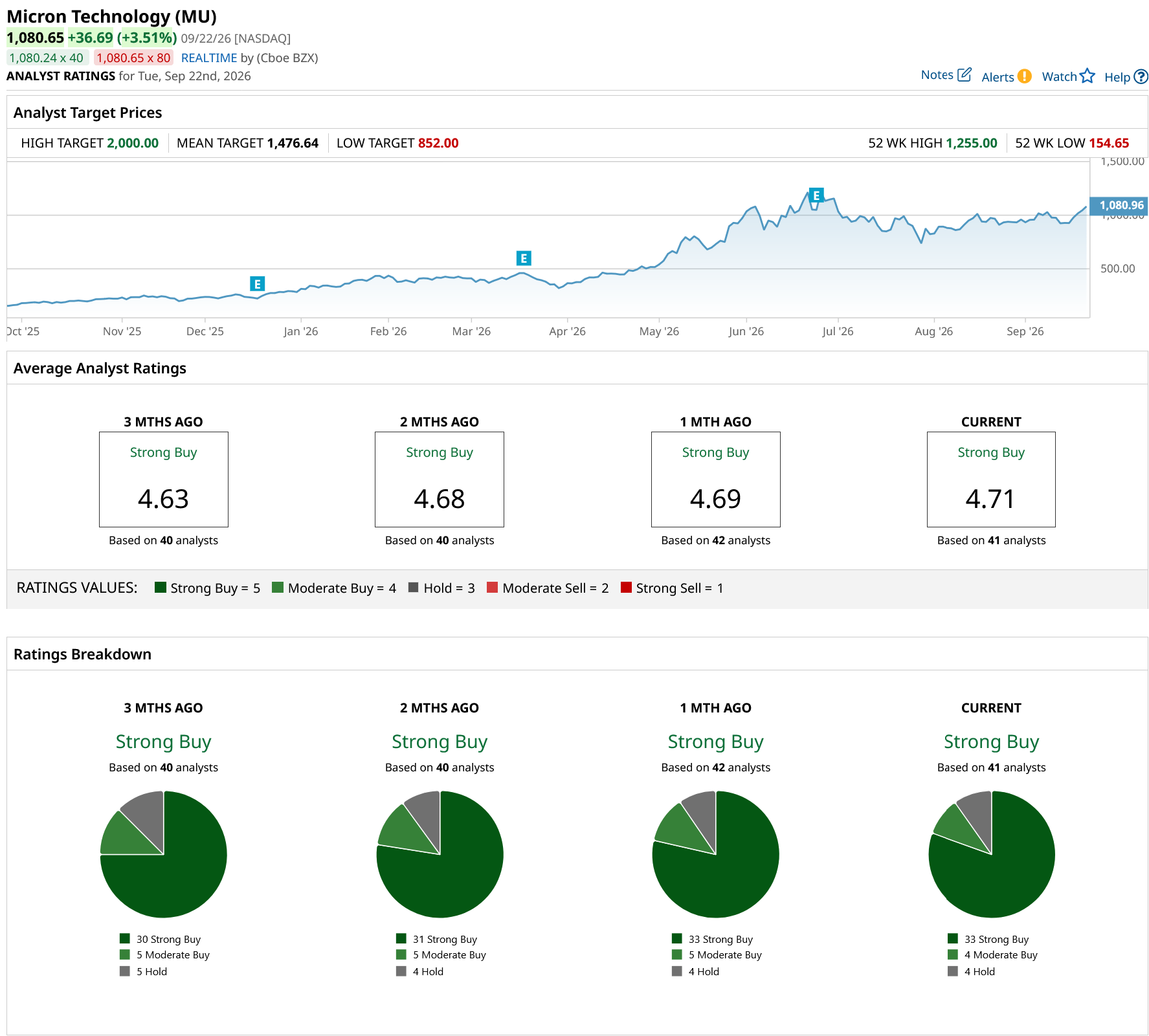
Finally, on Wall Street, MU stock holds a consensus “Strong Buy” rating. Out of the 41 analysts covering MU, 33 rate it a “Strong Buy,” four rate it a “Moderate Buy,” and four recommend a “Hold.” The stock has soared an impressive 277% YTD, and its average target price of $1,474.63 still gives it room for 36% more growth. And the high price target of $2,000 suggests MU stock has an upside potential of 85% from current levels.
On the date of publication, Sushree Mohanty did not have (either directly or indirectly) positions in any of the securities mentioned in this article. All information and data in this article is solely for informational purposes. For more information please view the Barchart Disclosure Policy here.