


Carnival Corporation Ltd. (CCL), based in Miami, Florida, is a global cruise company and the parent of Carnival Cruise Line and other cruise brands. Valued at a market capitalization of approximately $30.6 billion, it operates cruise ships worldwide, offering vacations with accommodations, dining, entertainment, activities and visits to destinations across multiple regions.
Companies valued between $10 billion and $200 billion are generally classified as “large-cap stocks,” and Carnival Corporation comfortably fits this category. Its market capitalization reflects its substantial size, influence and established position within the travel services industry. As the world’s largest cruise operator, its approximately 45% market share provides purchasing power and operational efficiencies, while its diverse brand portfolio helps serve different customer groups and geographies. Strong booking trends and onboard spending further support its business model.
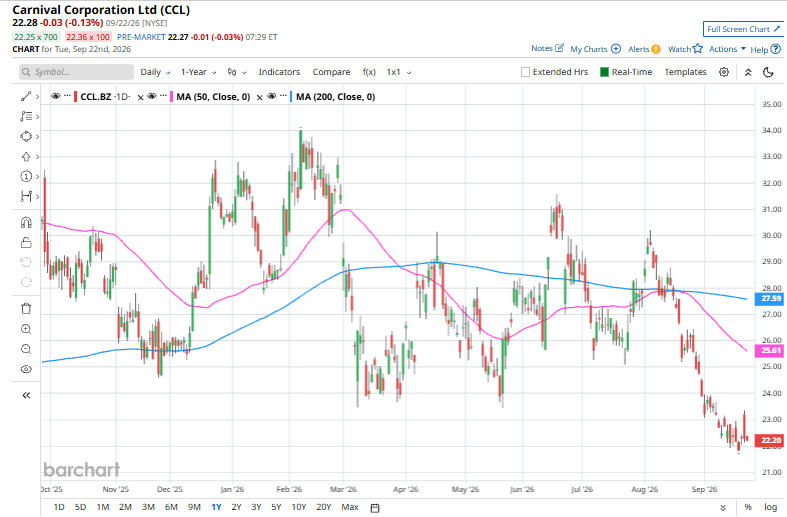
Despite its notable strengths, CCL is currently 34.5% below its 52-week high of $34.03, reached on February 6, 2026. Over the past three months, CCL shares have plunged 26.2%, compared with a 3.8% decline in the Invesco Dynamic Leisure and Entertainment ETF (PEJ) over the same period.
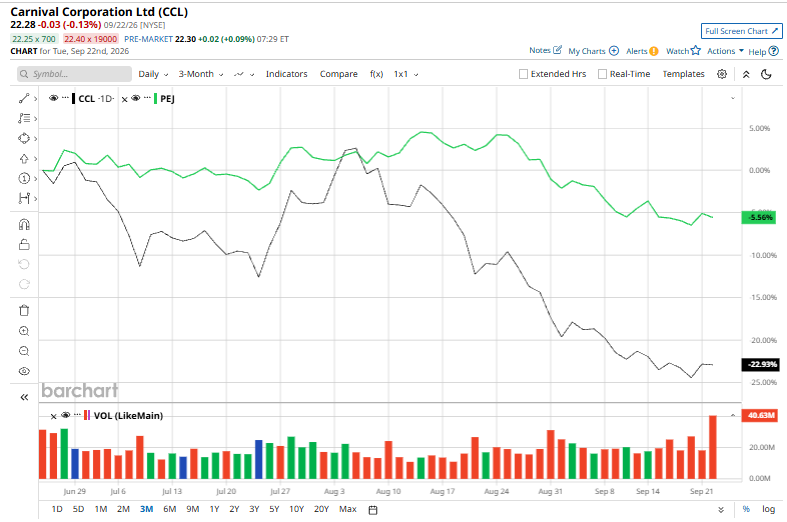
CCL shares have plunged 27.1% YTD and 27.5% over the past 52 weeks, significantly underperforming PEJ, which has gained 1.7% YTD and posted a marginal gain over the same period.
CCL has traded below both its 50-day and 200-day moving averages since mid-August, pointing to weakening momentum in recent weeks.
Carnival Corporation’s weaker stock performance over the past year may reflect relatively soft demand, as passenger cruise days have underwhelmed in recent periods. Meanwhile, the company’s 1.4% ROIC points to challenges in generating attractive returns on invested capital, while its free cash flow margin is expected to remain largely unchanged over the coming year, potentially limiting investor optimism.
Despite these headwinds, Carnival has continued to beat analyst expectations. On June 23, the company reported fiscal second-quarter adjusted EPS of $0.41, above the $0.35 consensus estimate, and revenue of $6.66 billion, also above expectations of $6.64 billion. Nevertheless, Carnival shares dipped 4.9% that day as investors digested the results.
Within the competitive travel services industry, Royal Caribbean Cruises Ltd. (RCL) has outperformed CCL YTD, with shares declining 15.8%. Over the past 52 weeks, however, RCL has fallen 28.7%, posting a steeper decline than CCL.
Wall Street analysts remain strongly bullish on CCL’s prospects. The stock carries a consensus “Strong Buy” rating among the 27 analysts covering it, while the mean price target of $34.26 implies a 53.8% premium to its current price.
On the date of publication, Kritika Sarmah did not have (either directly or indirectly) positions in any of the securities mentioned in this article. All information and data in this article is solely for informational purposes. For more information please view the Barchart Disclosure Policy here.