


Wall Street loves a growth story, and right now Coinbase Global (COIN) is writing one of the more interesting ones in finance. As one of the largest cryptocurrency platforms globally, Coinbase aims to diversify its revenue base and expand into other business segments.
Valued at a market cap of $53 billion, COIN stock is up 23% in the last three months. Despite the recent uptick, it is down more than 40% from 52-week highs. Coinbase executives have spent the past two weeks laying out a vision that stretches far past spot trading, and they are backing it up with numbers that are hard to ignore.
So what is fueling the optimism around Coinbase stock price action? Let’s dive deeper.
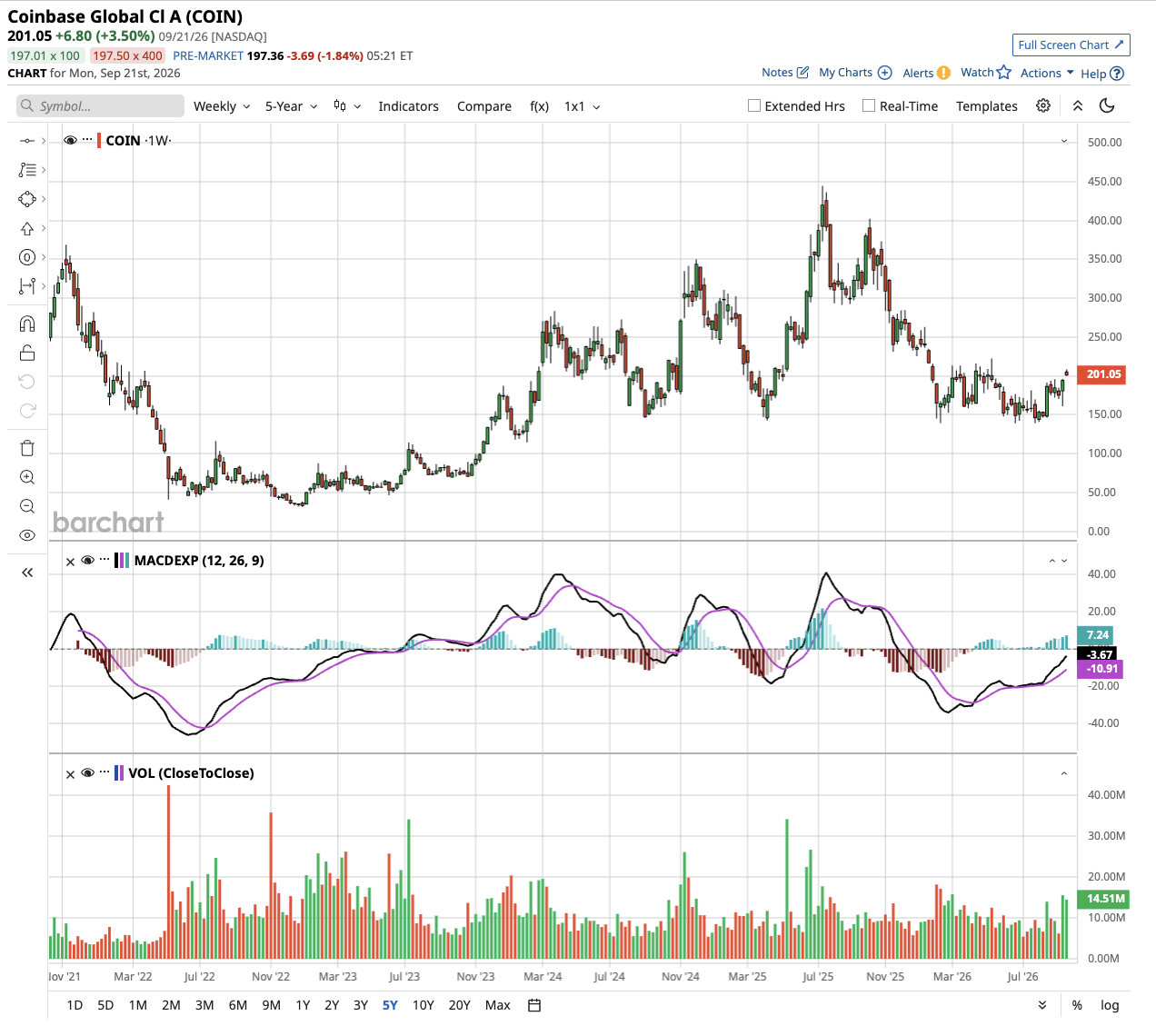
Coinbase Builds Its Everything Exchange
When Coinbase went public in 2021, its story was simple. Customers bought and sold cryptocurrencies, with Bitcoin (BTCUSD) trading volume driving more than 50% of total sales.
Coinbase CFO Alesia Haas told analysts at Goldman Sachs' Communacopia + Technology Conference 2026 that Bitcoin spot trading now makes up just over 10% of total revenue. Subscription and services revenue, driven largely by stablecoins, has grown to about $2.5 billion annualized, up from less than 5% of revenue at the time of the IPO.
The company now runs four separate trading pillars: spot crypto, derivatives, tokenized equities, and prediction markets.
Haas told Citi's 2026 Global TMT Conference that Coinbase is running 12 different product lines, each generating more than $100 million annually, something Citi's research director and analyst Peter Christiansen called “a remarkable amount of simultaneous scaling.”
Coinbase President and COO Emilie Choi summed up the strategy at the Goldman conference: the goal is one place where customers can trade any asset at any time. She pointed to the company's position as the world's largest regulated crypto custodian, holding roughly 12% of all on-chain assets, as the foundation that makes everything else possible.
Prediction Markets Ignite New Coinbase Stock Momentum
A new key driver for Coinbase is the prediction markets segment. The product crossed $100 million in annualized revenue within months of launching, then grew another 106% sequentially in the second quarter of 2026, according to Haas.
After Coinbase rolled out crypto binaries, which let users bet on short-term price moves in assets like Bitcoin, daily active traders in that category tripled and daily revenue quadrupled.
A newer contract type called combos is adding further momentum, and notably, Haas said the growth is not coming from marketing dollars. It originates from existing Coinbase users trying something new, which means the company has not even started actively courting new customers for the product yet.
Derivatives trading told a similar story. Choi said the business hit an all-time high in market share during the second quarter, helped by new regulatory clearance from the Commodity Futures Trading Commission that lets U.S. customers access global crypto perpetual futures markets for the first time without needing a workaround.
Tokenized equities are the newest addition. Coinbase launched one-for-one backed tokenized stocks on its Base network for non-U.S. customers just weeks before these conferences.
Haas described the product as a real security living on the blockchain, one that carries dividend rights and eventual voting rights, but can also be self-custodied and sent peer-to-peer once a customer passes identity verification.
Coinbase Opens IPO Access to Retail Traders
As this growth story continues to unfold, Coinbase announced another expansion that pushes it even further into traditional finance. The company is now giving everyday U.S. retail traders a chance to directly buy shares in initial public offerings, something historically reserved for large institutional investors.
According to a company statement, the rollout began this month with Oura's IPO, the wearable health tech maker. Eligible Coinbase customers can request shares at the actual offer price before the stock starts trading on the open market, a level of access that retail investors rarely get.
The process works through a new IPOs page inside the Coinbase app. Customers fund their account to cover the shares they want, then submit what the company calls a Conditional Offer to Buy once the expected price range becomes public, according to the statement. Once the order book closes, shares get divided up using an established allocation method and deposited straight into the customer's account at the IPO price.
Because final allocations depend on supply and customer demand, requests may be filled, partially filled, or not at all, the company said. Traders can cancel and resubmit their offers throughout the open period. Once the stock begins public trading, those shares become tradable on Coinbase right away.
A catch is built in for flippers. According to the statement, Coinbase's allocation system favors investors who plan to hold their shares long term. Selling IPO shares within the first thirty days can result in being barred from future IPO participation for 60 days, and repeat offenders will receive smaller, less frequent allocations going forward than those who hold longer.
Behind the scenes, Coinbase Capital Markets, a broker-dealer registered with FINRA, makes it all possible. The company said this unit participates in IPOs as a best-efforts selling group member, pooling customer orders and routing them through clearing partner Apex Clearing. Coinbase Capital Markets does not underwrite deals or take the other side of any trade. It acts as an agent working on behalf of its customers.
Regulatory Tailwinds Keep Coinbase Stock in Focus
Choi told the Goldman Sachs audience that the regulatory backdrop has shifted dramatically, moving away from what she called regulation by enforcement toward active rulemaking from the Securities and Exchange Commission and Commodity Futures Trading Commission.
Both executives pointed to the pending CLARITY Act as a potential accelerant, not a requirement. Haas told the Citi conference that congressional approval would be the most durable path forward, but stressed that Coinbase's roadmap does not depend on it passing.
On the cost side, Haas said the company trimmed headcount by 14% earlier this year and expects full-year 2026 expenses to land roughly flat compared with 2025, excluding stablecoin reward costs.
She credited artificial intelligence tools for meaningfully boosting employee productivity, allowing smaller teams to ship products faster while keeping spending in check. Put it all together, and the picture becomes clear: Coinbase is no longer betting its future purely on crypto prices.
Between derivatives, prediction markets, tokenized equities, IPO access, and stablecoin infrastructure, the company is methodically building toward something much bigger than the exchange investors bought into back in 2021.
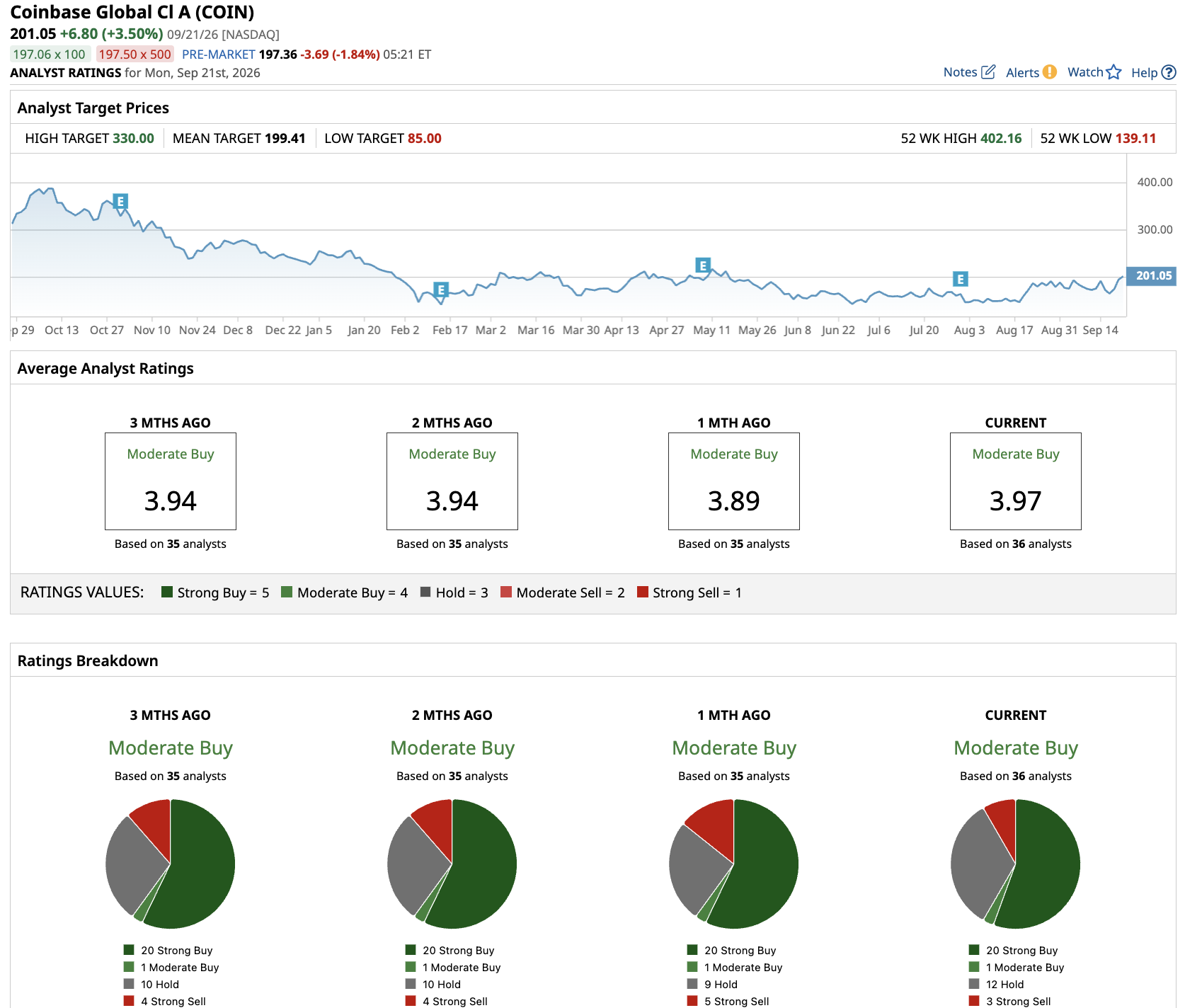
Out of the 36 analysts covering Coinbase stock, 20 recommend “Strong Buy”, one recommends “Moderate Buy”, 12 recommend “Hold”, and three recommend “Strong Sell”. The mean COIN stock price target is $199, marginally below the current price of $201.
On the date of publication, Aditya Raghunath did not have (either directly or indirectly) positions in any of the securities mentioned in this article. All information and data in this article is solely for informational purposes. For more information please view the Barchart Disclosure Policy here.