


The Zhitong Finance App learned that as cutting-edge AI agent workflow systems such as Muse and Astra expand the scope of commercial tasks that can be automatically completed, and also extend computing power requirements from a single question and answer to extremely complex intelligent workflows that continue to operate with high efficiency, global AI computing power demand is expected to usher in a new blowout expansion frenzy. This is also the recent global stock market that has accelerated the popularity of AI smart applications beyond expectations, transforming them into leaders in the AI computing chain such as SK Hynix, Samsung, Micron, Nvidia, AMD, TSMC, etc. Growth expectations for core computing power suppliers important logic.
As AI skeptics once again announce their surrender, traders who are optimistic about the subject of AI computing power are actively exploring future trends in technology stocks. The process of the Nasdaq 100 Index reaching its first record high since June can be described as full of ups and downs. Today, the stock market bulls driving this rise are looking for bullish evidence that the upward momentum based on the unprecedented AI infrastructure frenzy will not subside.
Wall Street giant Jefferies recently said that the S&P 500 index is expected to soar to 8,000 points by the end of 2026 and further hit 9,000 points in 2027, driven by the AI investment frenzy and rising profits of AI-related companies exceeding expectations. Jefferies's core logic is clear and powerful: in a cycle where AI-driven profit growth exceeds the historical average by more than two times the historical average, fighting against profit trends is dangerous. Jefferies's 2026 8,000-point S&P 500 benchmark forecast is based on earnings per share (EPS) reaching $373 (up 35% year over year, well above 29% of market consensus) and a price-earnings ratio of 21.5 times.
The core change brought about by the recently popular Meta Muse AI agent and the OpenAI Astra large model/AI agent “comparable to AGI” is that a single user command can trigger continuous, multi-stage computational work. A research, programming, or office task may in turn include planning, retrieving, reading documents, calling tools, executing code, checking results, and fixing errors. Multiple steps require re-calling the model, and complex tasks may also use parallel exploration and verification. Such an almost endless and increasingly complex AI workload will accelerate the transmission of growth opportunities to a complete AI inference load computing power system beyond the GPU.
Based on the “Jevons Paradox” (Jevons Paradox), the overall demand for AI computing resources will continue to expand in the future due to declining computational power costs on the inference side. Recently discussed, the so-called Jevins effect, also known as the “Jevans Paradox,” is a counterintuitive economic theory: when current technological advances improve the efficiency of the use of certain resources (such as energy, raw materials, or AI computing power infrastructure resources), it will reduce the unit cost, thereby stimulating large-scale expansion of market demand, which ultimately causes the total consumption of all types of resources not to decrease but to increase. The concept was first proposed by the English economist William Stanley Jevons (William Stanley Jevons) in the book “The Coal Problem” in 1865.
From the perspective of AI inference system architecture, more complex AI tasks led by Meta Muse often include longer context, multiple rounds of model calls, tool execution, and result verification: prefill (prefill) requires processing input, decode (decode) continuously generates output, and key value cache (KV Cache) takes up more memory as context and concurrency scale expand, and computational throughput, memory bandwidth, and capacity need to be increased collaboratively. Therefore, as cutting-edge intelligence such as Meta Muse further detonates demand for AI computing power, the core inference for the AI computing power industry is that GPUs and TPUs undertake model calculation, CPU tool execution and task orchestration, HBM, server DRAM, storage and high-performance network infrastructure, and data center optical interconnect devices all support efficient data transportation and state management; ultimately, a complete set of AI computing power server clusters will be needed to deliver sustainable operation services.
Meta's Muse and OpenAI's Astra have strengthened extremely professional computer operation, programming, and multi-step work capabilities. What can be deduced from this is that the accelerated expansion of AI applications is simultaneously increasing the infrastructure investment required for “model thinking” and “actual execution of work.” This is why, as the AI commercialization process has improved dramatically, UBS Group's senior analyst team sharply raised the 2027 operating cash flow forecast for global hyperscale cloud computing vendors and new cloud-type enterprises by 30%, and Wall Street financial giant Morgan Stanley expects the data center comprehensive capital expenses of the four largest North American supercloud computing and AI application vendors to rise from US$917 billion in 2026 to US$1.47 trillion in 2027 and US$1.64 trillion in 2028. The deployment capacity is expected to increase from 35 gigawatts in 2025 to an astonishing increase in 2028 145 gigawatts.
AI skeptics once again chose to surrender, and global capital once again flocked to tech stocks
According to the latest data compiled by Bloomberg Intelligence, stock market bulls have invested a total of up to 22 billion US dollars in US exchange-traded funds (that is, the US stock ETF sector), which focuses on the technology sector. In contrast, the net inflow to other sectors of the market was about 4.6 billion US dollars. The former is about 4.8 times that of the latter, close to 5 times. Meanwhile, the latest data from the US Commodity Futures Trading Commission (CFTC) shows that recently, hedge funds raised their net long positions in NASDAQ 100 futures to the highest statistical level since December.
Despite strong gains in this technology-led index and steady corporate profits, uncertainties surrounding tension in the Middle East, stubborn inflation, and the Federal Reserve's actions to contain inflation remain. Since the market is largely betting on AI computing power trading, the current pattern means there is very little room for fault tolerance.
“Investors are still optimistic about AI infrastructure-related allocation topics in view of strong corporate profits,” said Jed Ellerbrook, portfolio manager at St. Louis-based Argent Capital Management. The company is overequipped with cybersecurity, software, and AI chip leaders, under-allocating or shorting sectors including essential consumer goods and real estate. “But for the gains to continue, we need to continue to see the profit forecasts of the largest technology companies raised.”
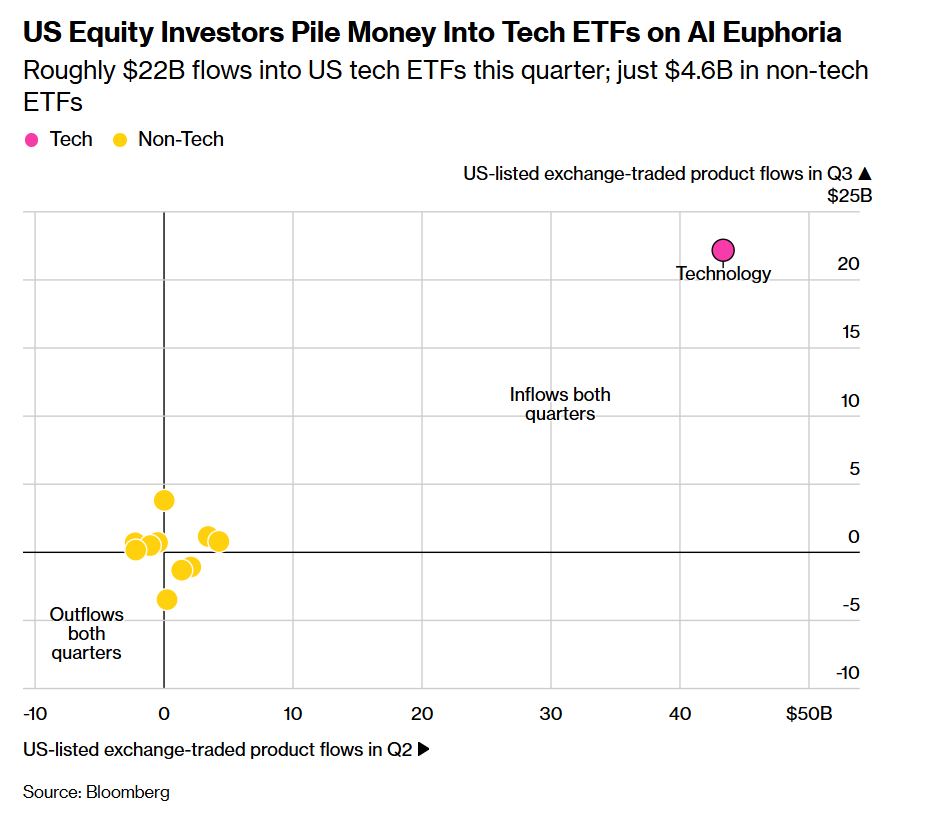
As shown in the chart above, under the unprecedented AI boom, US stock investors invested heavily in technology ETFs — about $22 billion flowed into US tech ETFs this quarter; non-tech ETFs attracted only $4.6 billion.
The Nasdaq 100 closed up 0.8% on Tuesday, closing at a record high, reversing a sharp decline earlier this year — a round of decline that once brought the index back more than 10% from its peak. The S&P 500 closed mostly flat, no more than 0.5% until it returned to the record high set in August.
Wall Street institutional investors are also planning to continue the rally. According to data from Goldman Sachs's main brokerage business department, US stocks last week saw the largest net purchase in five weeks, with software stocks leading the way. Bank of America strategists quoted EPFR Global data as saying that in the week ending September 16, US equity funds attracted nearly $64 billion in capital inflows, the highest in three months. At the same time, cash assets experienced the largest outflow of funds in nine weeks.
“There is still room for further growth in the AI-themed bull market, and we don't think investors will reduce their risk exposure in the short term,” Athanasios Psarofargis, an ETF analyst at Bloomberg Intelligence, said in a telephone interview. “The inflow of capital into tech stocks is far from extreme, and not enough to constitute a reverse indicator for selling these stocks. It is very difficult to interrupt this upward momentum. The good play continues.”
Not everyone is convinced that the rise in technology stocks and the rotation of capital to AI trading will continue. Bank of America strategists, including Jared Woodard and Michael Hartnett, said investors' positions seemed too optimistic compared to the prospects for profit growth. Meanwhile, the breadth of the market continues to deteriorate. According to data compiled by Bloomberg, as many as 6% of the S&P 500 index constituent stocks hit a 52-week low this month. The last time this happened was in October.
The impressive performance of major technology companies has supported the nearly four-year bull market in US stocks, and traders need to see more such performance to prove that the billions of dollars invested in AI infrastructure are reasonable. Less than a month until the start of the third quarter earnings season, investors expect profits in the IT sector to increase by 64%. Compared with that, the overall profit of the S&P 500 Index is expected to increase by 24%.
“There's no need to hold most sectors other than the tech sector,” said Todd Thorne, chief ETF strategist at Baird Strategas. “The energy sector experienced a brief period of excitement in the spring. The consumer sector is still plagued by macroeconomic unease. The healthcare sector has improved, but there are too many internal differences. However, if oil prices remain high, I think energy will be one of the sectors that will attract more capital inflows.”
However, Wall Street veterans still remember their experiences in the 1970s and during the internet bubble, when factors such as excessively tight monetary policies damaged the economy. Many traders also remember that in 2022, the Federal Reserve began raising interest rates in March of that year to deal with the worst inflationary pressure in a generation.
All of these factors make it more difficult for traders trying to grasp the rotation of capital to large technology stocks to determine the trend: August and September have historically been the worst months for stock returns, yet they reversed seasonal weakness before the November US midterm elections. The S&P 500 index rose 2.6% last month and has risen another 1% since September.
“Customers will ask, 'Is this round of upside too good? '” Argent's Ellerbrook added. “But the stock market is more dependent on tech companies than ever before, so you have to take this into account when allocating retirement funds.”
The Muse smart device frenzy ignites a new round of computing power demand: the trillion-dollar investment landscape resonates with the return of capital from technology stocks
The core of Muse and Astra enhancing AI computing power demand expectations is to expand a user instruction into a continuous execution workflow: planning, retrieving, reading data, writing code, calling tools, and verifying results, which can trigger multiple rounds of model calculation and software operation. Meta revealed that Muse has a dedicated cloud virtual machine and browser that can continue to work after users close the application; OpenAI added behavioral monitoring to Astra's inference of all external deployed tool calls, and clearly indicated that this would incur significant computational overhead. As a result, commercialization of intelligent devices has also expanded infrastructure requirements for “model thinking” and “actual task execution”, and growth opportunities cover AI accelerators, CPUs, memory, storage, and networks.
Judging from the AI Transformer inference architecture, prefill (prefill) is responsible for processing input, and decoding (decode) gradually generates output; long context, multiple rounds of interaction, and high concurrency will simultaneously increase computation, memory capacity, and data transmission requirements. GPUs, TPUs, and other ASICs are responsible for model calculation; CPUs are responsible for tool execution, virtual machines, task scheduling and data processing, HBM and server DRAM carrying models and operating states, and enterprise-level storage and storage of files, long-term memory, and task records.
OpenAI's disclosure shows that its Habitat online storage platform has processed more than 70 million requests per second, more than 500 PB of data, and undertakes CPU-intensive tasks such as routing, compression, encryption, and verification, providing an actual engineering basis for AI applications to drive CPU and storage at the same time. Derived from the perspective of actual large-scale AI inference engineering, the continuously increasing volume of tasks will also be transmitted to high-speed interconnection, power supply and cooling systems through cross-node communication, server capacity expansion, and increased rack power density.
Model/agent efficiency increases, and the scope of commercializable tasks can also be expanded. Comparative testing by Meta engineers showed that compared to 1.2, Muse Spark 1.3 reduced tool calls and token usage by about 20% and 25%, respectively. If the average token usage for similar tasks is reduced by 25%, as long as the number of tasks increases by more than one-third, total token consumption will still rise; when higher success rates and lower execution costs attract more users and more industries adopt AI, this demand expansion may exceed the savings brought about by increased efficiency. Goldman Sachs also pointed out that improvements in reasoning efficiency are expanding the range of tasks that companies can economically hand over to AI.
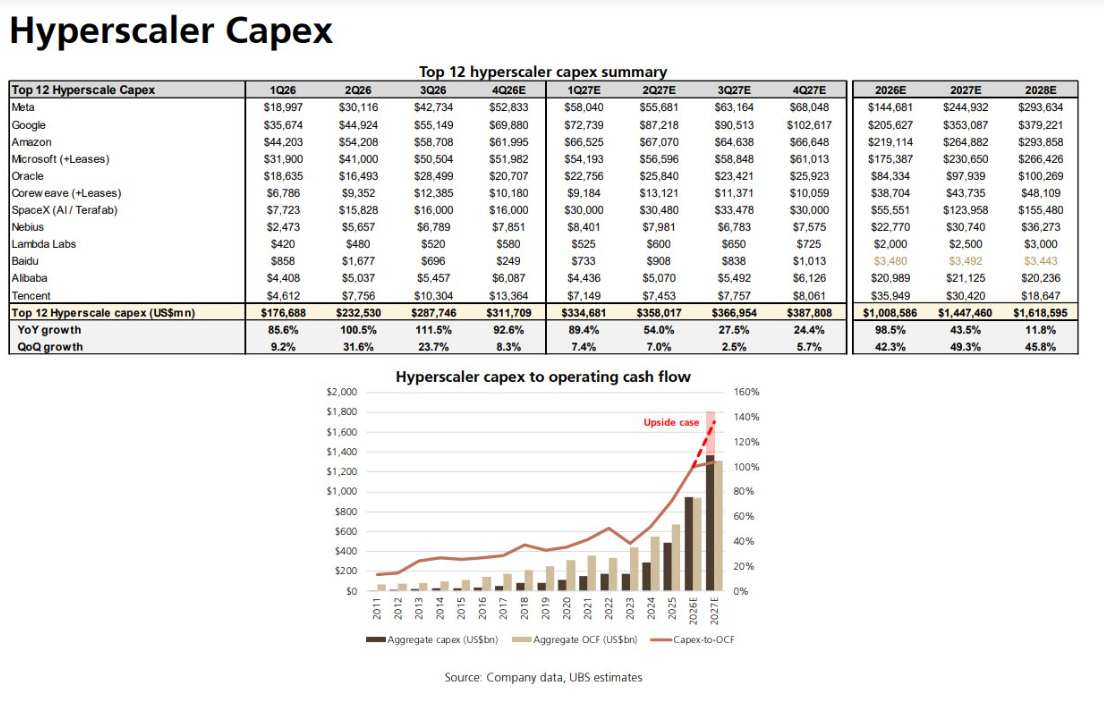
According to the UBS research summary, the capital expenses of the 12 cloud computing and AI infrastructure companies covered by it are expected to reach approximately $1.009 trillion, $1.447 trillion, and $1.619 trillion respectively, increasing by 98.5%, 43.5%, and 11.8% year-on-year; UBS also raised its 2027 operating cash flow forecast by 30%, reflecting an improvement in its ability to support commercialization. Morgan Stanley, on the other hand, predicts that capital expenditure related to hyperscale cloud vendors and AI will be about 1.2 trillion to 1.3 trillion US dollars in 2027, and may reach 1.4 trillion US dollars in 2028; in September, Goldman Sachs drastically raised the 2027 hyperscale cloud vendor spending forecast from 1.2 trillion US dollars in March to 1.7 trillion US dollars, and the forecast for 2029 was raised from 1.5 trillion US dollars to 2.1 trillion US dollars. The coverage and update times of these forecasts vary, but they all point to a continued increase in the scale of infrastructure investment.
Market conditions and capital flows also showed signs of technology stocks being re-increased: as of September 22, the Philadelphia Semiconductor Index rose about 6.44% this week, up about 11.09% from August 24; as of September 23, Korea's KOSPI index rose about 2.71% this week, up about 5.73% from August 24. Meanwhile, US tech ETFs attracted $22 billion this quarter, while non-tech ETFs were only about $4.6 billion; in the week ending September 16, US equity funds attracted nearly $64 billion in inflows.
Overall, behind the Nasdaq 100 Index's return to record highs, it can be said that capital return and profit growth expectations positively support and resonate with each other. Investors agree that profits in the IT sector will increase by 64% in the third quarter, which is significantly higher than the overall S&P 500's 24% increase. The next thing the bulls are concerned about is whether the profit forecasts of large technology companies can continue to be revised, so that additional investment in computing power can be further converted into revenue and profit.