


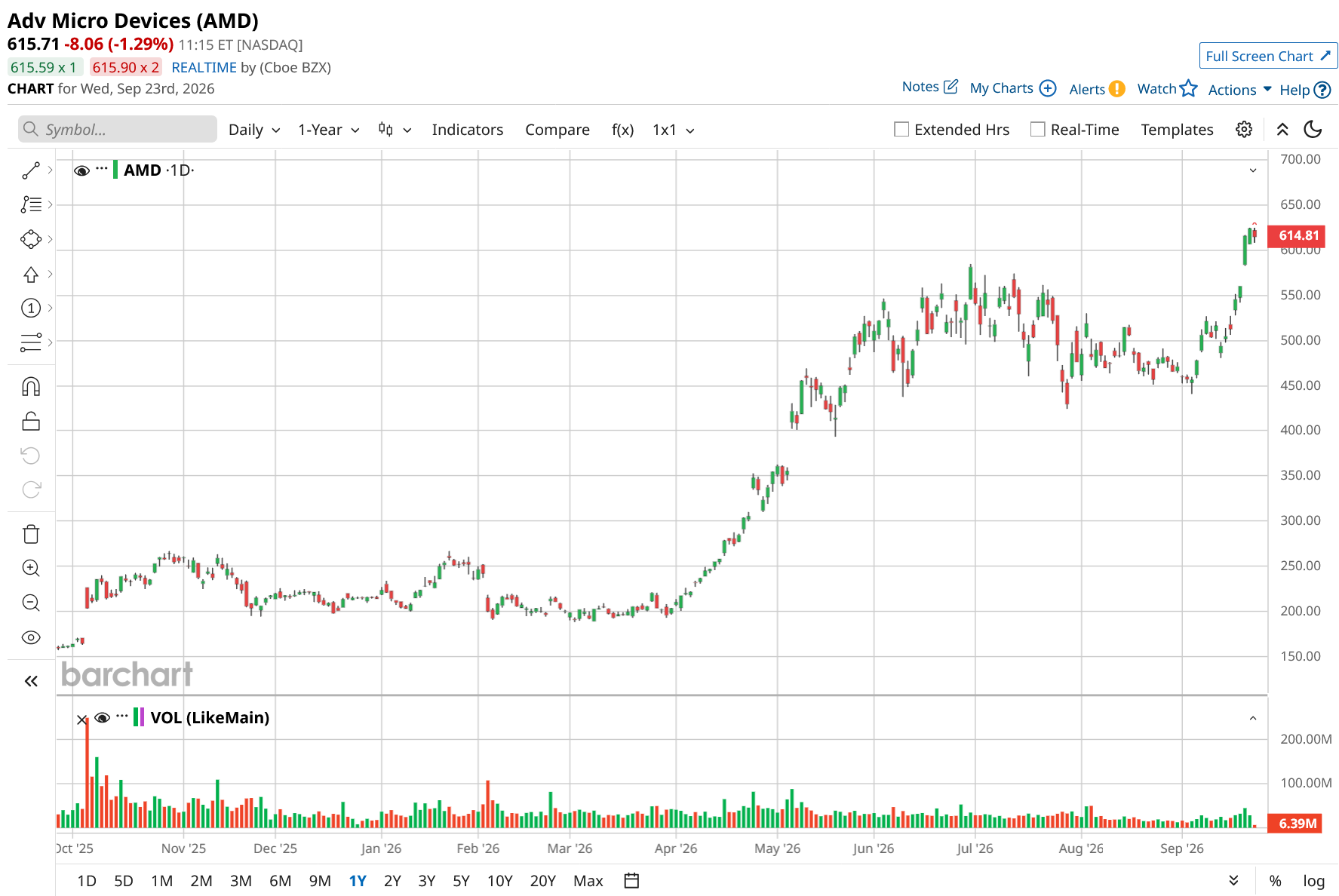
A decade ago, Advanced Micro Devices (AMD) was fighting for survival. It has now crossed a threshold few companies ever reach. On Monday, Sept. 21, 2026, AMD briefly surpassed a $1 trillion market capitalization for the first time.
Its shares surged nearly 10% to a record high above $616, lifting the company into rare territory. In doing so, AMD became only the fourth U.S. chipmaker to join the exclusive club, following Nvidia (NVDA), Broadcom (AVGO), and Micron (MU).
The move capped a powerful rally across semiconductor stocks, as the iShares Semiconductor ETF (SOXX) gained more than 4% on Sept. 21. What once seemed distant for a company viewed as Nvidia’s challenger in AI chips has become a market reality.
Yet the $1 trillion valuation raises sharper questions than it answers. What exactly happened to bring AMD here, and what does that transformation mean for the stock going forward? Let’s find out.
AMD’s Growth Numbers
Advanced Micro Devices, based in Santa Clara, California, develops CPUs, GPUs, adaptive computing products, and data center platforms. Its offerings serve cloud providers, enterprise customers, PC makers, gaming systems, and embedded-device manufacturers. Before its latest push above $1 trillion, AMD carried a market capitalization of $913.9 billion.
AMD stock finished trading at $615.52 on Sept. 21, having advanced 187% so far this year and 291% over the trailing 52-week period.
At 87.10x forward earnings and 26.38x sales, AMD trades above sector medians of 23.05x and 3.64x, respectively.
AMD released its second-quarter 2026 results on Aug. 4, with revenue climbing to a record $11.5 billion, gross margin reaching 54%, operating income totaling $2.0 billion, and net income coming in at $2.3 billion. This produced a diluted EPS of $1.38 under GAAP accounting.
Their adjusted results pointed to stronger underlying profitability. AMD recorded a 56% non-GAAP gross margin, $3.1 billion in operating income, $2.8 billion in net income, and non-GAAP diluted EPS of $1.66.
The company’s Data Center segment generated $6.7 billion in second-quarter revenue, accounting for roughly 58% of AMD’s total revenue.
Advanced Micro Devices generated $3.8 billion in Client and Gaming revenue, up 6% from the prior-year quarter. Its Client revenue rose 23% to $3.1 billion on continued Ryzen demand, but Gaming revenue declined 31% to $779 million because semi-custom sales weakened.
Its Embedded segment supplied another $977 million, up 19% year-over-year (YoY), as demand improved across multiple end markets.
Why AMD Earned a $1 Trillion Valuation
Advanced Micro Devices crossed the $1 trillion mark because investors now see it as a major supplier of the computing hardware behind AI, rather than only a maker of PC and gaming chips. The company’s appeal rests on its ability to serve two connected parts of AI data centers.
EPYC processors handle general server workloads, while Instinct accelerators handle the intensive calculations needed to train and run AI models. That thesis gained credibility in the second quarter, when AMD’s Data Center revenue more than doubled YoY to $6.7 billion, driven by strong demand for EPYC processors and Instinct GPUs as customers expanded capacity for AI and cloud workloads.
AMD has positioned Helios, its rack-scale platform, for the next stage of that spending cycle. The systems are designed to improve the speed, cost, and economics of AI inference, which occurs when trained models are used in real-world applications. Inference matters because it creates the recurring computing demand that can extend infrastructure spending beyond the initial rush to train large language models.
AMD’s $1 trillion valuation shows that investors expect the company to become one of the larger beneficiaries of AI infrastructure spending. Continued growth in EPYC server-chip sales, wider adoption of Instinct accelerators, and successful Helios deployments could support those expectations and give the shares room to rise further.
AMD must now show that rising customer adoption becomes sustained revenue growth, higher margins, and durable earnings gains. If data center growth slows, AI chip shipments disappoint, or profit margins fail to expand, investors could reassess those assumptions and pressure the stock.
Wall Street Expects Another Big Step Up
AMD’s next earnings report, due Nov. 3, will test whether the company can keep delivering growth consistent with its trillion-dollar valuation. For the September 2026 quarter, analysts expect earnings of $1.64 per share. That compares with $0.97 in the prior-year quarter, implying 69.07% YoY growth.
AMD’s management has set a similarly ambitious outlook. They expect third-quarter revenue of about $13 billion, plus or minus $300 million. The midpoint would represent a 41% increase from the same quarter last year. It would also mark a 13% sequential gain from its second-quarter revenue.
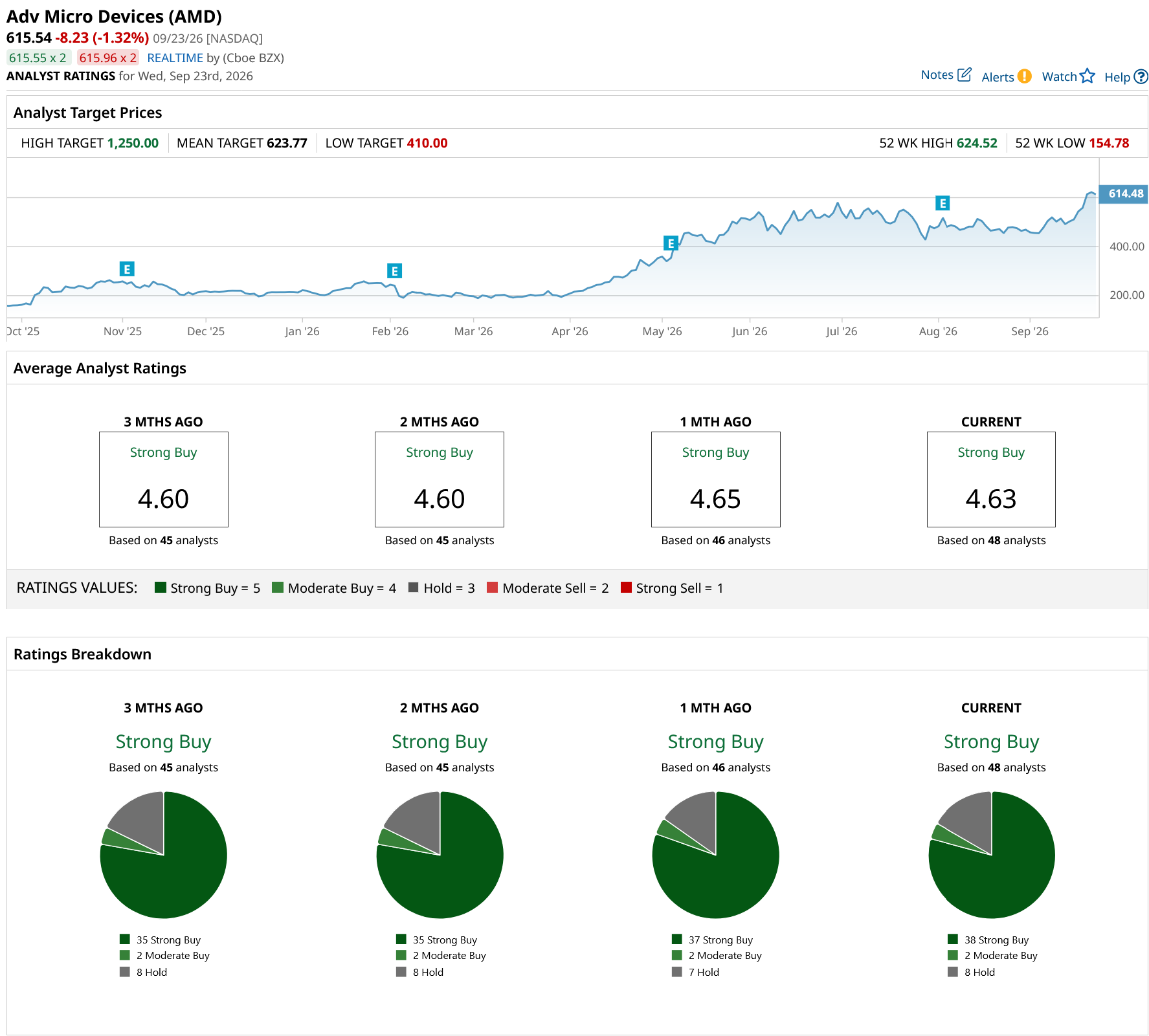
Wall Street’s consensus view remains firmly constructive. AMD stock holds a “Strong Buy” consensus rating based on 48 analysts. Their average price target is $623.77, an upside of about 1.3% from AMD’s Sept. 21 closing price. The limited gap shows that analysts broadly support the company’s long-term AI prospects.
Conclusion
AMD’s move into the $1 trillion club reflects confidence that its AI business can keep lifting revenue and profits. The stock could move higher if EPYC, Instinct, and Helios drive results above AMD’s $13 billion third-quarter target. Still, AMD’s premium valuation leaves little room for disappointment. Strong data center growth and stable margins should keep the bullish case intact, while weaker AI sales could pressure the shares. For now, AMD appears positioned for further upside, but execution will decide the next move.
On the date of publication, Ebube Jones did not have (either directly or indirectly) positions in any of the securities mentioned in this article. All information and data in this article is solely for informational purposes. For more information please view the Barchart Disclosure Policy here.