


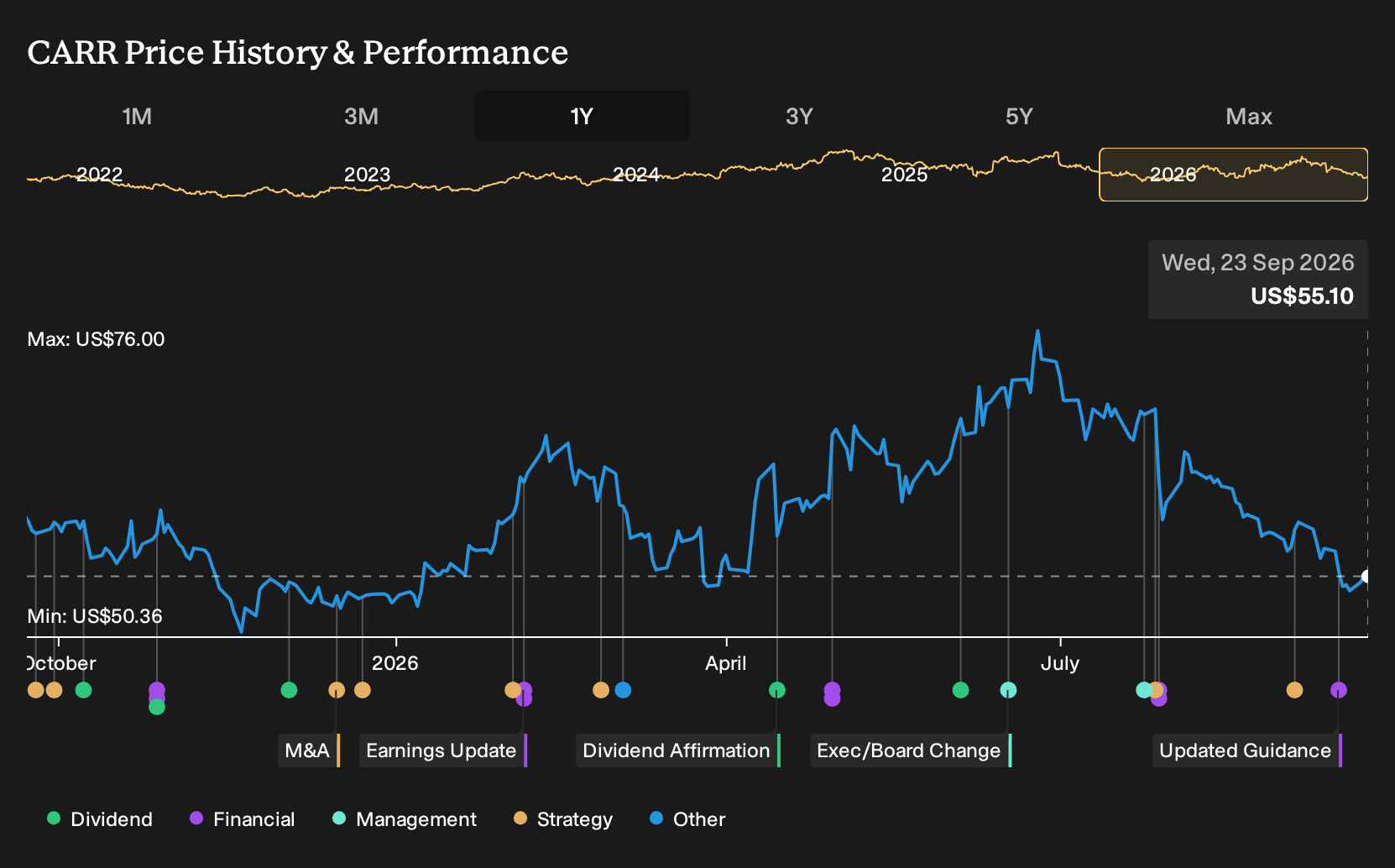
- Carrier Global reported that it expected about US$6 billion in sales for the third quarter of 2026, giving investors a clear short term revenue marker.
- The guidance directly ties Carrier Global’s near term outlook to demand for energy efficient climate solutions such as data center cooling and European heat pumps.
- This raises the question of how Carrier Global’s investment narrative could be affected by its roughly US$6 billion third quarter sales guidance.
Compare Carrier Global's Q3 sales marker with peers by scanning for other climate and energy solution stocks that could be setting up for similar demand trends in the 39 power grid technology and infrastructure stocks.
Carrier Global Investment Narrative Recap
For you to own Carrier Global, you need to believe that demand for energy efficient climate and refrigeration solutions can support steady orders across data centers, residential HVAC and European heat pumps. The Q3 2026 sales marker of about US$6 billion gives a near term health check on that thesis without changing it in a fundamental way.
The most important short term catalyst is execution on the existing backlog in data center cooling and higher value building controls, while working to rebuild margins that recently sat at 5.3%. The biggest near term risk remains uneven demand across regions and product lines, combined with input cost and tariff pressure that can dilute mix and keep profitability under strain.
The fresh Q3 sales guidance sits alongside earlier commentary that Carrier Global has roughly US$2 billion of 2026 data center revenue already in backlog and more than US$8 billion of total contracted work, heavily tied to commercial and data center projects. That backlog context matters, because the US$6 billion target effectively tests how efficiently the company converts committed projects into recognized sales.
For you, the key question is whether management can push more of that work through a manufacturing footprint that includes a planned U.S. data center site intended to roughly double Americas capacity, while still managing tariffs, fuel and metals costs. Strong execution here would support mix shift toward higher margin systems, software and aftermarket activity. However, any stumble on costs or regional demand could keep earnings and valuation debate front and center.
Carrier Global's narrative projects US$26.6b revenue and US$2.7b earnings by 2029. This assumes 6.3% yearly revenue growth and requires a US$1.5b earnings increase from US$1.2b today.
Uncover why Carrier Global's fair value indicates a 41% potential upside to its current price before other investors act on that opportunity.
Exploring Other Perspectives
For a different angle on Carrier Global, focus on residential demand risk. The most cautious analysts were assuming only 3.7% yearly revenue growth with earnings of about US$2.3b by 2029. That is well below the consensus US$2.7b view. The fresh Q3 sales marker could prompt both camps to rethink those paths.
Explore 4 other Carrier Global fair value estimates, including one that suggests as much as 9% downside from the current price.
Form Your Own Verdict
Don't just follow the ticker. Dig into the data and build a conviction that's truly your own.
- A great starting point for your Carrier Global research is our analysis highlighting 3 key rewards and 1 important warning sign that could impact your investment decision.
- See our latest analysis for Carrier Global. The report includes a comprehensive fundamental analysis summarized in a single visual, the Snowflake, making it easy to evaluate Carrier Global's overall financial health at a glance.
Looking for more investment ideas beyond Carrier Global?
If the Carrier Global story has sharpened your thinking about demand, pricing power and balance sheet strength, use that same lens across a broader watchlist with the Simply Wall St Screener.
- If you want potential value with quality fundamentals, scan for companies that score well on both earnings power and balance sheet strength using the 30 high quality undervalued stocks.
- If capital preservation matters most to you, narrow the field to businesses with steadier profiles through the 31 resilient stocks with low risk scores.
- If you are hunting for future leaders that are not yet widely followed, widen your research universe with the 16 high quality undiscovered gems.
This article by Simply Wall St is general in nature. We provide commentary based on historical data and analyst forecasts only using an unbiased methodology and our articles are not intended to be financial advice. It does not constitute a recommendation to buy or sell any stock, and does not take account of your objectives, or your financial situation. We aim to bring you long-term focused analysis driven by fundamental data. Note that our analysis may not factor in the latest price-sensitive company announcements or qualitative material. Simply Wall St has no position in any stocks mentioned.
Have feedback on this article? Concerned about the content? Get in touch with us directly. Alternatively, email editorial-team@simplywallst.com