


- Meta and PayPal Holdings previously announced that Meta’s Muse AI shopping agent now routes transactions through PayPal’s global merchant network, allowing consumers to discover products and complete PayPal-powered checkouts directly inside Muse.
- The link between Muse’s agent-driven shopping flow and PayPal’s branded checkout places the payments group inside emerging AI commerce journeys without requiring new front-end consumer adoption of a separate PayPal app.
- We will now examine how PayPal’s investment narrative around becoming a broader commerce platform interacts with its Muse AI integration.
PayPal Holdings Investment Narrative Recap
To own PayPal Holdings today, you need to believe its shift from pure payments to a broader commerce platform pays off, even as headline revenue growth expectations sit near 4% a year and earnings forecasts point to a slight decline. In the near term, the key variable is execution on higher margin, branded checkout and value added services, along with trimming less profitable Braintree volume.
The biggest risk remains that competition, regulation and softer consumer spending offset any gains from this transition, leaving earnings stuck despite solid free cash flow. The Muse AI integration helps operationally, but it does not remove those macro, regulatory or market share pressures on PayPal Holdings in the short run.
The Meta Muse partnership is the clearest announcement tying directly into that commerce platform story. Muse lets shoppers move from product discovery to PayPal powered checkout without leaving the agent, which keeps PayPal Holdings plugged into new AI driven shopping flows rather than displaced by wallets like Stripe’s Link or Shopify’s Shop Pay.
For catalysts, the key question is whether this kind of AI agent integration supports branded checkout relevance and transaction margins while PayPal continues its multi year cost and product overhaul. If AI routed volume stays meaningful and competition or tariffs bite harder, the risk is that earnings, already projected to soften, face extra pressure instead of stabilising.
What The Muse AI Story Means For PayPal Holdings' Numbers
PayPal Holdings' current analyst storyline ties the Muse AI partnership into a broader financial picture that is cautious on earnings but still assumes measured top line expansion. Analysts are working off revenue forecasts that grow at 4.3% a year, while expecting profit margins to compress from 14.4% today to 12.3% over the next three years. This sets a tighter backdrop for any AI driven commerce upside.
Earnings estimates reflect that squeeze. Consensus points to earnings of US$4.7b by 2029, compared with US$4.9b today, which implies an earnings decline of about US$0.2b even as PayPal Holdings pushes into higher margin branded checkout, value added services and agent based shopping flows like Muse. That gap highlights the tension between cost actions and product upgrades on one side, and competitive, regulatory and macro headwinds on the other.
On the equity side, the analyst framework assumes the stock trades on a P/E of 10.4x 2029 earnings, up from 9.2x now and below the 17.4x currently quoted for the wider US diversified financial peer group. Analysts also build in a 7% annual reduction in the share count over the next three years, which could support per share metrics even if absolute earnings stay under pressure.
The Muse AI link slots into this template as one concrete way PayPal Holdings tries to defend and extend branded checkout within emerging AI commerce flows. The potential value sits less in instant volume spikes and more in keeping PayPal visible when users let agents make purchase decisions. That said, the same report flags material dispersion in earnings expectations, from US$3.9b at the bearish end to US$6.3b at the bullish end, which underlines how uncertain the payoff from these commerce platform initiatives, including Muse, still looks on a five year view.
PayPal Holdings' narrative projects US$38.7b revenue and US$4.7b earnings by 2029. This rests on 4.3% yearly revenue growth and an earnings decline of about US$0.2b from US$4.9b today.
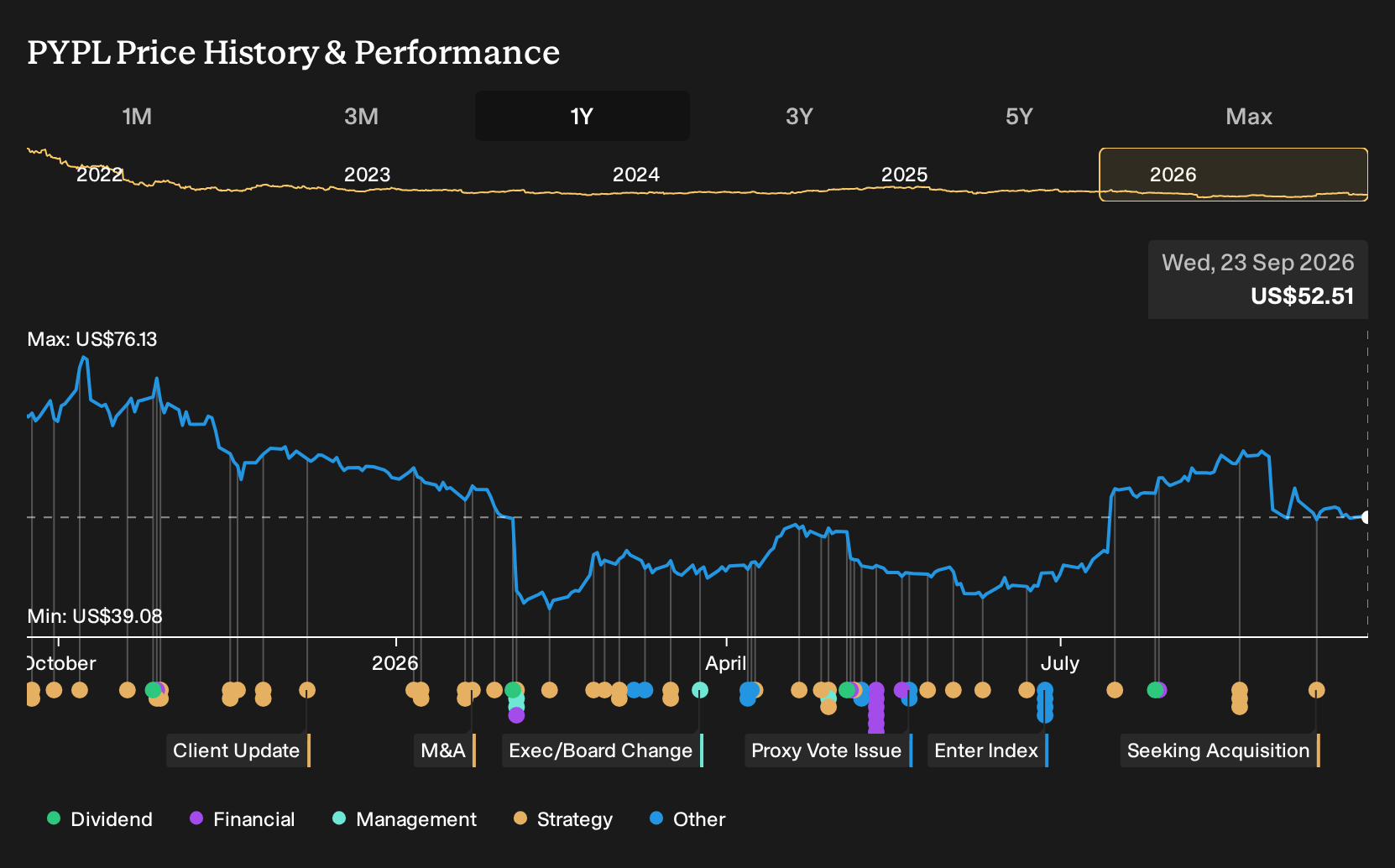
Uncover why PayPal Holdings' fair value indicates a 9% potential upside to its current price that may not last much longer.
Exploring Other Perspectives
For a very different lens on PayPal Holdings, focus on the bearish concern that digital currencies and super apps slowly squeeze out third party wallets. Those analysts were working with only 2.3% expected annual revenue growth to about US$36.1b and earnings near US$4.2b by 2029. That is far more cautious than the consensus. Both sets of numbers came before the Muse AI news. Treat them as starting points and explore which version of the story you find more convincing now.
Explore 29 other PayPal Holdings fair value estimates, including one that suggests it could be worth just $57.07.
Form Your Own Verdict
Disagree with existing narratives? Extraordinary investment returns rarely come from following the herd, so go with your instincts.
- A great starting point for your PayPal Holdings research is our analysis highlighting 3 key rewards and 1 important warning sign that could impact your investment decision.
- See our latest analysis for PayPal Holdings. The report includes a comprehensive fundamental analysis summarized in a single visual, the Snowflake, making it easy to evaluate PayPal Holdings' overall financial health at a glance.
Looking For More Ideas Beyond PayPal Holdings?
If the Muse AI story has you rethinking how PayPal Holdings fits into your portfolio, it can help to line it up against other opportunities with clear financial traits, from income machines to overlooked compounders and steadier low risk options.
- For investors who want potential growth but still care about underlying strength, scan a 9 elite penny stocks with strong financials that already show robust balance sheets and cleaner financial profiles than the typical micro cap.
- If value is the priority and you are hunting for businesses where quality and pricing still look out of sync, review a focused 30 high quality undervalued stocks that blend solid cash generation with disciplined capital structures.
- For a calmer ride and more controlled downside, concentrate on a 31 resilient stocks with low risk scores that screen on resilient earnings, stronger balance sheets and lower overall risk scores.
This article by Simply Wall St is general in nature. We provide commentary based on historical data and analyst forecasts only using an unbiased methodology and our articles are not intended to be financial advice. It does not constitute a recommendation to buy or sell any stock, and does not take account of your objectives, or your financial situation. We aim to bring you long-term focused analysis driven by fundamental data. Note that our analysis may not factor in the latest price-sensitive company announcements or qualitative material. Simply Wall St has no position in any stocks mentioned.
Have feedback on this article? Concerned about the content? Get in touch with us directly. Alternatively, email editorial-team@simplywallst.com