


- Tidewater recently reported quarterly results with revenue slightly ahead of forecasts and meaningful beats on both EBITDA and EPS estimates, reflecting solid operating execution in its offshore vessel fleet.
- The company’s ability to outperform analyst earnings targets while running a large global offshore service vessel fleet highlights operational discipline in a capital intensive, cyclical segment of the energy supply chain.
- We will now explore how Tidewater's stronger than expected EBITDA performance could reshape the existing investment narrative around vessel supply tightness.
Scan other offshore and energy-service stocks showing similar operating momentum to Tidewater by reviewing the hand picked 30 high quality undervalued stocks, which may also be surprising on earnings.
Tidewater Investment Narrative Recap
To own Tidewater, you need to be comfortable with a focused bet on offshore activity and tight vessel supply. The investment case leans on the idea that a limited global OSV fleet, plus a solid project pipeline, can support healthy utilization and pricing. The latest revenue, EBITDA and EPS beats reinforce that Tidewater is currently executing well in that context.
The key near term swing factor remains how consistently those vessels stay working across regions like West Africa, the Middle East and Europe. The biggest risk is still prolonged softness in offshore spending or pauses in drilling programs that leave ships idle. The latest quarter does not remove that risk; it shows the business handling present demand well.
No major fresh announcements accompany this earnings release, which puts the spotlight firmly on Tidewater’s core operating performance. That actually helps. You can focus on the existing fleet, the current balance of vessel supply and demand, and how effectively management is translating day rates into EBITDA and net income.
With analysts already expecting meaningful earnings growth and pointing to tight OSV capacity as a key driver, the recent upside surprise mainly tests whether Tidewater can sustain this level of execution. For investors tracking catalysts, the next checkpoints are contract activity across its five segments, any M&A to expand the fleet, and how management handles region specific volatility and customer payment risk.
Tidewater's current analyst narrative points to revenues of $1.9b and earnings of $416.5 million by 2029, based on 12.6% yearly revenue growth and an earnings increase of about $169.6 million from $246.9 million today.
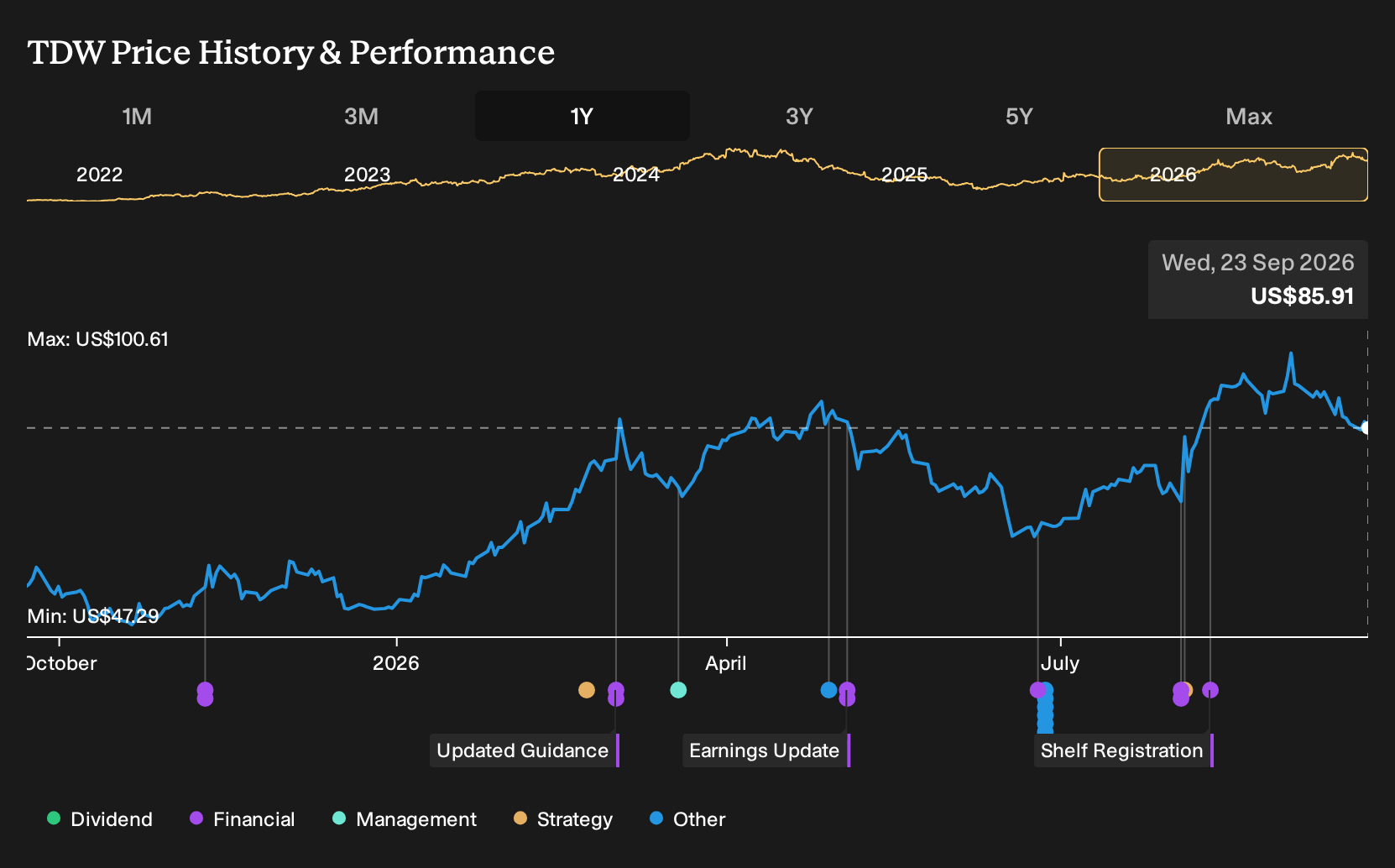
Uncover why Tidewater's fair value indicates a 10% potential upside to its current price that could narrow quickly.
Exploring Other Perspectives
The biggest swing factor in the alternate Tidewater view is conflict-related costs. Bearish analysts saw higher Middle East expenses and drydock spend squeezing margins, with earnings in 2029 at about US$290.8 million on roughly US$1.8b of revenue. That is far more cautious than consensus, and this latest earnings beat may eventually shift some of those assumptions.
Explore 4 other Tidewater fair value estimates, including one that suggests as much as 21% downside from the current price!
The Verdict Is Yours
Disagree with existing narratives? Extraordinary investment returns rarely come from following the herd, so go with your instincts.
- A great starting point for your Tidewater research is our analysis highlighting 4 key rewards and 1 important warning sign that could impact your investment decision.
- See our latest analysis for Tidewater. The report includes a comprehensive fundamental analysis summarized in a single visual, the Snowflake, making it easy to evaluate Tidewater's overall financial health at a glance.
Looking For More Ideas Beyond Tidewater?
Once you have a view on Tidewater, it can help to line it up against other opportunities with different risk and income profiles using the Simply Wall St screener.
- If you want income to do more of the heavy lifting in your portfolio, check out 7 dividend fortresses that focus on stronger yields.
- For those who prefer steadier balance sheets instead of headline growth, scan our list of solid balance sheet and fundamentals (23 results) to see which businesses line up with that preference.
- If you are hunting for underfollowed opportunities with solid fundamentals, the 16 high quality undiscovered gems can point you toward ideas that the broader market may not be watching closely yet.
This article by Simply Wall St is general in nature. We provide commentary based on historical data and analyst forecasts only using an unbiased methodology and our articles are not intended to be financial advice. It does not constitute a recommendation to buy or sell any stock, and does not take account of your objectives, or your financial situation. We aim to bring you long-term focused analysis driven by fundamental data. Note that our analysis may not factor in the latest price-sensitive company announcements or qualitative material. Simply Wall St has no position in any stocks mentioned.
Have feedback on this article? Concerned about the content? Get in touch with us directly. Alternatively, email editorial-team@simplywallst.com