


CAE (TSX:CAE) just secured a new US$300 million recompete contract with the United States Air Force, extending its role as prime contractor for C-130H aircrew training services through 2035.
Today’s CA$34.80 share price comes after a 1-day share price return of 1.02% and a 7-day share price return of 2.65%. However, the year-to-date share price return is down 18.02%, while the 3-year total shareholder return of 10.62% suggests CAE has still created value over a longer stretch, even as recent momentum has been softer.
Scan other defense and training peers that share some of CAE's contract-driven profile through our hand picked list of 8 resilient stocks with low risk scores for a different angle on resilience and downside protection.
CAE shares have slipped this year even as contracts like the new C-130H deal reaffirm its role in defense training. At today’s price, does that setback still leave enough upside to justify the risk?
Most Popular Narrative: 21% Undervalued
Relative to the narrative fair value of about CA$44.25, CAE at CA$34.80 is framed as discounted, with the story hinging on how its transformation plan, defense contracts, and multi-year training demand play out against its balance sheet and execution risks.
Rising defense spending across NATO, the EU, and Canada, combined with global modernization initiatives, is driving strong demand for simulation-based military training, a trend reflected in CAE's record defense backlog, multi-year contract wins, and opportunity pipeline, suggesting meaningful visibility into growing revenues and margin expansion.
See why 31 investors see CAE as 21% undervalued.
Result: Fair Value of CA$44.25 (UNDERVALUED)
Still, the CAE narrative relies on easing debt pressure and smoother integration of past acquisitions. Both of these factors could disappoint if costs or execution setbacks persist.
Find out about the key risks to this CAE narrative.
Another View: What CAE’s P/E Ratio Is Telling You
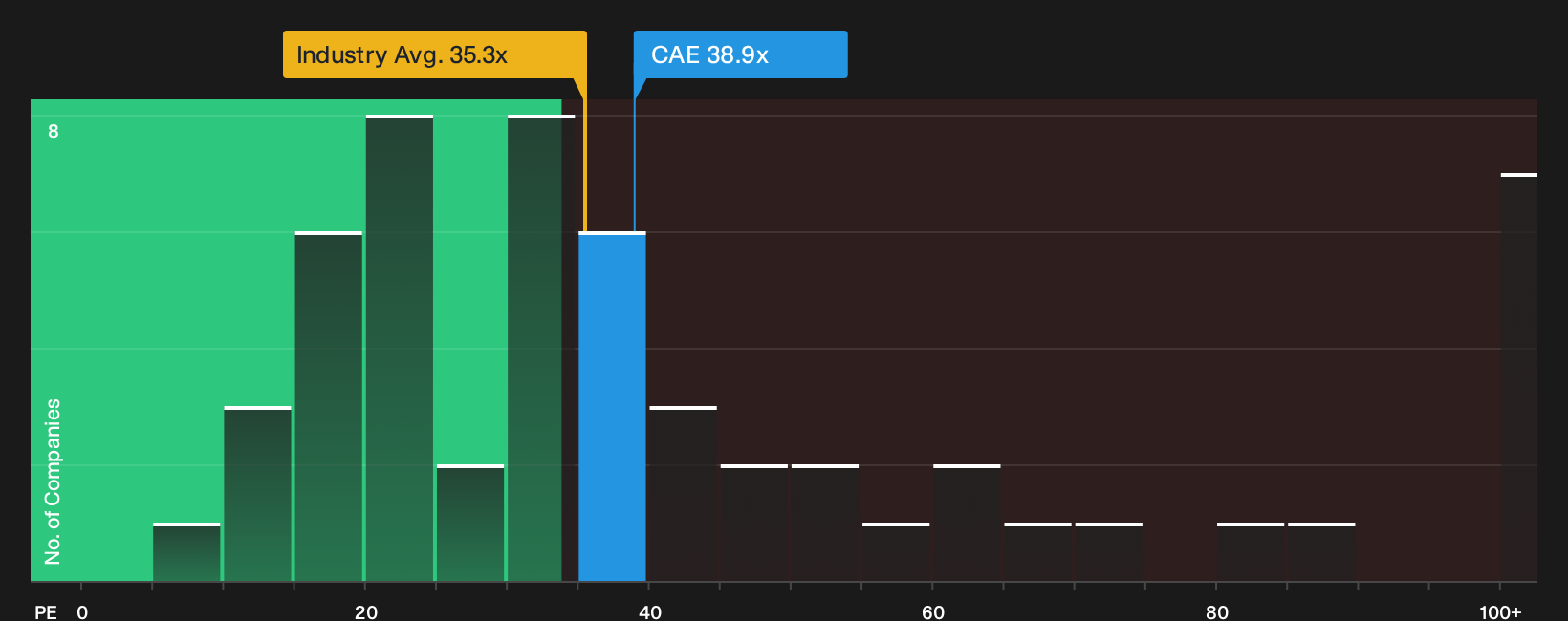
There is a catch. On P/E, CAE looks expensive. The shares trade at 38.9x earnings, compared with 35.7x for the broader North American aerospace and defense group and a fair ratio of 30.5x that the SWS model suggests the market could gravitate toward over time.
If sentiment cools or execution stumbles, that gap in multiples can matter more than any spreadsheet fair value. It raises a simple question for you as an investor: Is the current price a margin of safety, or a margin of error?
See what the numbers say about this price — find out in our valuation breakdown.
Next Steps
If the mixed signals around CAE leave you on the fence, now is the time to dig into the underlying data and pressure test your own thesis. To weigh both sides properly, start with the 3 key rewards and 2 important warning signs.
Looking for more CAE investment ideas?
If CAE has sharpened your appetite for opportunity, do not stop here. Broaden your watchlist with a few focused screens that surface very different types of potential winners.
- Hunt for priced-in pessimism by scanning a curated pool of quality stocks trading below fair value through the 5 high quality undervalued stocks.
- Zero in on resilience by reviewing a list of solid balance sheet and fundamentals (7 results) that can better withstand shocks and funding pressure.
- Spot future leaders early by checking a hand picked set of 9 high quality undiscovered gems before the crowd starts paying attention.
This article by Simply Wall St is general in nature. We provide commentary based on historical data and analyst forecasts only using an unbiased methodology and our articles are not intended to be financial advice. It does not constitute a recommendation to buy or sell any stock, and does not take account of your objectives, or your financial situation. We aim to bring you long-term focused analysis driven by fundamental data. Note that our analysis may not factor in the latest price-sensitive company announcements or qualitative material. Simply Wall St has no position in any stocks mentioned.
Have feedback on this article? Concerned about the content? Get in touch with us directly. Alternatively, email editorial-team@simplywallst.com