


Index exit puts DocuSign back under the microscope
DocuSign (DOCU) was removed from the FTSE All-World Index (USD) on 19 September 2026, a change that can reshape how index funds and benchmark-focused investors treat the stock.
The exit comes shortly after the company reported Q2 revenue growth of 9.4% year on year, lifted its outlook, and highlighted expanding use of AI agents across its agreement management platform.
Over the past year DocuSign has seen its share price move sharply in both directions, with a 90 day share price return of 49.3% but a 1 year total shareholder return that is down 17.2%. This points to momentum rebuilding after a weak stretch.
Scan how DocuSign compares to other software players showing strong price action and cleaner balance sheets using the hand-picked list of solid balance sheet and fundamentals (24 results).
DocuSign now trades only slightly below analyst targets but at a steep discount to some fair value estimates after a sharp rebound. Is that a bargain or a warning that the market's caution is warranted?
Most Popular Narrative: 10.7% Overvalued
On the most followed valuation work, DocuSign screens on the expensive side, with a fair value of $60.99 against the last close at $67.50, according to rcb9.
On a market capitalisation basis, justifying roughly $11.0 billion at a 9% discount needs about $850 million of GAAP net income in 2031. On 7% revenue growth this implies a net margin near 19%.
The buyback lowers that materially, because the same earnings are spread across fewer shares. Once you run the inputs and I can solve the constant, I will pin the exact requirement. My provisional read is that at the current repurchase pace the requirement falls to roughly 15%, which is close to the base case. This means DocuSign is priced near fair on these assumptions rather than obviously cheap or dear.
See why 6 investors see DocuSign as 11% overvalued.
Result: Fair Value of $60.99 (OVERVALUED)
Still, the whole DocuSign narrative can unravel quickly if Intelligent Agreement Management stalls below targets or if heavy share based pay keeps GAAP margins stuck.
Find out about the key risks to this DocuSign narrative.
Another View: DocuSign Through The Multiple Lens
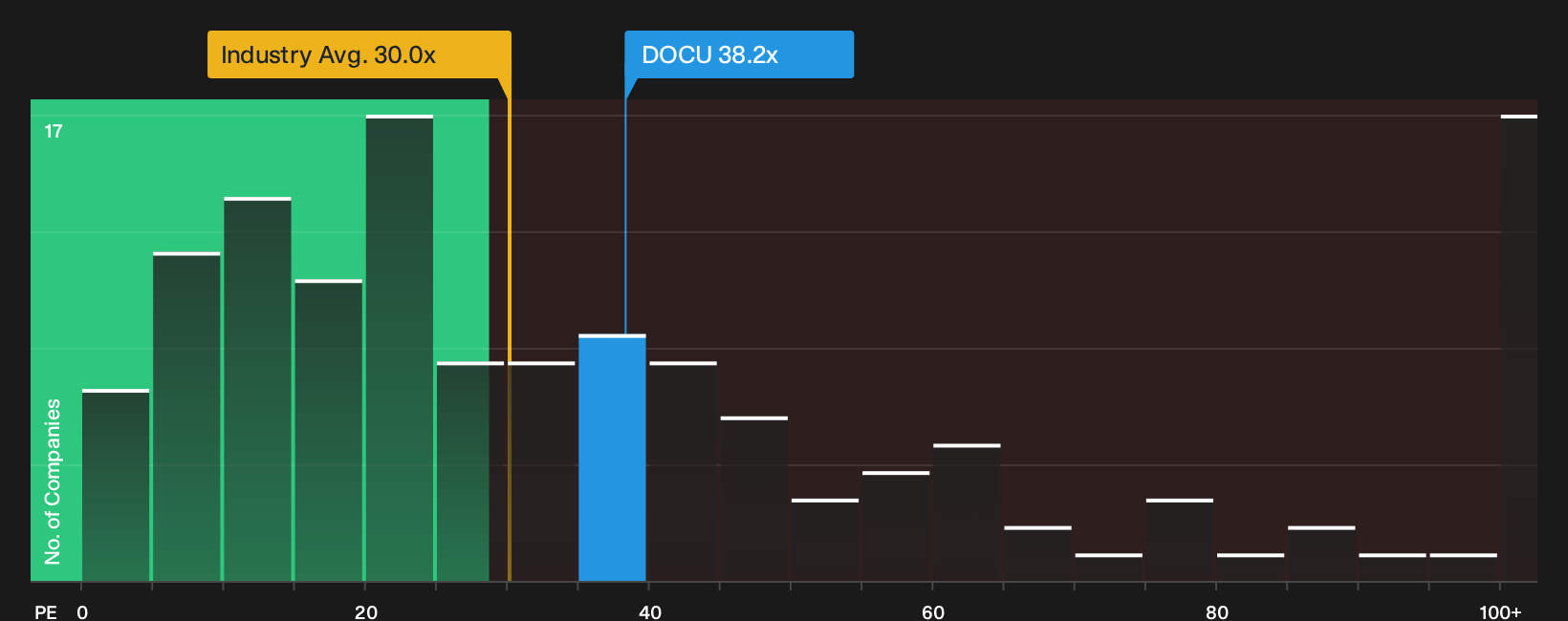
There is a very different read on DocuSign when you switch from narrative fair value work to straight comparison using earnings multiples. The stock trades on a P/E of 38.2x. That is almost identical to the 38.4x peer average but clearly above the broader US software group on 30x and also above an estimated fair ratio of 36.2x.
This mix of near peer parity, a premium to the wider industry, and a slight stretch versus the fair ratio points to both valuation risk and room for sentiment to soften if expectations slip. The question for holders is simple: which reference point matters more when the next set of results lands and the story is tested again?
See what the numbers say about this price — find out in our valuation breakdown.
Next Steps
Mixed signals around DocuSign can leave the story feeling unsettled, so move fast, pull up the data, and weigh both the potential upside and the pressure points highlighted by 3 key rewards and 1 important warning sign.
Looking for more DocuSign-sized opportunities?
If DocuSign has you thinking harder about risk and reward, widen your lens and scan other ideas that could better match your portfolio goals right now.
- Target quality at a discount by focusing on companies that combine stronger fundamentals with appealing pricing using the 32 high quality undervalued stocks.
- Prioritise resilience and steadier sleep-at-night potential by filtering for businesses that score well on financial strength through the 30 resilient stocks with low risk scores.
- Hunt for early-stage stories with robust numbers behind them instead of hype by zeroing in on the 16 high quality undiscovered gems.
This article by Simply Wall St is general in nature. We provide commentary based on historical data and analyst forecasts only using an unbiased methodology and our articles are not intended to be financial advice. It does not constitute a recommendation to buy or sell any stock, and does not take account of your objectives, or your financial situation. We aim to bring you long-term focused analysis driven by fundamental data. Note that our analysis may not factor in the latest price-sensitive company announcements or qualitative material. Simply Wall St has no position in any stocks mentioned.
Have feedback on this article? Concerned about the content? Get in touch with us directly. Alternatively, email editorial-team@simplywallst.com