


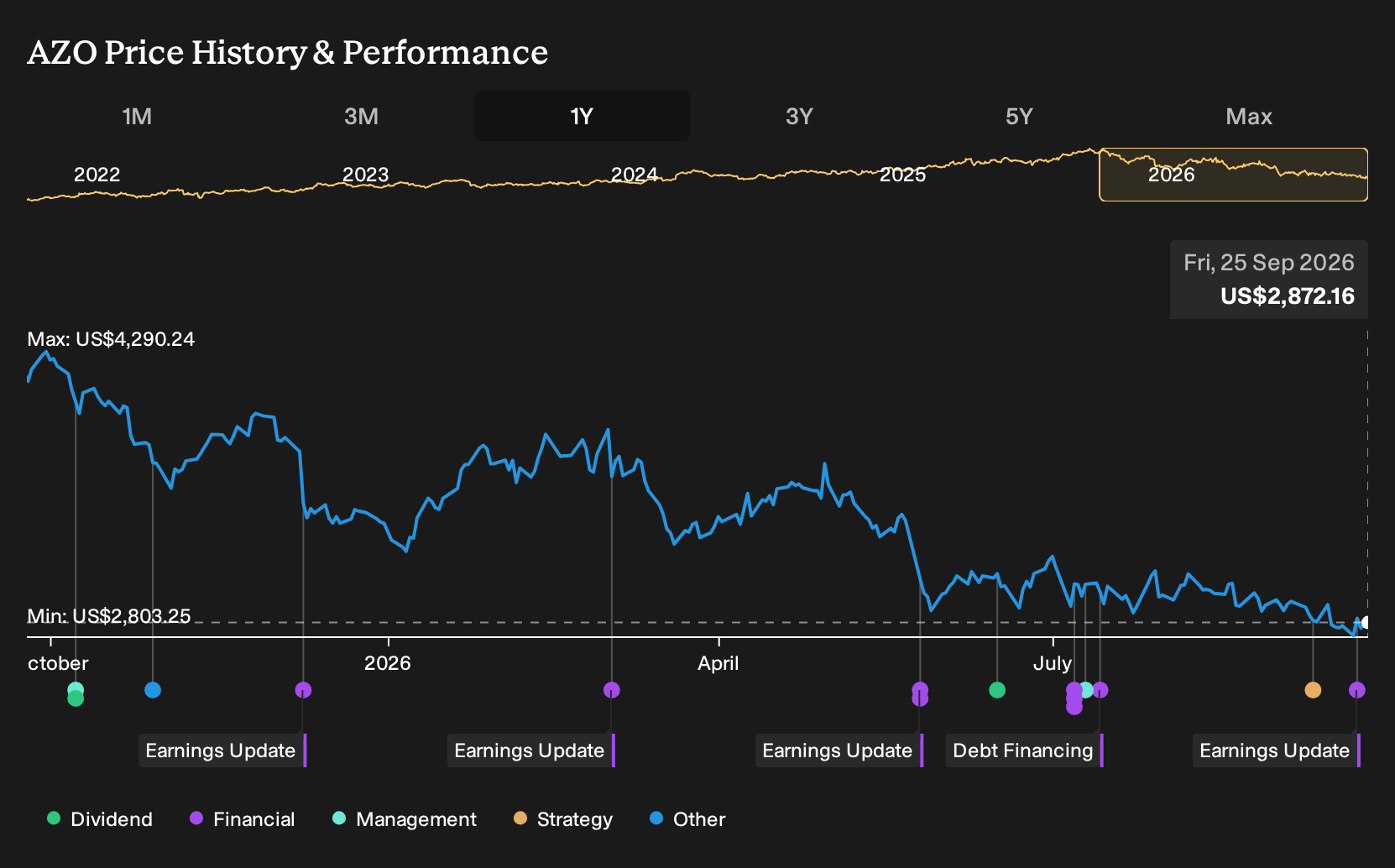
- AutoZone reported fourth quarter 2026 results in the past, with sales of US$6,594.88 million and net income of US$931.59 million. Earnings per share were higher than a year earlier as the business passed US$20 billion in annual sales and opened a record 374 stores.
- The results highlighted strong momentum in AutoZone's commercial segment, while do it yourself demand softened. This pointed to a mix shift within the core Auto Parts Stores business and raised questions about how consumer pressure and professional repair demand may shape future sales patterns.
- We will now look at how AutoZone's commercial performance and record store openings may influence its broader investment narrative.
AutoZone Investment Narrative Recap
To own AutoZone, you need to be comfortable with a retailer that relies on steady repair and maintenance demand while increasingly focusing on commercial customers. The latest quarter showed higher sales, net income and earnings per share, supported by record store openings and strong commercial momentum. That underpins the near term catalyst of execution on new locations and parts availability more than it changes the overall story.
The bigger watchpoint is consumer strain in the DIY aisle. Management has already highlighted weaker DIY transactions and deferred maintenance, which keeps inflation, tariffs and higher SG&A as meaningful risks to margins. If DIY softness broadens or foreign exchange and cost pressures persist, the balance between growth spending and profitability becomes more fragile.
The most relevant fresh data point for you is the fourth quarter 2026 earnings release. AutoZone reported US$6,594.88 million in sales and US$931.59 million in net income, with both basic and diluted earnings per share from continuing operations higher than a year earlier. Those figures accompany the milestone of passing US$20b in annual revenue.
That earnings backdrop connects directly to the main catalysts. Strong free cash flow margins and higher earnings per share give the retailer more room to fund new mega hubs, international stores and technology-focused distribution centers while continuing buybacks. The test from here is whether ongoing DIY weakness, inflation and potential tariffs reduce that flexibility faster than commercial growth and expansion can support it.
AutoZone's current analyst storyline points to US$24.9b in revenue and US$3.3b in earnings by 2029. That framework reflects analyst expectations of 7.6% yearly revenue growth and an earnings increase of about US$0.8b from US$2.5b today.
Uncover how AutoZone's fair value indicates a 35% potential upside to its current price that could narrow quickly if sentiment around AutoZone shifts.
Exploring Other Perspectives
Simply Wall St Community members offer three fair value estimates for AutoZone, ranging from about US$2,860 to nearly US$3,870 per share, which is a wide gap for the same stock. That spread appears alongside risks around tariffs, inflation and foreign exchange, so you are seeing sharply different views on how this business handles pressure. Use those contrasting opinions as a prompt to explore multiple angles before deciding how AutoZone fits your own portfolio framework.
Explore 2 other AutoZone fair value estimates, including one that suggests potential upside of as much as 35% from the current price!
Form Your Own Verdict
Don't just follow the ticker; dig into the data and build a conviction that's truly your own.
- A great starting point for your AutoZone research is our analysis highlighting 3 key rewards and 2 important warning signs that could impact your investment decision.
- See our latest analysis for AutoZone. The report includes a comprehensive fundamental analysis summarized in a single visual, the Snowflake, making it easy to evaluate AutoZone's overall financial health at a glance.
Looking For More Investment Ideas Beyond AutoZone?
If AutoZone helps you frame what quality looks like in an auto parts retailer, use that lens to size up other listed businesses with the Simply Wall St Screener. You can filter by balance sheet strength, income focus or lower risk profiles so you are not just following headlines but building a watchlist that actually fits your goals.
- If capital preservation is a priority, start with sturdier businesses by scanning our 30 resilient stocks with low risk scores that have historically shown more resilient risk scores.
- For investors focused on income, look for stocks that combine yield with staying power by checking out our 8 dividend fortresses that aim to pair payouts with balance sheet support.
- When you want to spot potential future leaders before they become widely followed, search through our 16 high quality undiscovered gems and see which fundamentals catch your eye.
This article by Simply Wall St is general in nature. We provide commentary based on historical data and analyst forecasts only using an unbiased methodology and our articles are not intended to be financial advice. It does not constitute a recommendation to buy or sell any stock, and does not take account of your objectives, or your financial situation. We aim to bring you long-term focused analysis driven by fundamental data. Note that our analysis may not factor in the latest price-sensitive company announcements or qualitative material. Simply Wall St has no position in any stocks mentioned.
Have feedback on this article? Concerned about the content? Get in touch with us directly. Alternatively, email editorial-team@simplywallst.com