


The Wendy's Company (WEN) is known for square burgers, Frostys, and a cheeky personality that has long helped it stand out in the crowded fast-food world. But lately, the fast-food chain has been dealing with a much less appetizing problem: Diners are pulling back, value has become a bigger priority, and Wendy’s has struggled to keep sales moving in the right direction. Same-store sales have declined for six consecutive quarters, while a revolving door of CEOs has made the company's turnaround strategy harder to pin down. Now, one of its biggest U.S. franchisees has waved an even bigger red flag.
Meritage Hospitality, which operates 314 Wendy’s restaurants across 15 states, recently filed for Chapter 11 bankruptcy protection, citing pressure from weaker demand and deteriorating restaurant economics. The franchisee said store-level EBITDA plunged, hit by higher beef costs and aggressive discounting. There’s also another awkward detail — Wendy’s itself is Meritage’s largest unsecured creditor with about $24.9 million in deferred franchise fees.
For shareholders, that makes this more than a franchisee problem. It offers a closer look at the financial strain building inside the restaurant system. Meanwhile, WEN stock is already in the red in 2026, and the company recently cut its quarterly dividend in half as management pointed to weaker traffic and franchisee pressures.
Is Meritage’s bankruptcy a one-off setback? Or a warning sign for the broader business? Let’s take a closer look at what happened and what could be next.
About Wendy’s Stock
Founded in 1969 and headquartered in Dublin, Ohio, Wendy’s is one of the world’s major quick-service restaurant brands. Known for its square hamburgers, fresh beef, and Baconator, Wendy’s operates through a largely franchise-driven model. Its network includes restaurants across both the U.S. and international markets.
The company also owns and leases real estate and supports the Dave Thomas Foundation for Adoption. Today, Wendy’s serves customers worldwide while navigating an increasingly competitive fast-food market. Its market capitalization currently stands at $1.24 billion.
Lately, Wendy's stock has been looking less like a juicy burger and more like one left under the heat lamp for too long. Shares have fallen 28% over the past 52 weeks, including a steep drop over the past month. In 2026 alone, WEN stock is down 21%.
The latest selloff came after major franchisee Meritage filed for Chapter 11 bankruptcy protection. That added another layer of pressure to an already uneasy story.
WEN stock also took a hit in late August after Trian Fund Management halted plans for a take-private deal. Reuters reported that Trian had concerns about “performance, valuation, and strategic direction,” although the door could remain open to a future bid. For now, that leaves CEO Bob Wright with more time to work on the turnaround, but investors clearly are not giving him a free side of fries.
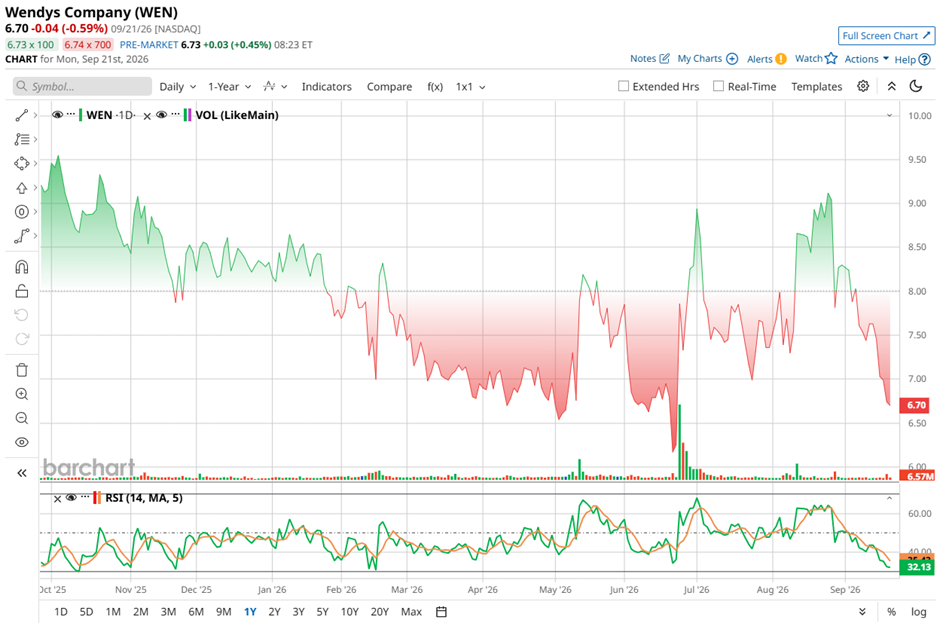
WEN stock may look like a bargain on paper, but there’s a reason the market is keeping the price tag low. The stock is priced at 13.5 times forward earnings and 0.59 times sales, below both the sector averages and its own historical median. Investors are being asked to weigh that cheaper valuation against a business still working through weaker traffic and franchisee pressure.
The dividend story has also changed. The fast-food chain recently halved its quarterly payout to $0.07 per share, citing declining customer traffic and weaker franchisee profitability. That puts the annualized dividend at $0.28 per share, translating into a forward yield of roughly 4.16%. The latest dividend was paid on Sept. 15.
A Snapshot of Wendy’s Q2 Numbers and Outlook
Wendy’s second-quarter results offered a classic case of an earnings beat that looked better on the surface than underneath. Revenue came in at $570.6 million, up 1.7% year-over-year (YOY) and ahead of consensus, while adjusted EPS of $0.18 also topped projections. But the underlying numbers told a tougher story. Adjusted revenue fell 1.4% to $443.2 million as franchise royalty revenue weakened, while adjusted EPS dropped 38% YOY.
The pressure was even clearer at the restaurant level. U.S. same-restaurant sales fell 7% in Q2, with domestic systemwide sales down 8.2% and global systemwide sales declining 6.5% to roughly $3.4 billion. Higher commodity costs, rising labor rates, softer traffic, and weaker royalty revenue pushed adjusted EBITDA down 15.4% to $124.1 million.
Wendy’s footprint is shrinking, too. The company opened 21 U.S. restaurants during the quarter, but its domestic system contracted by 81 locations on a net basis, bringing first-half net closures to 245.
There are still some financial cushions. First-half operating cash flow rose about 10% to $160 million, while free cash flow increased 10% to $120.3 million. Wendy’s ended the quarter with $341.2 million in cash against $2.72 billion of long-term debt, while net interest expense climbed to $33.9 million during the quarter.
For now, management is also keeping the buyback button untouched, with no repurchases in Q2 and about $35 million remaining under its authorization as of July 31.
Wendy’s recently cut its dividend as part of an effort to free up cash for its turnaround plans, giving management greater flexibility to fund strategic initiatives. At the same time, the company withdrew its full-year outlook, allowing management more time to assess the business, determine where it stands, and develop a detailed plan for the future. That includes taking a fresh look at how capital should be allocated as Wendy’s works to stabilize the business and address its current challenges.
Analysts tracking Wendy’s currently expect the company to generate about $533 million in revenue and roughly $0.10 in EPS for Q3. For fiscal 2026, the consensus calls for EPS of about $0.50, down 43% YOY. Looking ahead to fiscal 2027, analysts expect EPS to remain around the same level, suggesting a recovery could take time.
What Are Analysts Saying About WEN Stock?
The pressure on Wendy’s is getting harder for Wall Street to ignore. Seaport Global recently initiated coverage on WEN stock with a “Neutral” rating, pointing to weakening sales and profitability. The company has already pulled its 2026 outlook and slashed its dividend, underscoring just how challenging the current environment has become.
Wendy’s is also not expecting a quick rebound, saying systemwide sales are unlikely to return to growth in Q3 or Q4. Seaport’s take is even more sobering; the firm believes Wendy’s fundamentals are rapidly deteriorating at an unprecedented pace. For investors, that leaves the turnaround with plenty to prove.
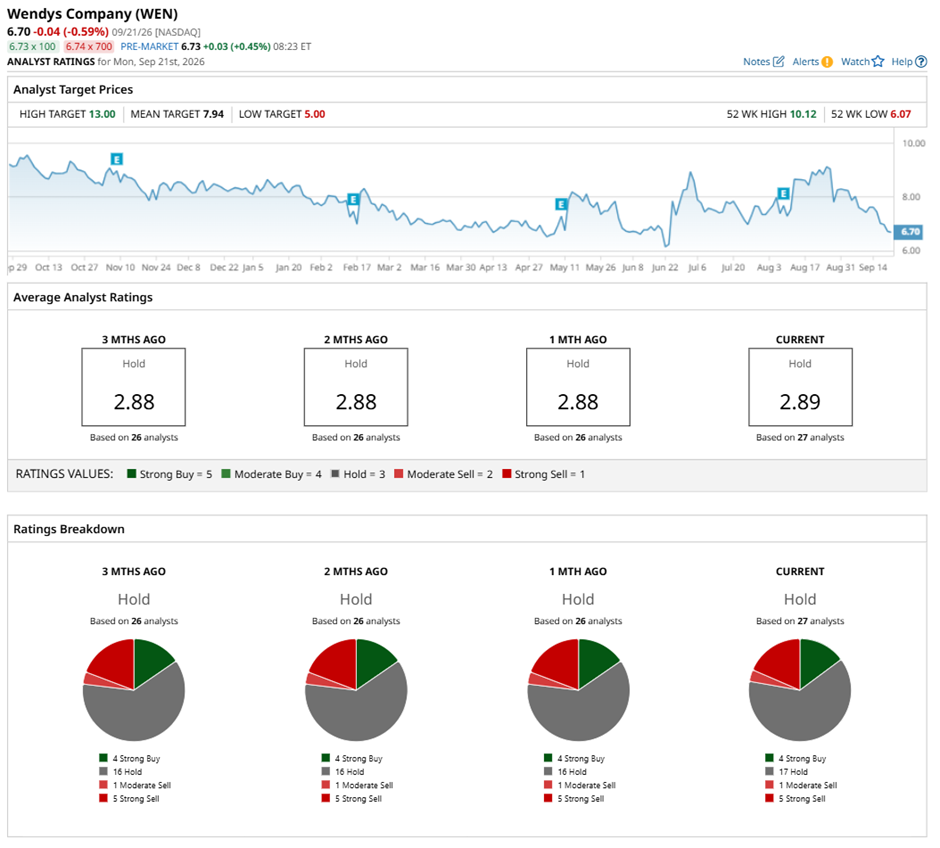
Wall Street is not exactly rushing to the drive-thru for Wendy’s. WEN stock currently has a consensus “Hold” rating based on 27 analysts with coverage. Of those analysts, four have a “Strong Buy” rating, 17 have a “Hold” rating, one analyst has a "Moderate Sell" rating, and five analysts have an outright “Strong Sell.” That split reflects the uncertainty surrounding the company's turnaround.
Still, Wall Street sees some room for recovery. The average price target of $7.94 implies about 21% potential upside from current levels, while the most bullish target of $13 points to a potential gain of roughly 98% from here. For now, analysts appear to be waiting for Wendy’s strategy to translate into better traffic and franchise economics.
On the date of publication, Sristi Suman Jayaswal did not have (either directly or indirectly) positions in any of the securities mentioned in this article. All information and data in this article is solely for informational purposes. For more information please view the Barchart Disclosure Policy here.