


SK Hynix (SKHY), a South Korean semiconductor company, may be looking at an unusual shortcut into U.S. memory manufacturing. Reuters reported the company is exploring possible ways to manufacture memory chips in the U.S., one of which could include Intel’s (INTC) delayed Ohio semiconductor fab. But there is an important caveat. SK Hynix has explicitly said that no specific plans or arrangements have been finalized regarding the reported scenarios, including cooperation with Intel or memory-chip production in the U.S. So this is not a confirmed deal.
It is, however, a potential scenario worth considering if the companies eventually decide to move forward. The timing makes this possibility interesting as SK Hynix is expanding production to keep up with demand from the AI-driven memory boom, while the company has already established a U.S. manufacturing presence through its Indiana HBM facility.
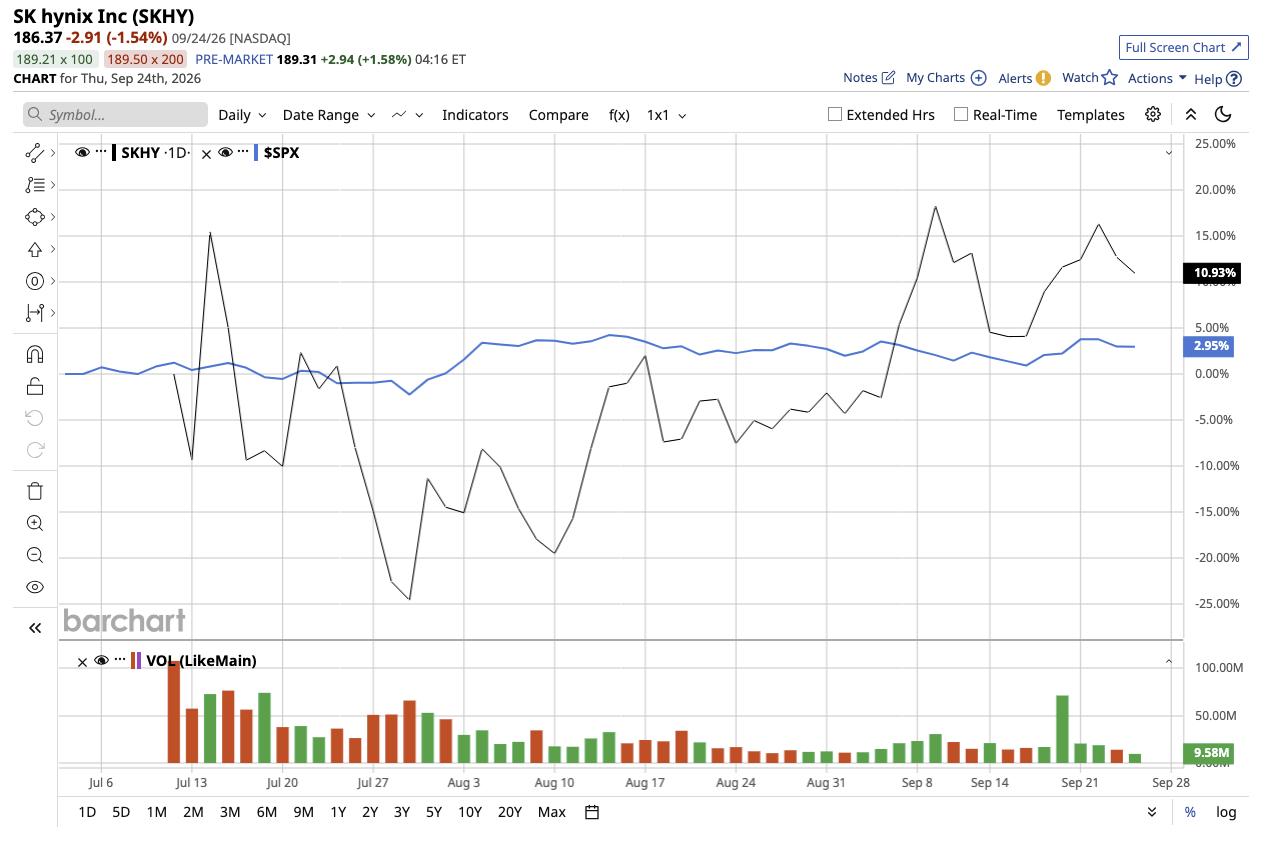
For SKHY investors who just gained direct access to the memory-chip giant through its recent Nasdaq ADR listing, will a potential U.S. manufacturing opportunity add another long-term growth angle to an already strong AI-memory story?
Let’s explore the possibility.
Why Intel’s Ohio Project Matters
According to Reuters, three people familiar with the matter reported that SK Hynix and Intel were exploring a potential arrangement that could result in SK Hynix manufacturing memory chips on U.S. soil for the first time. One possible option would be SK Hynix leasing part of Intel’s planned Ohio facility. Another possibility could involve a venture between Intel, SK Hynix, and major cloud companies looking to secure memory supplies.
Neither scenario has been confirmed by the companies. In fact, SK Hynix said it is “exploring various options to strengthen its global competitiveness,” but that no decisions have been made regarding the two scenarios described in the report.
Intel has long committed plans to rebuild its position as a leading U.S. semiconductor manufacturer. The company originally had announced more than $28 billion for two leading-edge fabs in Ohio. However, Intel believes the nearly 1,000-acre site could eventually support as much as $100 billion of investment at full buildout. The $100 billion investment is actually across its U.S. manufacturing network, including Ohio, Arizona, New Mexico, and Oregon. Intel sees domestic manufacturing as an important part of its comeback strategy, particularly as the U.S. tries to reduce its reliance on overseas semiconductor production. However, the Ohio project has been moving slower than originally planned, and the first fab is now expected to be completed in 2030 and begin operations between 2030 and 2031.
That delay is what has potentially given room for these possibilities for SK Hynix. If Intel's Ohio project has excess capacity, another semiconductor company, such as SK Hynix, might hypothetically gain access to that infrastructure. That said, SK Hynix doesn’t need the Ohio project to build a U.S. presence. The company has already started construction of an advanced packaging facility in West Lafayette, Indiana, backed by an investment of more than $4 billion. The company says the site will serve as its first U.S. base for HBM production, with mass production of next-generation HBM expected to begin in the second half of 2029. HBM, or high-bandwidth memory, is a high-speed memory technology crucial for AI processors, and SK Hynix is working to strengthen its position in this fast-growing market as it competes with rivals such as Micron Technology (MU) and SanDisk (SNDK).
In its second quarter, SK Hynix highlighted that AI infrastructure investment continues to drive demand for high-value memory. DRAM average selling prices increased by roughly 30% in Q2, while NAND average selling prices rose in the mid-50% range. Management said HBM4 mass-production shipments began in the second quarter and that production would ramp further during the second half of 2026. The company also said HBM4E samples had been supplied to major customers, with volume production targeted for 2027. The company reported a 257% year-over-year increase in total revenue to KRW 79.3 trillion.
If the Ohio arrangement ever becomes a possibility, SK Hynix will end up with a much broader U.S. manufacturing footprint spanning both memory production and advanced packaging. It could also provide more geographic diversification, since its largest manufacturing facilities are now in South Korea and China.
However, Reuters says manufacturing semiconductors in the U.S. can be substantially more expensive than manufacturing in South Korea because of higher labor and construction costs. Therefore, for any potential U.S. project, SK Hynix will have to balance those higher costs against the strategic benefits of manufacturing closer to U.S. customers.
What It Could Mean for SKHY Stock
If the Ohio opportunity ever becomes a real agreement, it won’t immediately boost SK Hynix’s earnings. Instead, it could potentially expand the company's U.S. manufacturing footprint, strengthen its relationship with American AI infrastructure customers, and diversify its production base. But the bigger story for SK Hynix is that it is expanding HBM capacity, investing heavily in new production facilities, and building its first U.S. HBM production base.
If Intel’s Ohio project eventually becomes a platform that SK Hynix can use, it could add another dimension to its long-term growth story. But for now, it remains a possibility and not a deal.
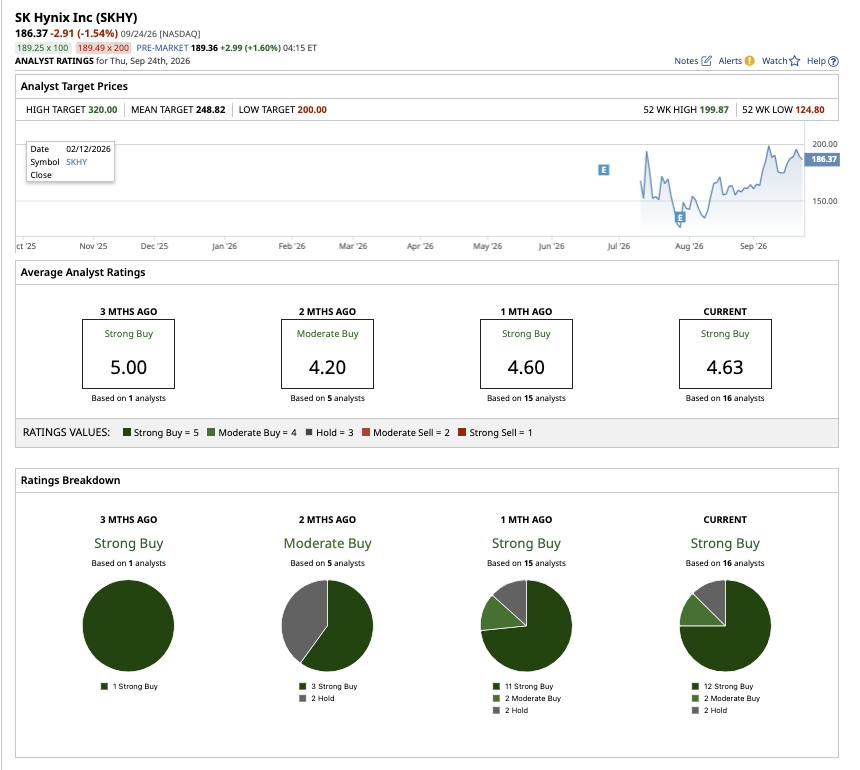
On Wall Street, SK Hynix holds a consensus “Strong Buy” rating. Of the 16 analysts covering the stock, 12 have a “Strong Buy” rating, two have a “Moderate Buy,” and two suggest a “Hold” rating. Based on its average target price of $248.82, analysts expect the stock to rise 33.5% from current levels. But its high price estimate of $320 suggests the stock could climb by 71% over the next 12 months.
On the date of publication, Sushree Mohanty did not have (either directly or indirectly) positions in any of the securities mentioned in this article. All information and data in this article is solely for informational purposes. For more information please view the Barchart Disclosure Policy here.