


The Zhitong Finance App learned that on Wall Street, few people chose to turn around and go long during the darkest hour of the bond market. But Jim Bianco did it.
This macro strategist with over 40 years of experience working at First Boston and UBS is now at the helm of Bianco Research in Chicago. Since 10-year US Treasury yields hit a record low of 0.3% during the height of the pandemic in 2020, he has been one of the staunchest bears in the bond market. However, now, as the benchmark yield soars to a nearly 20-year high, he has let go of his bearish fist for the first time and gradually established long positions with a “value buying” attitude.
“It's a value deal. If the yield continues to rise, I will continue to buy,” Bianco said.
Bianco's shift is notable because he was once the harshest critic of the bond market.
The analysis he published on Substack shows that as of this summer, the return on investment in US long-term treasury bonds had fallen to -1.85%, the worst performance since 1803. In the 223-year history since 1793, the total number of months with negative returns on long-term treasury bonds was only 25 months, of which 24 were concentrated in the current cycle — the only exception was December 1959, when the return rate was -0.08%.
What also alerted the market was the “standoff” between the US debt market and the Federal Reserve, which lasted nearly two years. Since the Federal Reserve began the interest rate cut cycle in September 2024, the 10-year US Treasury yield has instead climbed 98 basis points. Bianco pointed out that since 1971, the 10-year yield increase has only occurred twice in the Fed's interest rate cut cycle: the one in 1980 only lasted 119 days, and this time has continued for nearly two years.
“For the past two years, the market has been shouting at the Federal Reserve: 'Wrong policy, wrong policy! '” Bianco said.
Multiple forces reshape the pricing logic of the bond market
The driving forces behind this round of sell-off of US bonds are complex and far from being explained by a single factor.
Inflationary stickiness poses the primary pressure. According to the University of Michigan Consumer Confidence Survey, the one-year inflation forecast jumped to 4.6% in September, up from 4% in August, the highest reading since June. Meanwhile, the situation in the Middle East boosted oil prices above $100 per barrel, further strengthening the market's concerns about inflation.
Fiscal deficits and supply shocks are a secondary source of pressure. The total debt of the US federal government is approaching 40 trillion US dollars, and the total federal budget deficit for the first 10 months of fiscal 2026 reached 1.8 trillion US dollars. The massive issuance of treasury bonds and the supply of corporate bonds brought about by AI infrastructure construction — according to Vanguard estimates, Google (GOOGL.US), Amazon (AMZN.US), Meta (META.US), Microsoft (MSFT.US), and Oracle (ORCL.US) have issued about US$132 billion in debt as of July, far exceeding the annual average of about US$35 billion between 2020 and 2024. Broader AI-related bond issuance could reach $300 billion to $570 billion this year.
The structural weakening of overseas demand is the third pressure. For example, Japan, as the largest overseas holder, recently reduced its holdings of US debt to support the yen exchange rate. Rising foreign interest rates are weakening a key source of demand for US debt.
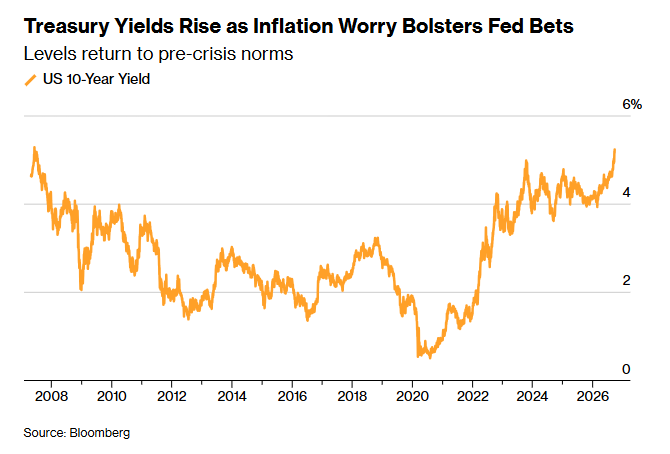
Under the combination of these forces, the 10-year US Treasury yield soared to 5.27% this week, the highest level since 2007. The 30-year yield surpassed 5.5%, the highest since 2004. The “bond police” in the market have pressured policymakers to restore fiscal discipline by continuing to sell long-term treasury bonds.
Watch more logic
Although there may be room for further continuation of this round of sell-off, Bianco said that the yield for most terms exceeds 5%, making the risk-reward ratio of holding bonds more and more attractive.
A key part of Bianco's bullish logic is a fundamental shift in the direction of the Federal Reserve's policy.
Walsh was sworn in as the chairman of the Federal Reserve on May 22 this year to replace Powell. The new chairman has a clear stance on inflation — when asked about the Federal Reserve's attitude towards inflation, he gave a two-word answer: “zero tolerance.”
This month, the FOMC raised the benchmark interest rate by 0.25 percentage points from 3.50%-3.75% to 3.75%-4.00%. This is the first rate hike since July 2023. The interest rate swap market shows that traders have set interest rate hikes of 25 basis points nearly four times in the next 12 months, which will push the policy interest rate to about 5%.
Bianco sees this as a key turning point. He believes that only when the Federal Reserve begins to take inflation seriously and starts a cycle of interest rate hikes can long-term yields actually peak. This judgment is based on historical observations of bond market behavior: the market continues to push up long-term yields, essentially a “vote of no confidence” over the Federal Reserve's previous excessively loose policies.
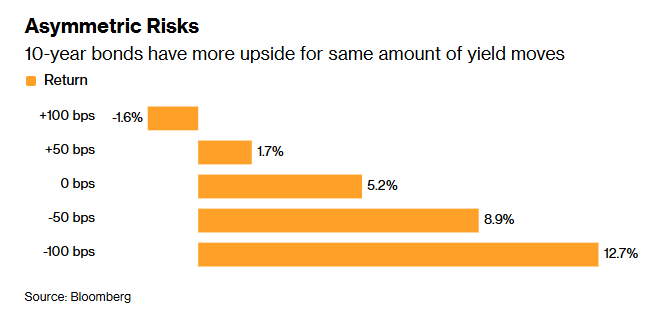
According to Bianco, the core appeal of the current bond market is not directional judgment, but rather the significant asymmetry in the return structure.
Compiled data shows that when investors buy 10-year US bonds at the current level, they need to see the yield rise to about 6% within the next year before price losses completely offset coupon income. In other words, the yield would need to rise by about 75 basis points before investors could face a net loss. However, the distribution of returns is also skewed: for every percentage point of decline in yield, it will bring about 13% of return; conversely, for every percentage point of increase in yield, the loss is less than 2%.
This asymmetry between return and risk forms what Bianco calls a “thick buffer.” In particular, he emphasized that the current market sentiment is extremely skewed — “everyone is ridiculously bearish on the bond market” — and this extreme sentiment itself often means that pricing already contains too many pessimistic expectations.
From a longer-term historical perspective, Bianco believes that current yield levels reflect more a return to historical normality than a sign of economic hardship. He pointed out that since its peak in 1981, the average yield on 10-year US Treasury bonds has been around 5.3%, which is roughly equivalent to the current level. “We are returning to normal,” he said. “Zero interest rates from 2010 to 2020 are ridiculous outliers.”
Bianco's analysis based on the R-squared regression model further supports this judgment. The R square value between bond yield and return on investment has reached 0.85 since 1914 (the year after the establishment of the Federal Reserve), which means that the current yield level of 5% or more is 85% explanatory for predicting an annualized return of about 5% over the next ten years.
In the current environment, Bianco sees an opportunity to gradually increase exposure rather than aggressive betting. His views are reflected in the $100 million WisdomTree Bianco Total Return Fund, which tracks an actively managed bond index he launched in 2023. Since December 2023, the index has achieved an annualized return of 2.6%, while the Bloomberg Benchmark Index rose 2.32%. The WisdomTree ETF has a fee rate of 0.6% and returns of around 2.1%.
Notably, Bianco has raised the duration of the index it manages to more than 6 years from the previous level, which is higher than the 5.7 year period of the Bloomberg Composite Bond Index. The prolonged lengthening means that his bets on the downward direction of interest rates are increasing — a substantial sign of a shift from “wait and see” to “layout.”
“I'm entering the venue tentatively,” Bianco said. This statement is highly consistent with his analytical framework: instead of calling on investors to do their best to go long, he emphasizes gradually increasing exposure at high yields in exchange for time in exchange for coupon income and safety margins.