


- Apollo Global Management has reportedly explored selling marine infrastructure operator Energos Infrastructure Management for about US$3b and is also rumored to be a potential buyer of Johnson & Johnson’s medical device unit DePuy Synthes for about US$20b.
- The mix of a prospective US$3b infrastructure exit and a possible US$20b healthcare acquisition highlights how Apollo Global Management is reassessing portfolio risk and capital allocation while private credit sector pressures build.
- We will now look at how private credit stress tied to rising US Treasury yields could reshape Apollo Global Management’s investment narrative.
Scan how Apollo Global Management’s repositioning compares with other capital allocators that are reshaping portfolios under higher yields by reviewing the hand-picked 30 resilient stocks with low risk scores.
Apollo Global Management Investment Narrative Recap
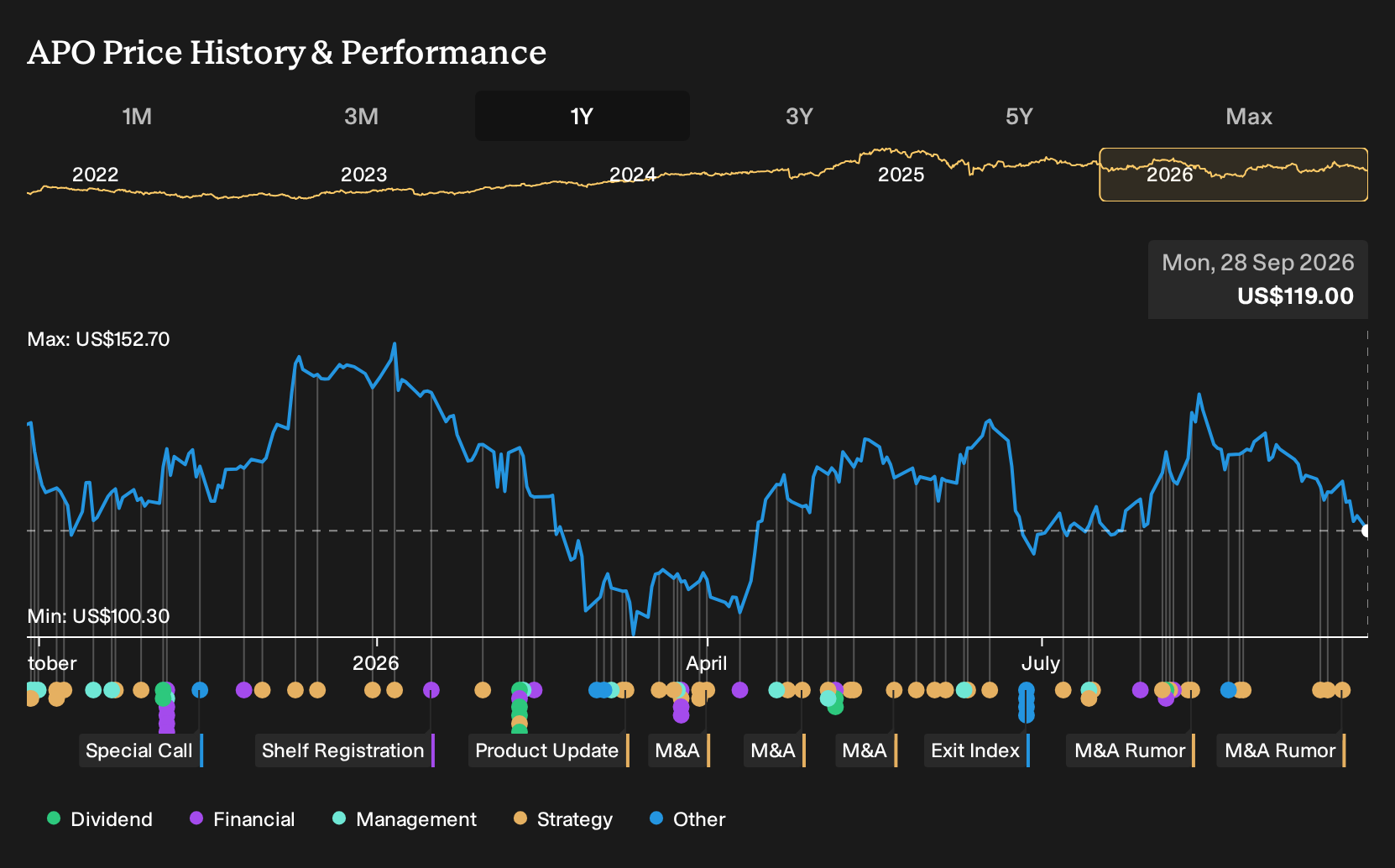
To own Apollo Global Management, you need to believe its mix of credit, retirement services and alternatives can still compound earnings even as higher US Treasury yields pressure portfolio companies and private credit valuations. The stock has pulled back from recent highs and 1 year total return is down about 13%, so sentiment already reflects some of that strain.
The key near term swing factor is whether Apollo can keep raising and deploying capital into credit and retirement products without compressing spreads or taking on outsized risk. Execution missteps or further pressure on profit margins, which sit around 5.3% versus 13.7% last year, remain the biggest operational risk.
The Energos Infrastructure sale rumor is the most relevant recent development here. A full or partial exit around US$3b would test Apollo’s ability to recycle capital out of energy infrastructure into areas aligned with its focus on credit, retirement flows and the so called global industrial renaissance without disrupting fee streams.
For you as an investor, the useful lens is execution. If Apollo can complete an Energos transaction while keeping fee related earnings on track and maintaining discipline on funding, which is fully reliant on higher risk external borrowing, that supports the existing catalyst of scaling origination. If bids fall short or terms are weak, it would underline how fragile private credit and infrastructure valuations are under higher yields.
Apollo Global Management Analyst Case Under Private Credit Pressure
Apollo Global Management's analyst narrative rests on some unusually sharp assumptions. Revenue is modeled to decline by 64.6% each year over the next three years, even as analysts project an aggressive step up in profitability. That combination is rare. It effectively assumes the firm can lean much harder on fee and investment income while top line activity shrinks.
Profit margins are expected to move from 12.4% today to a very large level in three years. For you as a shareholder, that implies analysts are baking in a mix of richer fee economics, higher contribution from spread income and cleaner underwriting outcomes across private credit and retirement products. It also means any slip in underwriting discipline, funding costs or default trends could have an outsized impact on the thesis.
On earnings, the consensus points to US$3.1b today rising to US$6.6b by 2028, which is a bit more than a 2x increase. That jump is paired with modest share count reduction of about 0.67% a year, so per share earnings growth depends more on how effectively Apollo Global Management compounds spread income and monetizes existing funds than on financial engineering. In an environment where private credit marks are under scrutiny, that reliance on execution is central.
Valuation expectations also carry clear conditions. To line up with the current consensus price target of US$161.86, you would need to accept that by 2028 Apollo Global Management can generate US$1.1b of revenue and US$6.6b of earnings while trading on a 17.3x P/E multiple. That multiple is slightly higher than the cited 17.2x for the broader US diversified financials group, so the forecast implicitly assigns a small quality premium to the business model despite private credit sector stress and higher Treasury yields.
Apollo Global Management's narrative projects US$1.1b revenue and US$6.6b earnings by 2028. This requires a 64.6% yearly revenue decline and a bit more than a 2x earnings increase from US$3.1b today.
Uncover why Apollo Global Management's fair value indicates a 33% potential upside to its current price that could close more quickly than many investors expect.
Exploring Other Perspectives
The Simply Wall St Community currently offers 2 fair value views on Apollo Global Management, clustered tightly between about US$153 and US$171, so no one is calling extreme mispricing. Those retail forecasts were formed before the Energos and DePuy Synthes deal chatter, which could shift expectations on earnings quality, balance sheet risk and longer term performance. If you want context beyond the market’s latest reaction to private credit worries and AI related project delays, explore these different viewpoints to see how other investors frame the trade off between execution risk and potential catalysts.
Explore another Apollo Global Management fair value estimate, including one that suggests it could be worth just $153.47!
The Verdict Is Yours
Don't just follow the ticker. Dig into the data and build a conviction that's truly your own.
- A great starting point for your Apollo Global Management research is our analysis highlighting 3 key rewards and 2 important warning signs that could impact your investment decision.
- See our latest analysis for Apollo Global Management. The report includes a comprehensive fundamental analysis summarized in a single visual, the Snowflake, making it easy to evaluate Apollo Global Management's overall financial health at a glance.
Looking for more Apollo Global Management sized ideas?
If this Apollo Global Management story has sharpened your thinking and you want to cast a wider net, the Simply Wall St Screener can help you focus on other stocks that fit the kind of risk and return profile you care about.
- If capital protection matters most to you, filter for companies that score well on resilience and balance sheet strength using the 30 resilient stocks with low risk scores.
- If you want businesses that combine quality with room to rerate, scan through the 16 high quality undiscovered gems that may not yet be widely followed.
- If you prefer to get paid while you wait, narrow the field to higher yielding opportunities by reviewing the 6 dividend fortresses that match your income targets.
This article by Simply Wall St is general in nature. We provide commentary based on historical data and analyst forecasts only using an unbiased methodology and our articles are not intended to be financial advice. It does not constitute a recommendation to buy or sell any stock, and does not take account of your objectives, or your financial situation. We aim to bring you long-term focused analysis driven by fundamental data. Note that our analysis may not factor in the latest price-sensitive company announcements or qualitative material. Simply Wall St has no position in any stocks mentioned.
Have feedback on this article? Concerned about the content? Get in touch with us directly. Alternatively, email editorial-team@simplywallst.com