


- Ford Motor halted F-150 production at the Dearborn Truck Plant and some Kansas City Assembly shifts in late September due to a supplier-related logistics outage, with management planning overtime and a new third crew at Dearborn to recoup lost output in 2026.
- The disruption highlights how concentrated supplier links can strain Ford Motor's truck segment, even as the company seeks to increase F-150 capacity with added staffing.
- This article examines how Ford Motor's investment narrative holds up when a key F-150 supplier issue briefly interrupts flagship truck production.
Scan how Ford Motor stacks up against other manufacturers facing similar production and policy crosswinds by reviewing our hand picked list of solid balance sheet and fundamentals (25 results).
Ford Motor Investment Narrative Recap
To own Ford Motor today, you need to be comfortable with a business that still leans heavily on trucks, SUVs and commercial vehicles while trying to reset its EV and software plans. The short supplier outage on F-150 output looks operational rather than demand driven, so it mainly tests how resilient Ford’s manufacturing and logistics playbook really is.
The key near term checkpoint is Q3 earnings in late October, which should show whether lost F-150 units are largely recovered through overtime and the added Dearborn crew. The bigger risk remains execution on EV and hybrid product timing, while managing high investment needs alongside debt and dividend commitments.
The recent shift in U.S. fuel economy rules is the announcement that feels most relevant here. Looser standards lower the regulatory pressure to push EV volumes at all costs, which gives Ford Motor more room to lean into profitable ICE and hybrid trucks like the F-150 without the same compliance strain that existed under prior rules.
That extra flexibility cuts both ways for investors watching catalysts. It can support near term mix and pricing on trucks, yet it also increases uncertainty around long run EV share, where Ford is already juggling delays and re-scoped programs and using licensed CATL battery technology in Michigan under political scrutiny. Your view on that execution risk is central to any thesis.
Ford Motor's current earnings are a loss of US$7.4b, while analysts expect earnings to reach US$16.2b by 2029 on forecast revenue of US$192.2b. This implies a change in earnings of about US$23.6b over that period, with revenue projected to remain broadly flat.
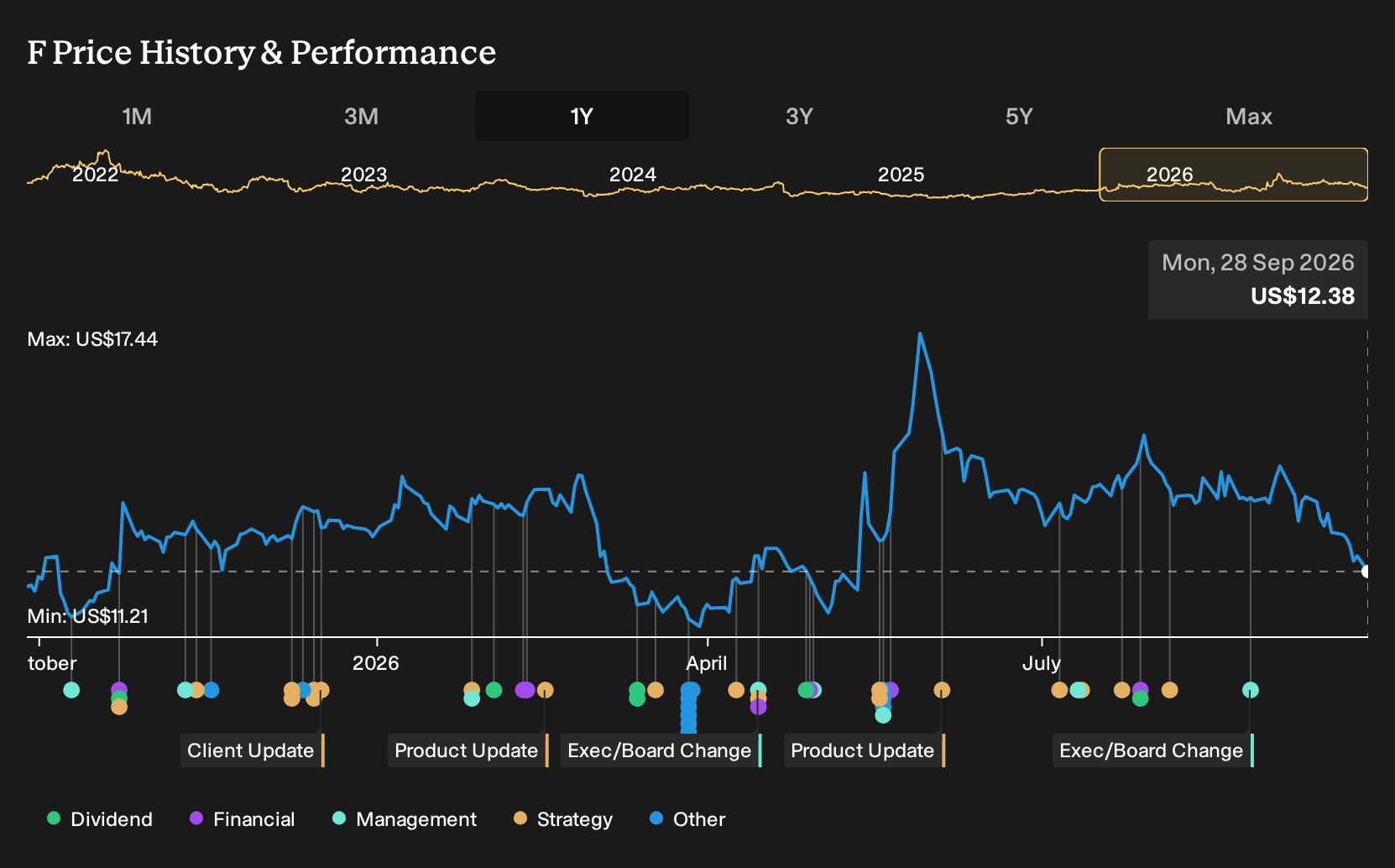
Uncover why Ford Motor's fair value indicates a 27% potential upside to its current price, a discount that could close more quickly than many investors expect.
Exploring Other Perspectives
Some of the lowest Ford Motor analysts lean hard into supply side risk. They were already modeling revenue drifting to about US$170.3b by 2029 and earnings near US$13.4b, before this F-150 stoppage hit the headlines. You should treat this pause as a fresh test of those more cautious views.
Explore 6 other Ford Motor fair value estimates, including one that suggests it could be worth just $12.01.
Decide For Yourself
Disagree with existing narratives? Extraordinary investment returns rarely come from following the herd, so consider your own analysis and research.
- A great starting point for your Ford Motor research is our analysis highlighting 3 key rewards and 2 important warning signs that could impact your investment decision.
- See our latest analysis for Ford Motor. The report includes a comprehensive fundamental analysis summarized in a single visual, the Snowflake, making it easy to evaluate Ford Motor's overall financial health at a glance.
Looking For More Investment Ideas Beyond Ford Motor?
If the Ford Motor story has sharpened your thinking about risk, cash flow and balance sheets, use that same lens across a wider watchlist with the Simply Wall St Screener.
- For investors hunting for mispriced quality, scan a curated group of 32 high quality undervalued stocks that pair solid fundamentals with more modest expectations baked into their prices.
- If income is your priority, focus on durable payouts by reviewing a hand picked set of 6 dividend fortresses that combine higher yields with balance sheets that aim to support those distributions.
- For a steadier ride through market swings, filter for resilience first by checking out a 30 resilient stocks with low risk scores that scores well on financial strength and business risk.
This article by Simply Wall St is general in nature. We provide commentary based on historical data and analyst forecasts only using an unbiased methodology and our articles are not intended to be financial advice. It does not constitute a recommendation to buy or sell any stock, and does not take account of your objectives, or your financial situation. We aim to bring you long-term focused analysis driven by fundamental data. Note that our analysis may not factor in the latest price-sensitive company announcements or qualitative material. Simply Wall St has no position in any stocks mentioned.
Have feedback on this article? Concerned about the content? Get in touch with us directly. Alternatively, email editorial-team@simplywallst.com