


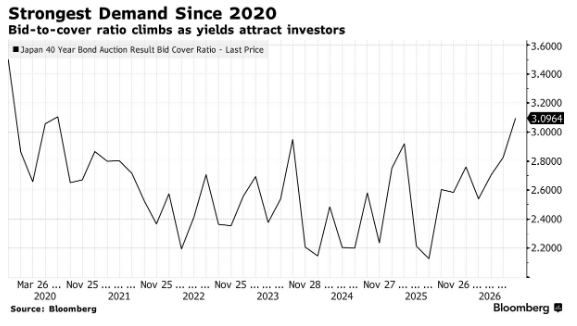
The Zhitong Finance App learned that Japan's 40-year treasury bond auction recorded the strongest demand in six years. The high yield attracted investors to return to Japan's longest term debt category, and also brought potential relief to the weak global market.
The bid multiplier for this auction reached 3.1 times, the highest since 2020, 2.82 times higher than the previous auction, and far higher than the 12-month average of 2.67 times. Demand was partly boosted by the reduction in the scale of issuance of 40-year treasury bonds in May. At the same time, market expectations for a more aggressive interest rate hike by the Bank of Japan also helped ease concerns about inflation.
Rinto Maruyama, senior interest rate and foreign exchange strategist at SMBC Nikko Securities, said, “The market expects the Federal Reserve and the Bank of Japan to continue to raise interest rates, which mainly puts upward pressure on short-term yields. Meanwhile, term premiums are narrowing as the market believes that tighter monetary policies will eventually control inflation.”
The market is increasingly speculating that the Bank of Japan may raise interest rates again as early as next month. Previously, the Bank of Japan had decided to raise the benchmark interest rate to a 31-year high of 1.25%. Kazuo Momma, the former head of monetary policy at the Bank of Japan, also agreed with this outlook in an interview.
Meanwhile, Japanese and US policymakers last week curbed the yen's decline through verbal intervention, helping to support market sentiment.
This strong auction may bring a brief relief to the global bond market. Recently, the global bond market has been disrupted by factors such as rising spending on artificial intelligence, inflation caused by the Middle East War, and the expansion of global government debt. The benchmark 30-year US Treasury yield hit a 22-year high of 5.58% on Monday.
Japanese 40-year varieties are traditionally favored by life insurance companies to match long-term liabilities, so this auction is a key indicator to measure whether higher yields are attracting these buyers back.
Masayuki Koguchi, chief fund manager of Mitsubishi UFJ Asset Management, said that despite strong auction results, it will take time to determine whether basic demand is actually stable.
Fiscal concerns continue to weigh on Japan's treasury debt. Earlier, it was reported that Japan is considering raising the medium-term defense spending target to 3.5% of GDP to keep Japan in line with NATO and other major US allies. The potential increase has intensified the market's scrutiny of Prime Minister Takaichi Sanae's broader fiscal agenda and how his government can finance additional spending.
Maruyama of SMBC Nikko said that at the same time, short-term bonds may continue to be under pressure in anticipation of the Bank of Japan speeding up interest rate hikes.
Market focus has now turned to Wednesday's two-year treasury bond auction, and investors will be watching closely for signals regarding the Bank of Japan's policy path. As one of the most sensitive periods to interest rate expectations, the two-year yield currently hovers around 2%, and traders are taking into account the risk of accelerated monetary tightening.