


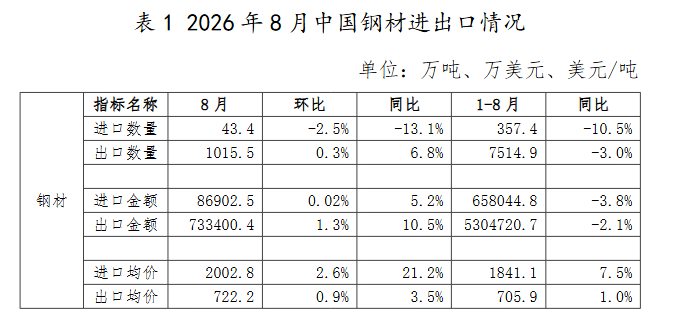
The Zhitong Finance App learned that on September 29, the China Steel Association released the monthly report on the import and export of steel products for August. In August 2026, China exported 10.155 million tons of steel, up 0.3% month-on-month, up 6.8%; the average export price was 722.2 US dollars/ton, up 0.9% month-on-month and 3.5% year-on-year. From January to August, China exported a total of 75.149 million tons of steel, down 3.0% year on year; the average export price was 705.9 US dollars/ton, up 1.0% year on year.
In August, China imported 434,000 tons of steel, a year-on-year decrease of 2.5% and a year-on-year decrease of 13.1%; the average import price was 2002.8 US dollars/ton, up 2.6% month-on-month and 21.2% year-on-year. From January to August, China imported a total of 3.574 million tons of steel, down 10.5% year on year; the average import price was 1841.1 US dollars/ton, up 7.5% year on year.
I. Overall import and export situation of steel and primary products
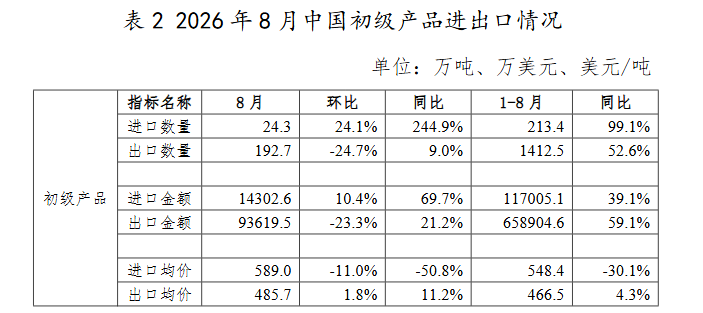
In August 2026, China exported 1.927 million tons of primary products (steel billets, pig iron, direct reduced iron and recycled steel raw materials), a year-on-month decrease of 24.7%; the average export price was 485.7 US dollars/ton, up 1.8% from the previous month. From January to August, China exported a total of 14.125 million tons of primary products, up 52.6% year on year; the average export price was 466.5 US dollars/ton, up 4.3% year on year.
In August, China imported 243,000 tons of primary products, up 24.1% from the previous month; the average import price was 589.0 US dollars/ton, down 11.0% from the previous month. From January to August, China imported 2,134 million tons of primary products, up 99.1% year on year; the average import price was 548.4 US dollars/ton, down 30.1% year on year.
II. Export situation of steel products
In August 2026, China's steel exports exceeded 10 million tons for four consecutive months, increasing both month-on-month and year-on-year. By variety, exports of long lumber have remained steady, the overall pressure on board materials is under pressure, and the trend of segmented varieties is diverging. Billet exports have been declining for two consecutive months. Looking at the subregion, exports to the African Union market continued to improve, exports to the ASEAN market continued to weaken, and the performance of the GCC and EU was weak.
1. Situation by variety
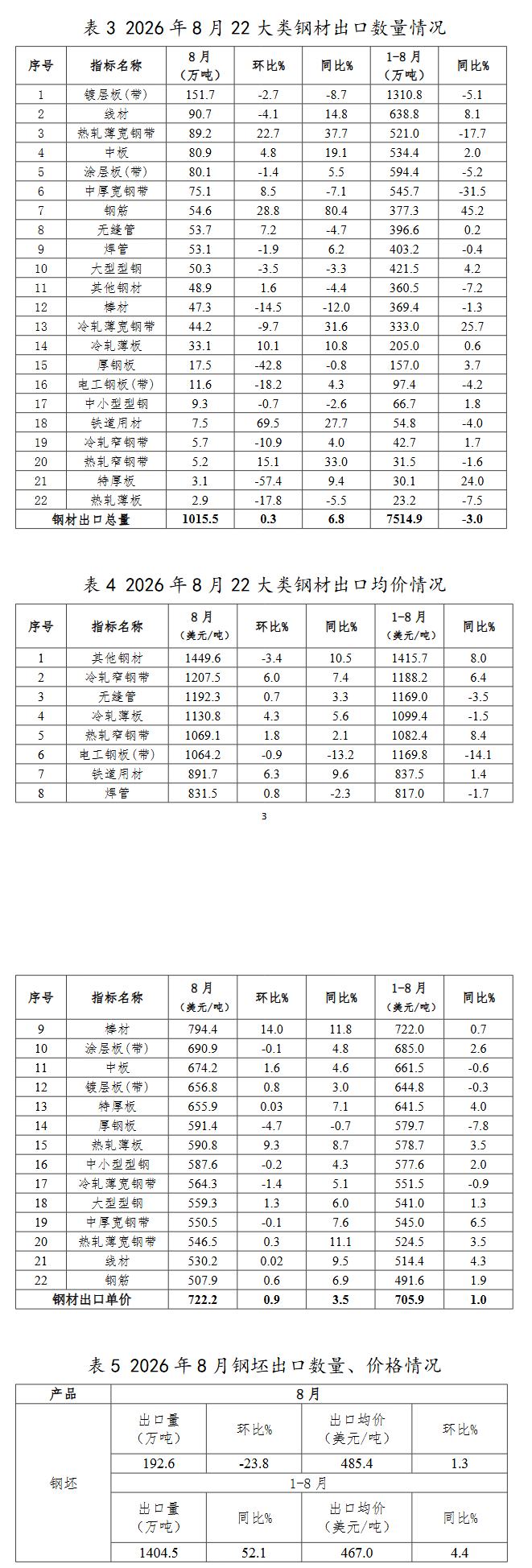
In August, the export volume of 9 of the 22 major steel varieties increased month-on-month, with a total of 10 varieties exported over 500,000 tons in the same month. Among the types of export growth, hot-rolled thin and wide steel strip increased by 165,000 tons month-on-month, or 22.7%. The monthly export volume was the highest level since April 2025; steel bars increased 122,000 tons month-on-month, an increase of 28.8%. Among the varieties that declined in exports, thick steel sheets decreased by 131,000 tons month-on-month, or 42.8%; bars decreased by 80,000 tons month-on-month, or 14.5%. From January to August, total exports of coated sheets (strips) ranked first among the 22 categories; the cumulative export volume of 10 varieties achieved year-on-year growth. Among them, the cumulative export volume of steel bars increased by 45.2% year on year, and the cumulative exports of medium thick and wide steel strips and hot-rolled thin and wide steel strips decreased by 31.5% and 17.7%, respectively. In terms of prices, in August, export unit prices for a total of 15 varieties rose month-on-month, with bars rising 14.0% month-on-month and 11.8% year-on-year. From January to August, export unit prices for a total of 14 types rose year on year. Hot-rolled narrow steel strips and other steels had the highest year-on-year increase, rising 8.4% and 8.0% respectively.
In August, billet exports fell month-on-month for two consecutive months, and prices rose slightly. Exports were 1.926 million tons in the same month, down 23.8% from the previous month; the export unit price was 485.4 US dollars/ton, up 1.3% from the previous month. In January-August, a total of 14.045 million tons were exported, up 52.1% year on year, and the export unit price increased 4.4% year on year.
2. Subregional situation
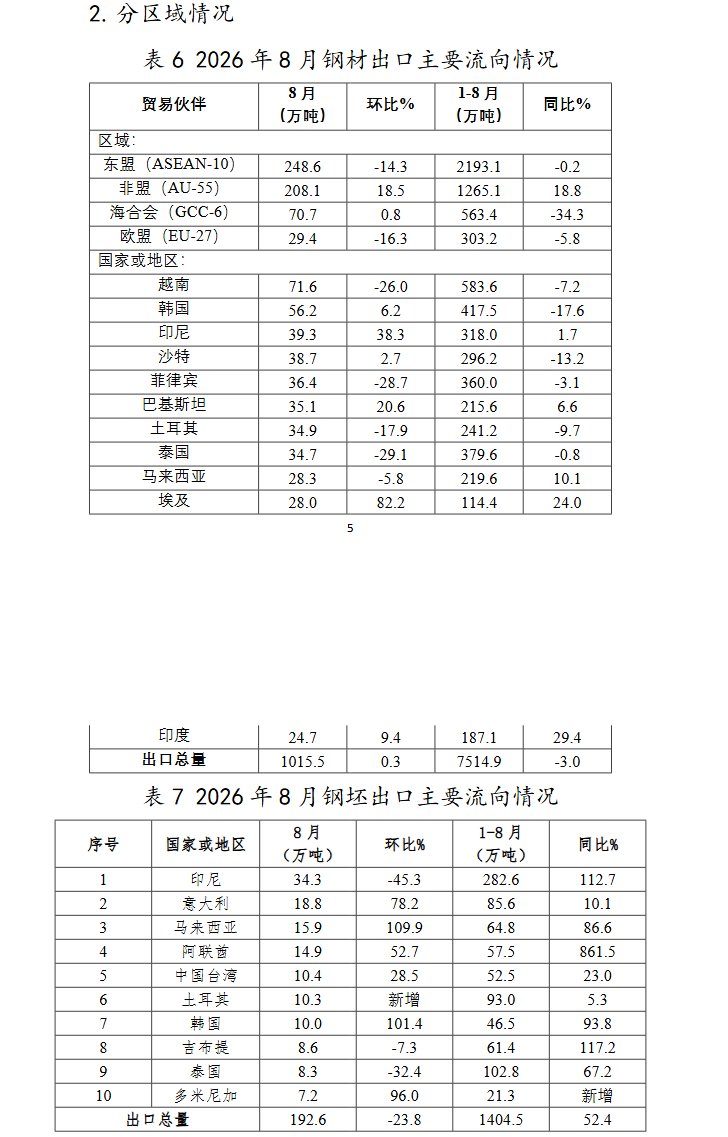
In August, the performance of steel exporting countries was divided. Exports to the African Union continued to grow, with exports to Egypt increasing by 82.2% month-on-month; exports to ASEAN continued to decline, with exports to Vietnam, the Philippines, and Thailand all falling by more than 26% month-on-month, falling 5.8% to Malaysia, and 38.3% month-on-month only. The overall export volume to the GCC and EU is under pressure. Although it rebounded 2.7% month-on-month to Saudi Arabia, it is still difficult to reverse the weak regional trend, and there is no incremental support for exports to the EU. In January-August, exports to ASEAN fell slightly by 0.2% year on year, and the growth rate of exports to the EU changed from positive to negative, down 5.8% year on year; exports to the GCC continued to decline sharply, reaching 34.3% year on year. The African Union was the only region that achieved growth, with a year-on-year increase of 18.8%.
In August, China's steel billet exports fell by 600,000 tons month-on-month. The reduction in exports mainly came from traditional major markets such as Southeast Asia and the Middle East. Indonesia is still China's largest export destination for steel billets, but the monthly export volume was 343,000 tons, a decrease of 284,000 tons, a decrease of 45.3%; exports from Saudi Arabia and the Philippines fell 87.0% to 30,000 tons month-on-month, and the Philippines fell 80.6% to 38,000 tons month-on-month; exports from Thailand and Djibouti also showed varying degrees of month-on-month decline. The incremental market is fragmented and limited in scale. Among them, exports from Malaysia and South Korea doubled month-on-month, but it is difficult to hedge the total volume gap caused by the sharp decline in leading markets.