


The Zhitong Finance App learned that on September 28, the 14th comprehensive test flight of the SpaceX (SPCX.US) Starship took off from the Starport base in Texas, entered Earth orbit for the first time, and released 26 third-generation Starlink (Starlink V3) satellites through the spacecraft's deployment agency known as the “candy dispenser.” Obviously, it's not just this launch that the market values; Wall Street investment banks have expressed their bullishness one after another.
TD Cowen launched coverage on Monday, giving a “buy” rating and a target price of $200; together with Royal Bank of Canada (RBC), Clear Street, and Lyon Securities (CLSA), the target price range for the four institutions is $200 to $250, which corresponds to an upward margin of about 37% to 72% based on Monday's closing price. However, in this round of reviews, what has been repeatedly mentioned is not rockets; it is computing power leasing.
Starship is in orbit for the first time: all satellites are deployed, and it flew back after two laps
According to reports, the B21 booster and S41 spacecraft were used this time, both of which are third-generation starship systems; one of the spacecraft's six engines failed, and the live broadcast commentary determined that it was impossible to enter orbit. After re-evaluation, the engineering team confirmed that they could still try to ignite in orbit. The starship was put into orbit about 25 minutes after launch, then it took about half an hour to release the satellites one by one. The company established links with all 26 satellites, and Musk confirmed that all satellites were operating normally.
Flying isn't flawless. One engine in the ascending stage shut down early. The original plan was to fly about 6 laps around the Earth at an altitude of about 275 kilometers, with a total duration of close to 10 hours. Eventually, it was shortened to about 3 hours and only 2 laps were completed. The remaining engines on the upper stage extended their ignition to make up for it. The overweight booster splashed in the Gulf of Mexico, and no attempt was made to recover it with a launch tower robotic arm; the spacecraft completed its first off-orbit ignition and splashed in the scheduled waters of the Pacific Ocean west of Chile.
The weight of this flight is that since the first comprehensive test flight in 2023, all 13 previous test flights have stayed in sub-orbit, and getting into orbit is the basic threshold for launch vehicles. Aerospace engineer Dean Sladen said the launch of 26 V3 satellites into target orbit was a “huge victory” and marked Starship's first revenue-generating commercial flight — a batch of satellites worth millions of dollars. Kathryn Curley, a senior analyst at Georgetown University's Center for Safety and Emerging Technology, was more restrained: the mission made significant progress but was not a “super success,” and “judging from SpaceX's own metrics and goals, they didn't complete the 10-hour flight, and there was a real engine problem.”
Single star 1 Tbps: the capacity jump brought about by V3
According to documents submitted to regulators by SpaceX, the V3 satellite is designed to have a downstream capacity of about 1 Tbps, which is equivalent to each 10,000 households running 100 megabytes of broadband at the same time, and the uplink capacity is 160 Gbps; compared with V2, the downlink is about 10 times higher and the uplink is about 22 times higher, and the antenna supports 2,048 upstream and downstream beams (V2's phased array has 192 downlinks and 144 uplinks). According to SpaceX technical notes, a single starship launch can deliver about 20 times the capacity of Falcon 9 to launch the V2 satellite into the constellation.
Weight is another hurdle: a single V3 weighs about 2,000 kilograms, about twice as much as the previous generation, and the Falcon 9 cannot be delivered. Third-party comments are more optimistic, but personal: First Principles Group managing partner Rob Moller said on X, “Today's Starship launch alone, SpaceX's increase in Starlink capacity in the past hour exceeds the sum of the first year and a half of Starlink launch”; Phil Bethel, a former Apple executive and current senior director of Rivian, said that the design user capacity of a single V3 is 1.16 Tbps, and the optical link between satellites is 2.4 Tbps. It can route more traffic and even connect computing resources to the backbone of the network in space.
Musk wants the Starship to launch 60 V3s in a single run after normal operation; according to estimates, in order to significantly improve the overall level of Starlink service, the on-orbit V3 would need to reach about 1,000, and at least 17 launches per full load. SpaceX has applied to the US Federal Communications Commission (FCC) to operate up to 100,000 V3 satellites; as of September 2026, Starlink has launched a total of about 13,000 satellites and 11,000 satellites in orbit, serving tens of millions of users in more than 160 countries and regions.
Wall Street price hikes: computing power is the near-end engine
TD Cowen, led by analyst John Blakeridge, launched the coverage with a rating of “buy” and a target price of $200, saying that SpaceX's broader opportunities in the field of AI and space are “huge.” The agency predicts that AI computing power leasing will contribute about 60% of revenue in 2027, a compound annual revenue growth rate of 62% from 2026 to 2031, and the number of low-orbit launches is expected to be close to 1,000 by 2031.
TD Cowen also anticipates that about 35% of sales in 2026 will come from the computing power-related business. This business may surpass Starlink's “crown jewel” as early as the first quarter of 2027. By 2028, it will account for 65% of overall revenue, and nearly half of the planned computing power will be leased to external companies in the next few years. Deutsche Bank analyst Edison Yu gave a “purchase” with a target price of 235 US dollars, and estimated that the five customers that have signed contracts correspond to a revenue operating rate of about 54.5 billion US dollars, saying “it is expected that at least a few more large orders will land” as production capacity goes online.
Other agency actions on the same day: RBC reaffirmed “outperforming the market” and a target price of $225; Clear Street maintained a “buy” and a target price of $217; Clear Street maintained a “buy” and a target price of $217, believing that the mission advanced the company's ability to expand the high-capacity constellation, but engine issues reminded that execution risks were still there; CLSA covered the “increase” and target price of $250; Bernstein SocGen maintained a “buy” with a target price of $248. According to Tipranks data, the average price target given by analysts is 233 dollars.
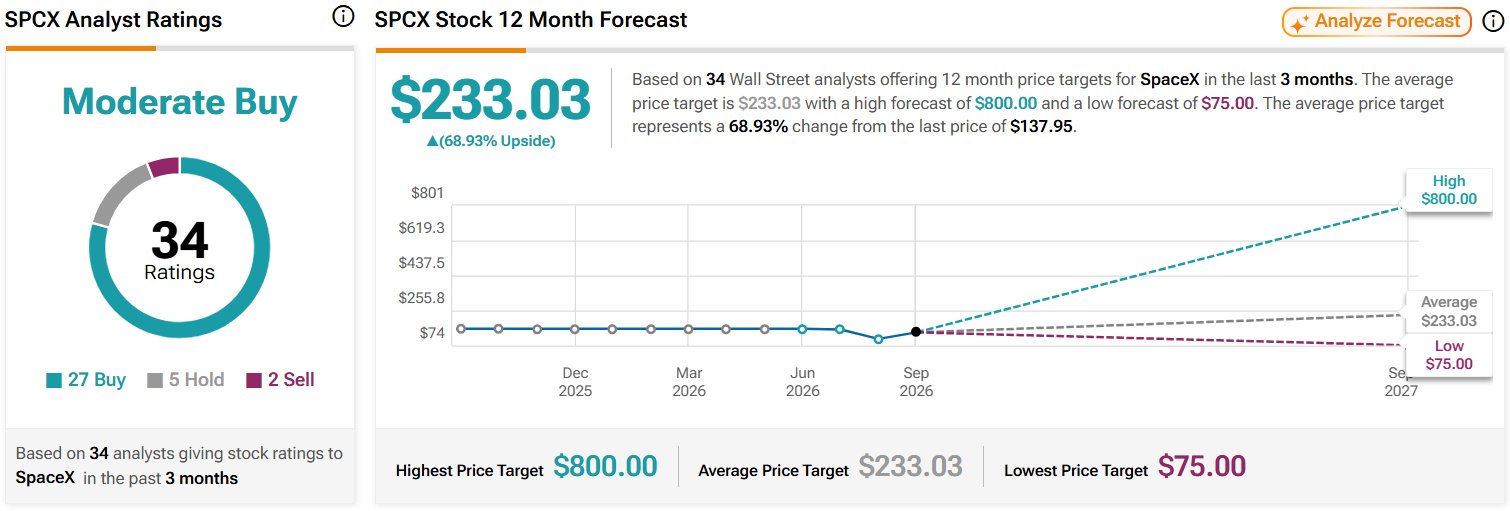
The details of the computing power contract are the key to understanding this round of expectations. Anthropic is paying $1.25 billion a month to rent the computing power of SpaceX's Colossus data center in Memphis; Google Cloud signed a computing power agreement of $9.2 billion per month, effective next month; Reflection AI is $150 million per month; and an unnamed customer has been paying $1.11 billion a month since December — totaling around $3.4 billion per month and $40.8 billion per year after full implementation. However, the identities of only three of the five disclosed customers have been publicly confirmed, and the fourth one disclosed in July this year was speculated by some analysts to be the US Department of Defense; these leases also included an “abnormally short” 90-day cancellation clause, making it relatively easy for customers to quit.
The parent company's performance provided bottom support. According to the financial report summary, SpaceX's second-quarter revenue (released on August 4) was 7.8 billion US dollars, up 92% year over year, higher than market expectations of 6.81 billion US dollars. The adjusted EBITDA was 3.5 billion US dollars, an increase of 191%, and a net loss of 541 million US dollars, of which the AI segment revenue was 2.6 billion US dollars, an increase of 247%. Chief Financial Officer Brett Johnson said the company is expected to reach an annual recurring revenue (ARR) operating rate of $100 billion by the end of 2026; management plans to reach 15 to 20 gigawatts of computing power infrastructure by the end of 2027, while Musk has advanced the target of $1 trillion in annual revenue from 2031 to 2030.
The source of this computing power narrative is the merger in February of this year: SpaceX acquired xAI in full stock (consideration of about $250 billion, valuation of about 1.25 trillion US dollars after merger), and in July, the AI business officially changed its name to SpaceXAI, and Colossus became an asset of a listed company. Musk explained the merger logic very bluntly — orbital data center: The company has applied for up to 1 million satellites in orbit from the FCC for AI computing power, and plans to launch them using Starships as early as the end of next year.
The other side: Market capitalization of about 1.9 trillion dollars, 20 times the market sales rate, and the lifting of the ban on Hong Feng
The other side of the stock price is valuation. Based on the closing price on September 28, SpaceX's total market value is about 1.92 trillion US dollars; according to the original version, the company's stock price fell 10% during the year, but it still rose 1% during the month. According to calculations, the company's revenue in 2025 was about $18.7 billion and still at a loss, while Wall Street expects to jump to $44.8 billion and $108.3 billion this year and next, respectively — even if all are achieved, the market sales ratio based on expected revenue for 2027 is still close to 20 times, which is not cheap for asset-heavy companies; its forward price-earnings ratio is about 204 times.
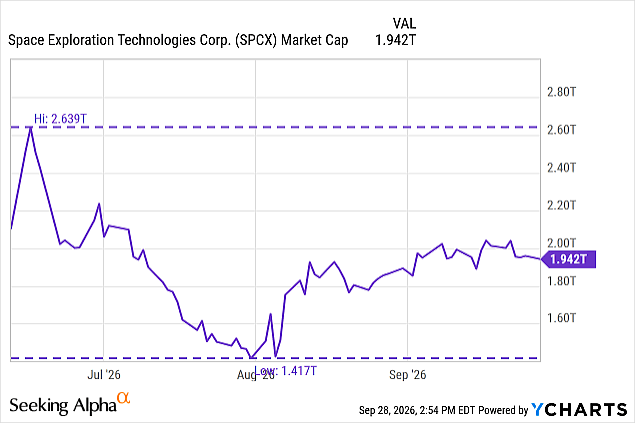
“Big Short” Michael Burry said when the company went public that nothing in the prospectus could support even a $1 trillion valuation. Since then, he has described it as “a small space business, a niche telecom business, a struggling social media platform, plus a 'lightweight version of CoreWeave'.” Stock supply is a more recent problem: the company only issued about 4% of the shares in the IPO, and the lockdown period has expired one after another — a batch of bans was lifted on September 24, up to 328.4 million shares were available for circulation on October 9 and October 24, and as many as 1.3 billion shares may pour into the market after the release of the third quarterly report; Musk himself is locked in until next June, and not for employees and institutional investors.
Financing costs are also rising: according to the same report, the company issued $25 billion in bonds soon after listing, with interest rates of 5.35% to 6.65%; in a context where the Federal Reserve just raised interest rates and hinted that interest rates may continue, if additional bonds are issued to finance the next round of computing power and launch site construction, the path to profit will be tighter.
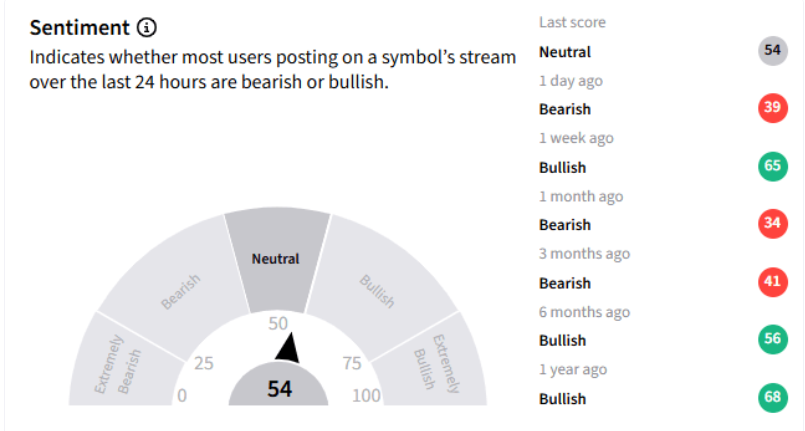
Retail sentiments have picked up somewhat. On the Stocktwits platform, SPCX's retail sentiment index rebounded to “neutral” from the previous day's “bearish”, with a 74% increase in 24-hour news volume; some long-term holders left comments saying “the money will come, all major bank analysts have confirmed this”, while others emphasized that the flames and falling fireballs at the time of re-entry were “completely normal for this stage of testing”, adding that the 14th flight was a “historic success.”
The rival that fell behind, landed on the moon with NASA on a Starship
Instead, the competitor's situation highlights SpaceX's position. The “New Glen” of blue origin first flew in January of this year, but the first mission in May failed during the power landing phase and the rocket was damaged. The sole launch pad was also damaged, and the target for resuming the flight was set before the end of the year; the Joint Launch Alliance's “Vulcan” has been grounded since February due to an abnormal booster. Amazon's Leo constellation was last successfully deployed on July 2, with a total of 396 launches. There is a clear gap with over 11,000 Starlinks in orbit. Its goal of starting commercial use in 2026 has already expired.
What's more critical is NASA's dependency. According to industry media estimates, the Starship is the only manned landing system for the Artemis (Artemis) lunar landing program, and the mission requires 10 to 20 “refueling starship” flights and transfer low temperature methane and liquid oxygen in orbit. There is no precedent for this process so far; SpaceX has postponed the in-orbit propellant transfer demonstration twice. The latest goal is “no earlier than the end of 2026,” while the Artemis III plans to conduct an unmanned lander Earth orbital demonstration at the end of 2027. Humans land on the moon, and both depend on the success of this demonstration.
Back to Musk's own schedule: he wrote on Sunday, “Starship is still 2 to 3 years away”; the longer-term goal is to launch 10,000 times a year by 2030 — as a reference, Falcon 9 flew 165 times in 2025, which is already a company record, accounting for about half of that year's global orbital launches. TD Cowen's estimate of close to 1,000 low-orbit launches in 2031 falls roughly in the “less than 3 per day” range. The results of the investigation of engine abnormalities will determine whether the 15th flight can attempt to use the launch tower robotic arm to recover the spacecraft as originally planned.