


- KKR recently launched Akrapoint Commercial Capital, a mid-ticket equipment finance platform backed by a US$350 million commitment from KKR-managed funds to support financing for vocational assets, specialty trailers and industrial equipment across multiple U.S. industries.
- The move deepens KKR's asset based finance footprint by pairing long-term capital with an experienced equipment finance team that is focused on small and middle-market business demand for tailored funding solutions.
- We will now look at how KKR's investment narrative is affected by this asset based finance expansion through Akrapoint Commercial Capital.
Compare KKR's push into equipment finance with other capital providers by scanning our curated list of list of solid balance sheet and fundamentals (25 results) that are already funding real economy assets.
KKR Investment Narrative Recap
Owning KKR means believing that its broad alternatives platform, including private equity, real estate, credit and insurance, can keep turning fee paying assets into resilient earnings even as conditions shift. The Akrapoint launch fits that story by extending asset based finance into mid ticket equipment, but on its own it does not change the near term setup.
Right now the key swing factor is whether fundraising and deployment stay strong enough to offset pressure where analysts see revenue declining over the next few years, even as margins are expected to improve. The biggest risk remains asset quality and liquidity across private credit and ABF if deal performance weakens.
Akrapoint matters most because it plugs directly into one of KKR's central growth engines, credit and asset based finance. Management is pairing a US$350 million commitment with an experienced equipment finance team, which broadens origination beyond traditional corporate credit into vocational assets and industrial gear for smaller borrowers.
For you as a shareholder, the operational question is execution quality. If Akrapoint sources sound loans across areas like manufacturing, sanitation and logistics, it can reinforce fee related earnings and add to performance income over time. If underwriting missteps emerge, it would amplify the existing risk around asset quality in the wider ABF portfolio.
Analysts see KKR reaching US$13.7b in revenue and US$5.4b in earnings by 2028, which implies a 13.9% yearly revenue decline and an earnings increase of about US$3.4b from US$2.0b today.
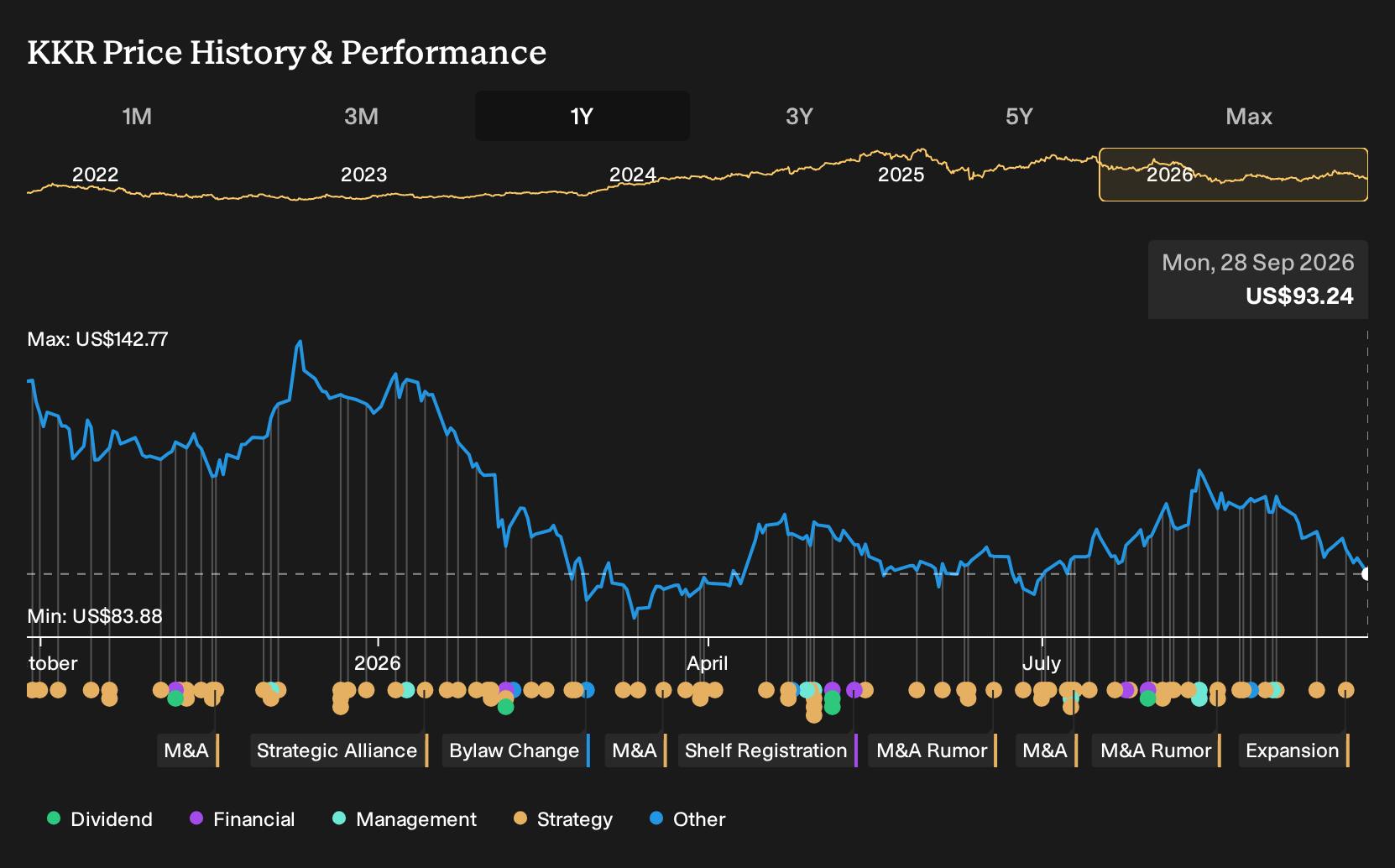
Discover why KKR's fair value indicates a 50% potential upside to its current price that may not last much longer.
Exploring Other Perspectives
One alternate view focuses on how aggressive KKR can be on margins. The most optimistic analysts were already penciling in earnings of about US$6.5b on US$12.4b of revenue by 2029, with profit margins rising toward 52.4%. Those expectations came before Akrapoint, so it is reasonable to expect some opinions to shift as the story evolves.
Explore 5 other KKR fair value estimates, including one that suggests as much as 56% upside from the current price.
Form Your Own Verdict
Disagree with existing narratives? Extraordinary investment returns rarely come from following the herd, so trust your own analysis and judgment.
- A great starting point for your KKR research is our analysis highlighting 3 key rewards and 1 important warning sign that could impact your investment decision.
- See our latest analysis for KKR. The report includes a comprehensive fundamental analysis summarized in a single visual, the Snowflake, making it easy to evaluate KKR's overall financial health at a glance.
Looking For More Ideas Beyond KKR?
Once you have a view on KKR, it can help to compare it with other opportunities that share some of the qualities you care about most.
- If resilience and balance sheet strength matter to you, start by scanning a 30 resilient stocks with low risk scores that aim to keep downside risk in check.
- For investors hunting for quality at a reasonable price, review a hand picked set of 32 high quality undervalued stocks that combine solid fundamentals with more attractive entry points.
- If you prefer to focus on companies that are still under the radar, broaden your watchlist with 16 high quality undiscovered gems that already show strong financial traits.
This article by Simply Wall St is general in nature. We provide commentary based on historical data and analyst forecasts only using an unbiased methodology and our articles are not intended to be financial advice. It does not constitute a recommendation to buy or sell any stock, and does not take account of your objectives, or your financial situation. We aim to bring you long-term focused analysis driven by fundamental data. Note that our analysis may not factor in the latest price-sensitive company announcements or qualitative material. Simply Wall St has no position in any stocks mentioned.
Have feedback on this article? Concerned about the content? Get in touch with us directly. Alternatively, email editorial-team@simplywallst.com