


Oil prices have been climbing as worries about supply from the Middle East keep resurfacing. That puts aircraft makers, weapons suppliers and mission support specialists in sharper focus for governments trying to secure energy routes and national borders. For investors, this creates a concentrated pocket of potential opportunity in companies tied to aerospace and military services. This article highlights 3 stocks from that universe that merit closer attention now.
The three aerospace and defense stocks below are only a sample, and the full screen surfaced another 313 companies with similarly detailed stories that are not covered here.
If you want to identify, compare, and analyze more potential ideas in this space, head straight into the Aerospace And Defense screener.
General Electric (GE)
Overview: General Electric, through GE Aerospace, builds and services commercial and military jet engines, propulsion components and aircraft systems worldwide.
Operations: General Electric generates most of its revenue from Commercial Engines & Services at US$37.7b, with Defense & Propulsion Technologies contributing US$11.5b.
Market Cap: US$339.4b
General Electric sits squarely in the Aerospace And Defense theme through its engine and propulsion franchise, which ties directly to both global airlines and long term military programs. That twin demand picture is what makes the next quote so important for investors tracking the sector.
"Acceleration of next generation engine programs such as adaptive cycle engines and CCA propulsion, supported by rising defense book to bill of 1.7x and a Defense & Propulsion Technologies backlog above US$30b, points to multi year visibility on future defense revenue and contribution to segment profit.
What matters most now is how one unresolved pressure in the engine services business ultimately feeds through to margins and free cash flow.
That margin puzzle is exactly what the full narrative for General Electric unpacks, including how accelerating engine programs could reshape cash generation and risk for long term holders.

Rocket Lab (RKLB)
Overview: Rocket Lab provides commercial and government launch services using its Electron rocket, while also building satellites, components, and space systems.
Operations: Rocket Lab generates about US$544 million from Space Systems and roughly US$225 million from Launch Services, making hardware and missions tightly linked.
Market Cap: US$44.3b
Rocket Lab matters for this Aerospace And Defense screen because it does not just sell parts into space programs, it runs the full launch and spacecraft service stack that defense and government customers increasingly rely on for orbital infrastructure.
"Neutron's successful operation should be that turning point, but Neutron's failure would risk the entire company."
What investors really need to watch is how one untested shift in the launch mix ultimately reshapes pricing power, demand visibility, and long term returns.
That turning point question is exactly what the full narrative for Rocket Lab tackles, mapping how Neutron risk, contract momentum and capital intensity could be accelerating or masking Rocket Lab's long term potential.

Lockheed Martin (LMT)
Overview: Lockheed Martin develops and supports combat aircraft, advanced missiles, helicopters and space systems for the U.S. and allied defense sectors worldwide.
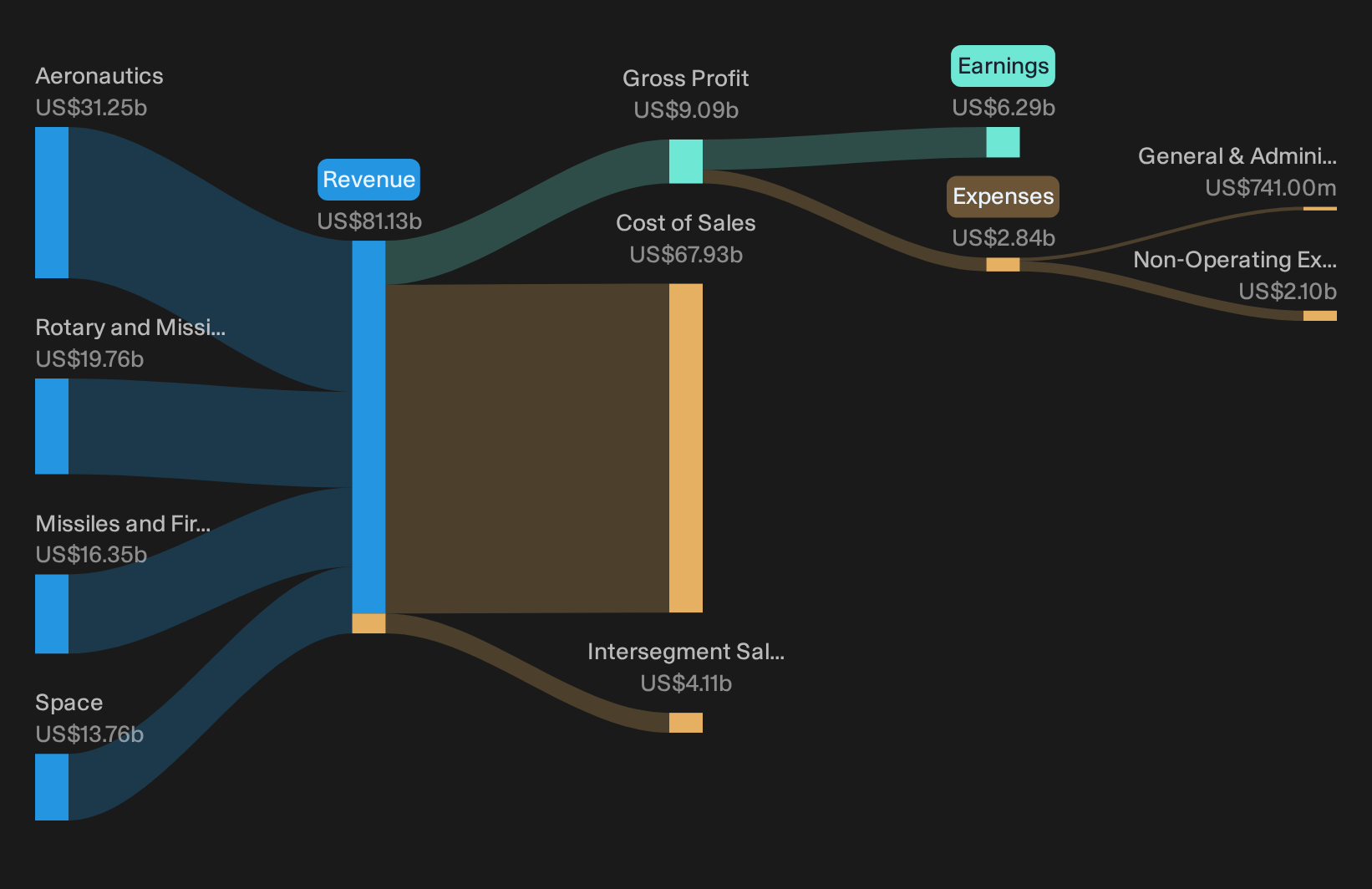
Operations: Lockheed Martin generates US$31.2b from Aeronautics, US$19.8b from Rotary and Mission Systems, US$16.4b from Missiles and Fire Control, and US$13.8b from Space.
Market Cap: US$119.9b
Lockheed Martin matters here because it does not only build jets and satellites, it underpins how allied air and missile defense actually gets fielded at scale.
"Lockheed Martin is moving munitions like PAC-3, THAAD, PrSM and JATM onto seven year framework agreements that aim to triple or quadruple production and allow the company to retain a larger share of cost savings from capacity investments such as robotics in Camden. This can support higher future revenue and structurally stronger net margins."
What really reshapes the investment case is how one shift in contract economics filters through to long term defense pricing power and profitability.
That contract shift is just the starting point, and the full narrative for Lockheed Martin shows how accelerating demand, capital spend and program risk could reshape Lockheed Martin's long term payoff.
Curious About What You Might Be Missing Next
Fresh opportunities can move from quiet to flying quickly. Use that first-mover edge to spot potential breakouts while it matters. Before the crowd piles in, consider your options and decide whether to act.
- Spot income ideas that aim to keep paying even when markets feel choppy by scanning the 6 dividend fortresses and seeing which yields still look resilient.
- Track potential beneficiaries of AI infrastructure momentum before it gets fully priced in by running through the curated 88 AI infrastructure stocks and checking how each one makes money.
- Catch early movers in robotics and automation while they are still under the radar for now by reviewing the hand picked 92 robotics and automation stocks and shortlisting what fits your risk profile.
This article by Simply Wall St is general in nature. We provide commentary based on historical data and analyst forecasts only using an unbiased methodology and our articles are not intended to be financial advice. It does not constitute a recommendation to buy or sell any stock, and does not take account of your objectives, or your financial situation. We aim to bring you long-term focused analysis driven by fundamental data. Note that our analysis may not factor in the latest price-sensitive company announcements or qualitative material. Simply Wall St has no position in any stocks mentioned.
Have feedback on this article? Concerned about the content? Get in touch with us directly. Alternatively, email editorial-team@simplywallst.com