


- Teleflex reported new peer-reviewed data showing Arrowg+ard Technology central venous catheters were associated with a 70% lower hazard of central line associated bloodstream infections over 30 days in a 1,750 patient multinational study.
- The findings expand prior 2025 cohort results and support guideline recommendations to consider antimicrobial catheters. This speaks directly to Teleflex's ability to defend value in higher acuity hospital procedures.
- We will look at how Teleflex's investment narrative interacts with this new 70% CLABSI risk reduction evidence from Arrowg+ard protected catheters.
Scan how Teleflex compares with other hospital-focused businesses by running through our curated list of solid balance sheet and fundamentals (25 results), built for investors who care about infection risk, capital discipline and resilience.
Teleflex Investment Narrative Recap
To own Teleflex, you need to believe the infection prevention portfolio can offset pressure in weaker areas like UroLift and help the group move from losses to the profitability analysts expect over the next few years. The new Arrowg+ard data supports that infection focused thesis, but it does not change the near term swing factors of BIOTRONIK integration and procedural volumes.
The biggest short term catalyst still lies in how efficiently Teleflex executes on BIOTRONIK Vascular Interventions and stabilizes core product lines. The main risk remains margin strain and execution missteps while interest costs are not well covered by earnings. This new study adds clinical depth, not a direct fix for those financial constraints.
Recent commentary that Teleflex could be a rerating story rests on growth prospects, leadership changes and potential debt reduction. The Arrowg+ard CLABSI study fits into that context as an operational proof point that the infection control portfolio has differentiated outcomes in critical care, which matters for share retention in hospital budgets.
For that rerating argument to gain traction, execution needs to connect these clinical wins to measurable revenue mix and margin quality, while BIOTRONIK integration risk, tariffs and procedure shifts are managed tightly. Investors watching Teleflex can reasonably treat this study as incremental support for the clinical moat rather than a standalone catalyst for the equity story.
Teleflex's current analyst narrative points to revenues of $2.5b and earnings of $374.2 million by 2029, based on 4.0% yearly revenue growth and an earnings change of about $399 million from a loss of $25.1 million today.
Uncover why Teleflex's fair value indicates a 22% potential upside to its current price, which could narrow quickly.
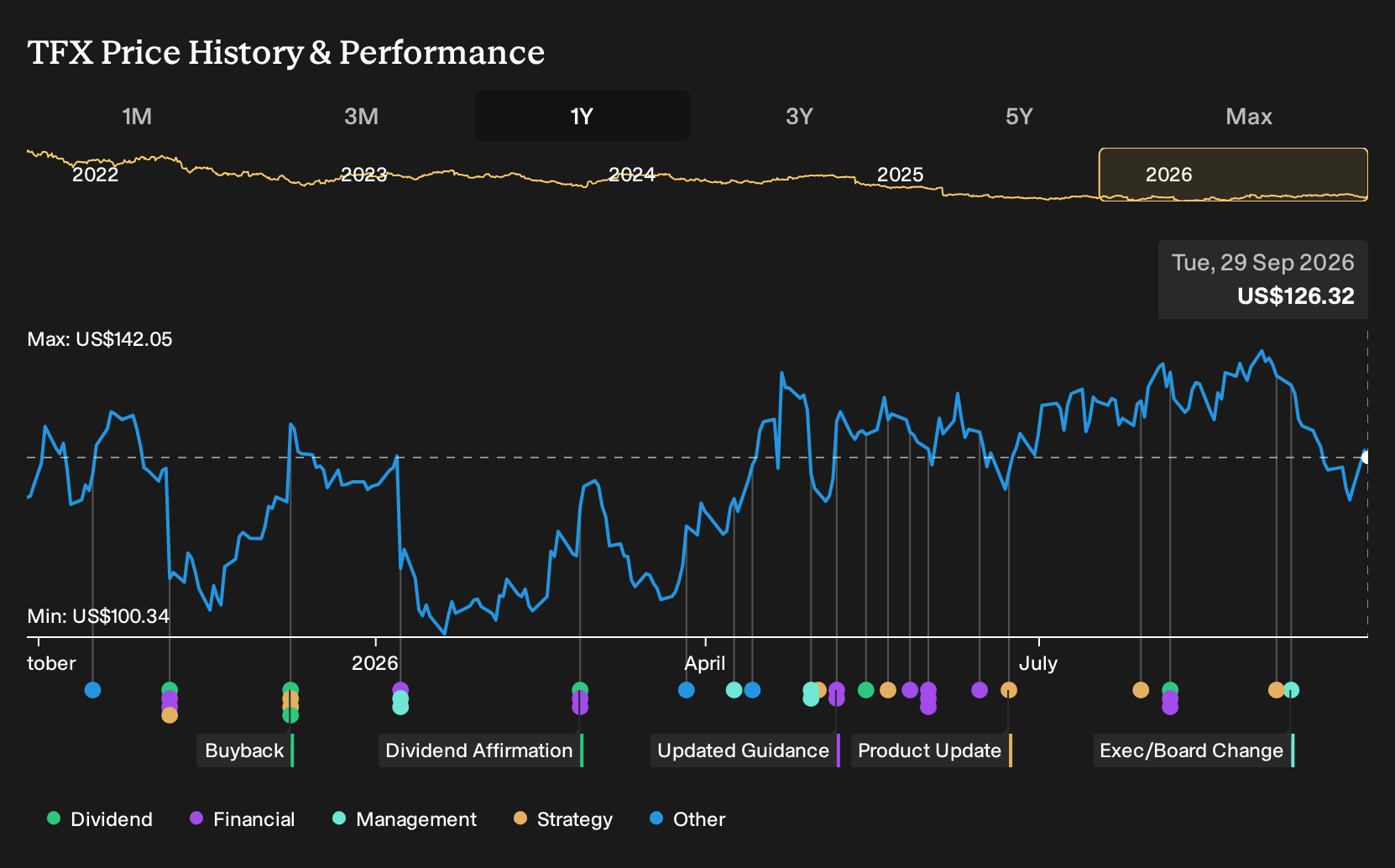
Exploring Other Perspectives
Some of the most optimistic Teleflex analysts lean on faster execution of NewCo separation and capital redeployment as the real swing factor. Before this Arrowg+ard infection data, they were sketching out about $2.6b of revenue and $508.6 million in earnings by 2029. You can treat this study as fresh input that could reshape those assumptions.
Explore 3 other Teleflex fair value estimates, including one that suggests a potential 100% upside from the current price!
Form Your Own Verdict
Disagree with existing narratives? Extraordinary investment returns rarely come from following the herd, so consider conducting your own research.
- A great starting point for your Teleflex research is our analysis highlighting 3 key rewards and 1 important warning sign that could impact your investment decision.
- See our latest analysis for Teleflex. The report includes a comprehensive fundamental analysis summarized in a single visual, the Snowflake, making it easy to evaluate Teleflex's overall financial health at a glance.
Looking for more Teleflex sized investment ideas?
If the Teleflex story has sharpened your focus on quality and risk, the next step is widening your opportunity set with a structured search across other businesses.
- If you want income to matter as much as growth, start by scanning a curated group of high yield payers through the 6 dividend fortresses that meet strict payout and balance sheet criteria.
- If value is your priority, use the 31 high quality undervalued stocks to surface companies where quality metrics and pricing screens point to potential mispricing.
- If capital preservation comes first for you, narrow the field to resilient businesses with stronger financial buffers using the 32 resilient stocks with low risk scores.
This article by Simply Wall St is general in nature. We provide commentary based on historical data and analyst forecasts only using an unbiased methodology and our articles are not intended to be financial advice. It does not constitute a recommendation to buy or sell any stock, and does not take account of your objectives, or your financial situation. We aim to bring you long-term focused analysis driven by fundamental data. Note that our analysis may not factor in the latest price-sensitive company announcements or qualitative material. Simply Wall St has no position in any stocks mentioned.
Have feedback on this article? Concerned about the content? Get in touch with us directly. Alternatively, email editorial-team@simplywallst.com