


Telecom stocks have long appealed to investors looking for regular income, but the size of the payout is only part of the story. This month, Verizon (VZ) declared a quarterly dividend of almost $0.71 per share, unchanged from its previous payment. What really matters for investors following the sector is which carriers generate enough cash flow to keep raising their dividends.
That brings T-Mobile US (TMUS) into focus. On Sept. 24, the company raised its quarterly dividend by 14.7% to $1.17 per share. This announcement came after T-Mobile generated $4.8 billion in adjusted free cash flow in the second quarter, up 4% year-over-year (YOY).
The numbers provide a solid starting point for the dividend increase, but they do not answer the question of what comes next. Can T-Mobile's growth and cash generation keep up with the bigger dividend? Let’s take a closer look.
T-Mobile’s Dividend and Cash Flow
Headquartered in Bellevue, Washington, T-Mobile US provides wireless phone and broadband services across the United States. With a market capitalization of approximately $178.5 billion, the company serves consumers and businesses through its T-Mobile, Metro by T-Mobile, and Mint Mobile brands, and offers home internet using its 5G network.
On Sept. 29, TMUS stock closed at $162.98 per share, posting a 20% decline year-to-date (YTD) and a nearly 32% drop over the past 52 weeks.
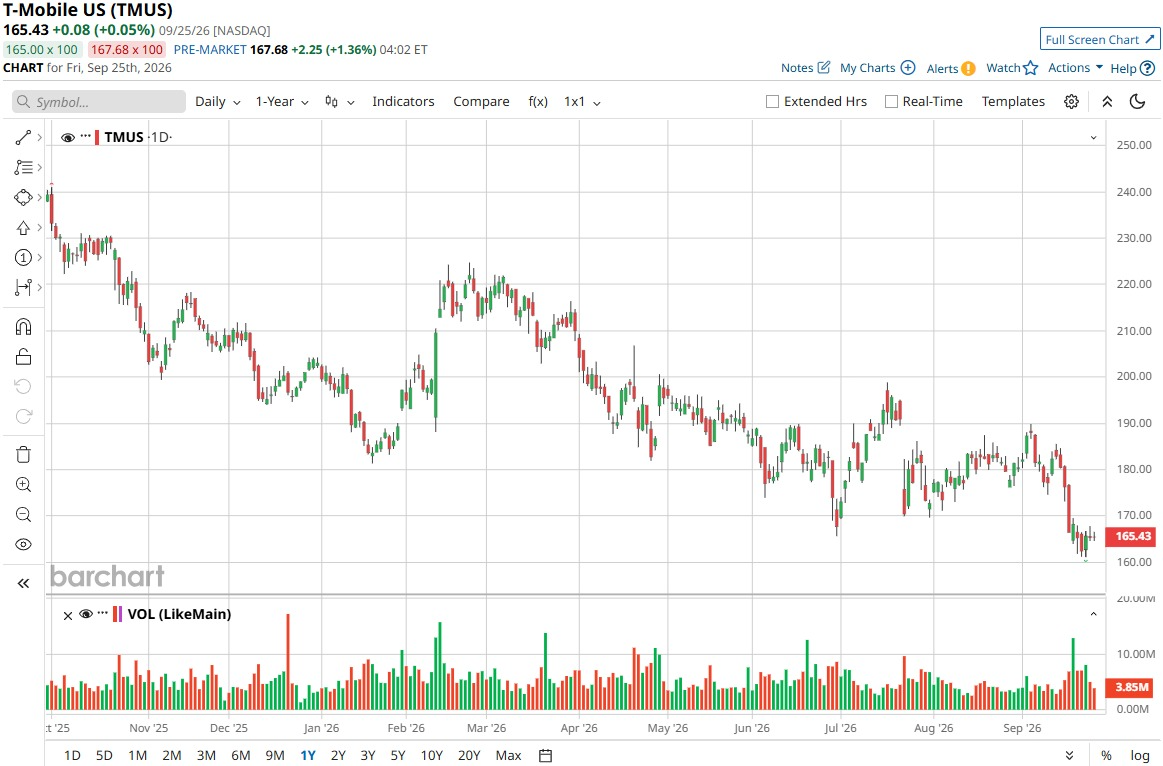
TMUS stock currently trades at 15.6 times trailing earnings, a premium to the sector median of roughly 13 times. However, its 7.4 times price-to-cash flow (P/CF) multiple sits almost exactly in-line with the sector median.
T-Mobile's higher dividend delivers a more direct benefit to shareholders right away. The company recently lifted its quarterly payment by $0.15, or almost 15%, to $1.17 per share. That amounts to $4.68 per share annually. Investors who own TMUS stock as of the close of business on Nov. 25 will get the first payment of the increased amount on Dec. 10, 2026.
The company's latest results help put that increase in context. On July 23, T-Mobile US reported Q2 net income of $3.24 billion, up roughly 1% from a year earlier. Diluted EPS of $2.99 rose 5% YOY, even after UScellular merger-related costs reduced earnings by $0.14 per share. The results also reflected $146 million in merger-related costs, including accelerated depreciation, after tax.
This growth was stronger in the underlying service business. The firm generated $19 billion in service revenue, up 9% YOY, including $15.9 billion in postpaid service revenue, up 13% YOY. Its postpaid average revenue per account rose 2% to $152.91, helping offset a 13% decline in net account additions to 277,000.
The dividend’s support comes into focus through cash generation. T-Mobile produced $9.5 billion in core adjusted EBITDA, up 12% YOY, and $7.5 billion in operating cash flow, up 7%. Adjusted free cash flow rose 4% YOY to $4.8 billion.
That distinction matters for the dividend. In April, T-Mobile increased its 2026 shareholder-return authorization by as much as $3.6 billion to up to $18.2 billion through Dec. 31. The authorization covers both share repurchases and cash dividends, not $18.2 billion in dividends alone.
What’s Behind T-Mobile’s Bigger Dividend
T-Mobile is investing in its network while freeing up cash that could help support its larger dividend. On Sept. 24, the company announced a nationwide rollout of its AI-powered AutoPilot system and added Dynamic CX to help its network anticipate demand at major events. It also said hybrid generators could keep network sites running up to 50% longer during extended outages.
The company is extending its service beyond the United States, too. On Sept. 21, T-Mobile and India’s Jio announced what they described as the world’s first 5G standalone roaming connection, supported by Syniverse. The connection is intended to give travelers a more consistent 5G experience across the two networks.
T-Mobile has also turned some of its spectrum holdings into cash. In August, the firm completed the sale of its 800 MHz spectrum portfolio to Grain Management, receiving $2.9 billion and all of Grain’s 600 MHz spectrum licenses. The proceeds give T-Mobile more flexibility to invest in its network and return cash to shareholders, although the sale is a one-time source of funds.
Finally, T-Mobile is also preparing for a finance leadership change. Formerly Shell’s (SHEL) CFO and most recently President of GE Vernova (GEV), Jessica Uhl is set to succeed Peter Osvaldik as CFO of T-Mobile US in February 2027. Osvaldik will remain a strategic advisor until his planned retirement on July 1, 2027.
These moves may give T-Mobile ways to hold onto customers and grow revenue, while the spectrum sale gives the company more financial flexibility. Still, future dividend increases will have to come from recurring cash flow, not the spectrum sale.
What Analysts Expect From T-Mobile
T-Mobile's next earnings release is expected on Oct. 28, covering the quarter ending in September 2026. Analysts have an average EPS estimate of $2.85 for the period, compared with $2.59 a year earlier. That would represent 10% YOY growth.
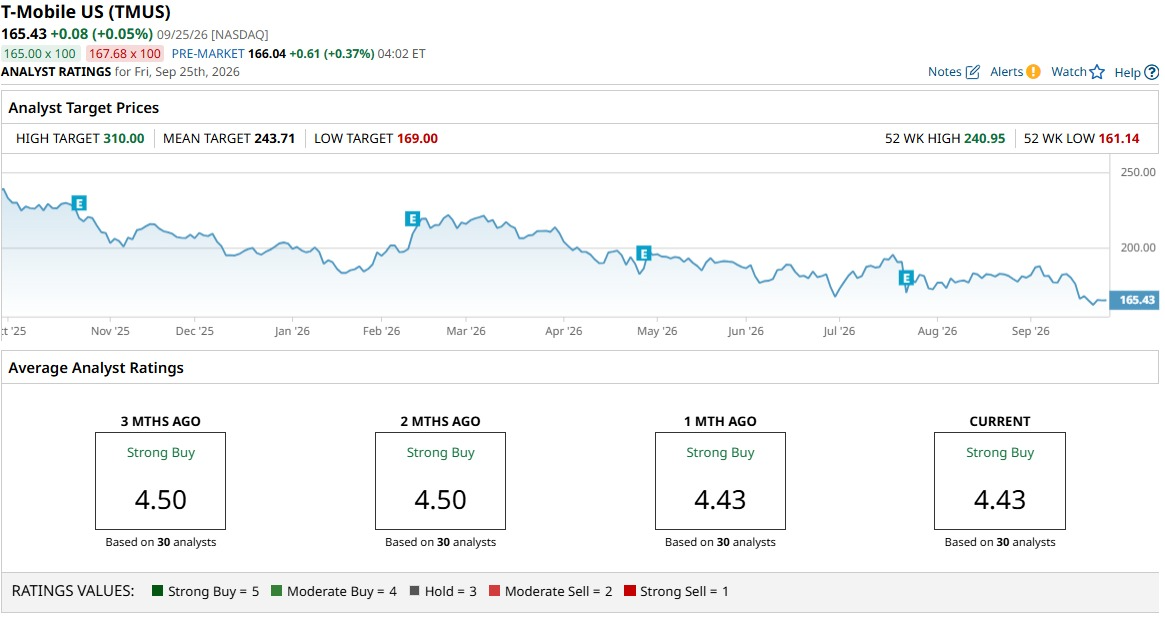
Wall Street remains broadly positive on TMUS stock, even as individual analysts have become more selective about price targets. On July 24, Scotiabank kept its “Outperform” rating on TMUS stock while cutting its price target from $243 to $232, which still implies potential upside from current levels.
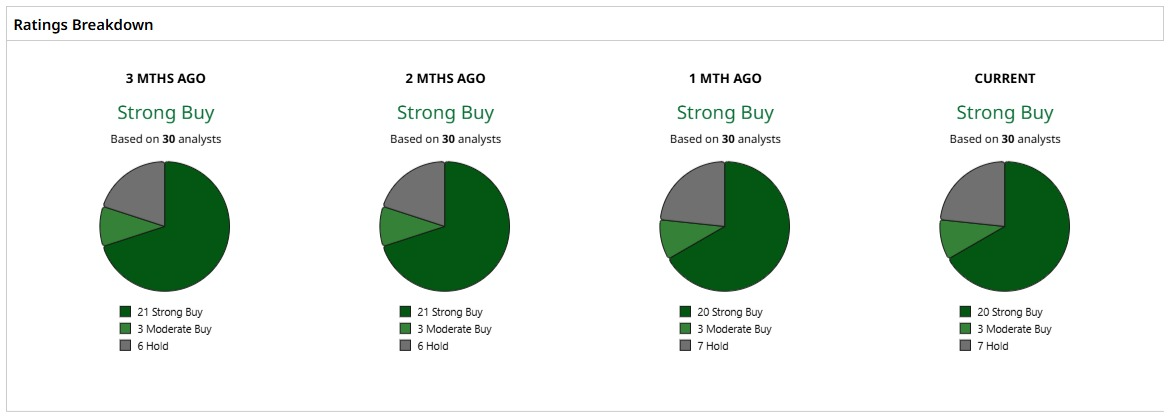
The wider analyst view points in a similar direction. Among 30 analysts with coverage, T-Mobile carries a consensus “Strong Buy” rating. The average price target of $243.71 implies potential upside of approximately 50% from here.
Conclusion
T-Mobile’s bigger dividend looks sustainable for now. Service revenue is growing, and management expects $18.4 billion to $18.8 billion in adjusted free cash flow this year. That gives the company room to pay shareholders while investing in its network. TMUS stock may also have room to recover if earnings meet expectations, though slower customer growth could hold it back. The dividend looks set to remain steady, with further increases depending on whether cash flow keeps growing.
On the date of publication, Ebube Jones did not have (either directly or indirectly) positions in any of the securities mentioned in this article. All information and data in this article is solely for informational purposes. For more information please view the Barchart Disclosure Policy here.