


HubSpot shares have retreated sharply over the past few years, which puts a spotlight on what investors are really paying for the company’s earnings today. With that backdrop, the core question is whether the current HubSpot stock price is still aligned with the profits the business is generating.
- The share price has fallen 69.3% over the past 5 years. This makes the link between HubSpot’s earnings power and its valuation far more important for anyone still holding or considering the stock.
- The business relies heavily on converting subscription revenue into sustainable earnings. As a result, the efficiency of its marketing spend, customer retention and upselling may support or constrain how much of its top line flows through to profit over time.
- The analysts covering HubSpot have run their own numbers. See what analysts think HubSpot's shares could be worth.
For investors, the debate is whether HubSpot’s current market price is adequately explained by the earnings the company is producing today and is expected to generate in the future.
To pressure test whether HubSpot’s earnings-based valuation still makes sense to you, it helps to compare it with other companies screened for 33 high quality undervalued stocks.
Does HubSpot Look Fairly Valued on Earnings?
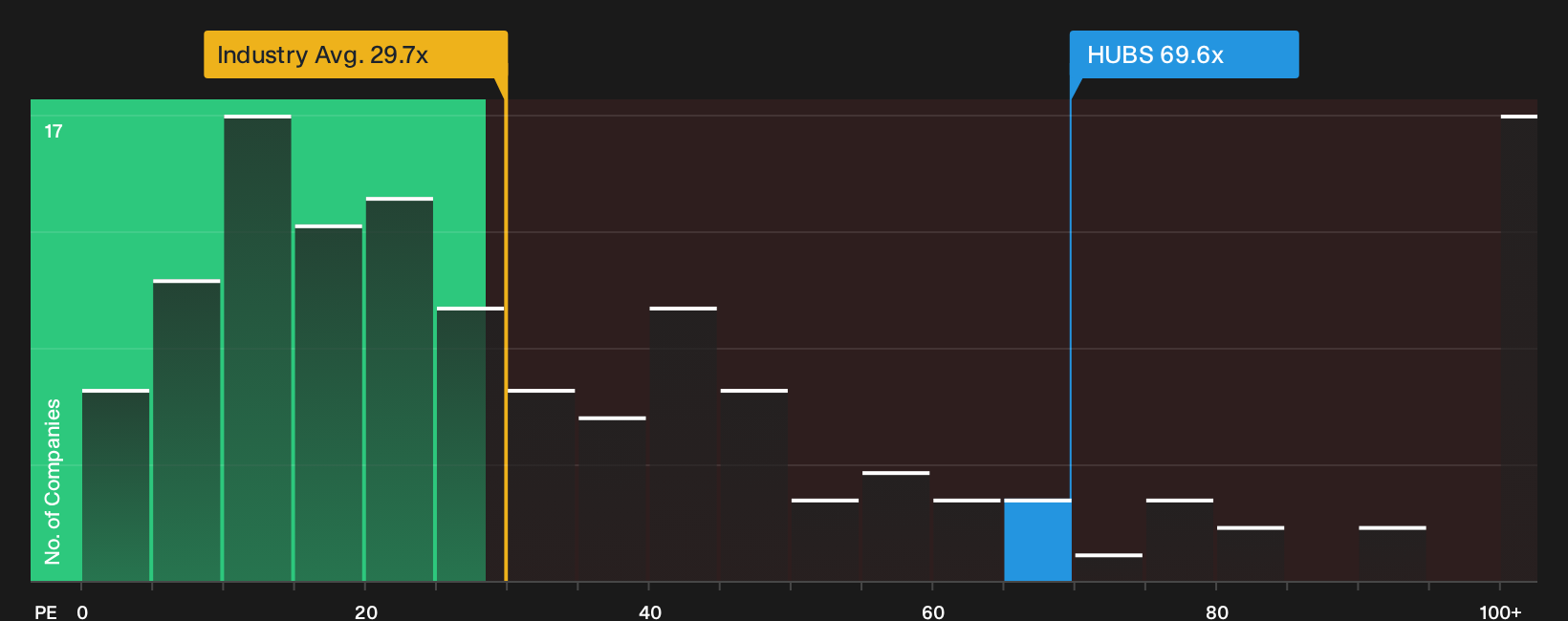
The P/E ratio fits HubSpot because investors mostly focus on how efficiently it can turn recurring software revenue into bottom line profit. Right now the stock trades on a P/E of about 69.6x, which is well above the broader Software sector average of roughly 29.7x and also higher than the peer group at about 42.9x. That points to a price that bakes in a strong view on the quality and durability of its earnings stream compared with many other software platforms.
A more tailored “fair” multiple that factors in HubSpot’s growth profile, margins, size and risk puts the current P/E close to what you might expect rather than far above or below it. In other words, the valuation looks rich against simple industry screens yet more aligned when you anchor it to the company’s own economics. That leaves the question of whether that premium makes sense resting on your view of its long term earnings power. Explore the numbers behind HubSpot's P/E valuation.
The HubSpot Narrative: What Would Justify Today's Price?
Narratives on HubSpot sit between the high P/E puzzle and your own expectations. They spell out which combinations of future growth, margins and earnings would need to hold for the stock to trade meaningfully above or below today's level, and each one treats fair value as a thesis about the business. This is something that you can revisit over time rather than a single frozen snapshot on Simply Wall St's Community page.
Community views on HubSpot split between one camp that sees a durable SMB CRM platform and another that is more focused on AI monetization risks and slower sales cycles.
Bull case: 38% undervalued
"HubSpot is a leading, product-led CRM platform for SMBs and mid-market companies that bundles marketing, sales, service, operations and commerce capabilities in an easy-to-adopt cloud suite..."
Discover why this Narrative puts HubSpot at 38% undervalued.
Bear case: 8% overvalued
"The small and medium business customer base that underpins HubSpot's growth may remain cautious in adopting advanced AI capabilities and multi-hub bundles, which could constrain upgrades, credit consumption and ultimately slow revenue growth and earnings expansion over the long term..."
Explore why this Narrative puts HubSpot at 8% overvalued.
The key unanswered issue for HubSpot investors
The valuation picture for HubSpot only tells part of the story, since separate checks have flagged specific business risks that could matter just as much for your thesis. Take a closer look at 2 warning signs before settling on a valuation.
This article by Simply Wall St is general in nature. We provide commentary based on historical data and analyst forecasts only using an unbiased methodology and our articles are not intended to be financial advice. It does not constitute a recommendation to buy or sell any stock, and does not take account of your objectives, or your financial situation. We aim to bring you long-term focused analysis driven by fundamental data. Note that our analysis may not factor in the latest price-sensitive company announcements or qualitative material. Simply Wall St has no position in any stocks mentioned.
Have feedback on this article? Concerned about the content? Get in touch with us directly. Alternatively, email editorial-team@simplywallst.com