


Netflix (NFLX) is one of the leading media entertainment providers with over 325 million paid subscribers globally. While many legacy media companies have struggled with streaming losses, Netflix generated $45.18 billion in annual revenue for 2025, operating with a highly efficient profit margin. Recently, however, the company’s investment case has increasingly shifted from subscriber growth to engagement. Netflix has already reached massive scale, so investors are now debating whether users are spending more time on the platform or gradually drifting elsewhere.
The debate intensified after Wells Fargo turned bearish on NFLX stock. The firm argues that the company’s recent push into gaming, podcasts, live programming, and other content categories may be weakening the core engine that made its platform successful in the first place. While Wells Fargo's downgrade highlights growing concerns about engagement trends, not everyone on Wall Street agrees that Netflix’s evolving strategy is a problem.
The Cost of Expanding Beyond Core Streaming
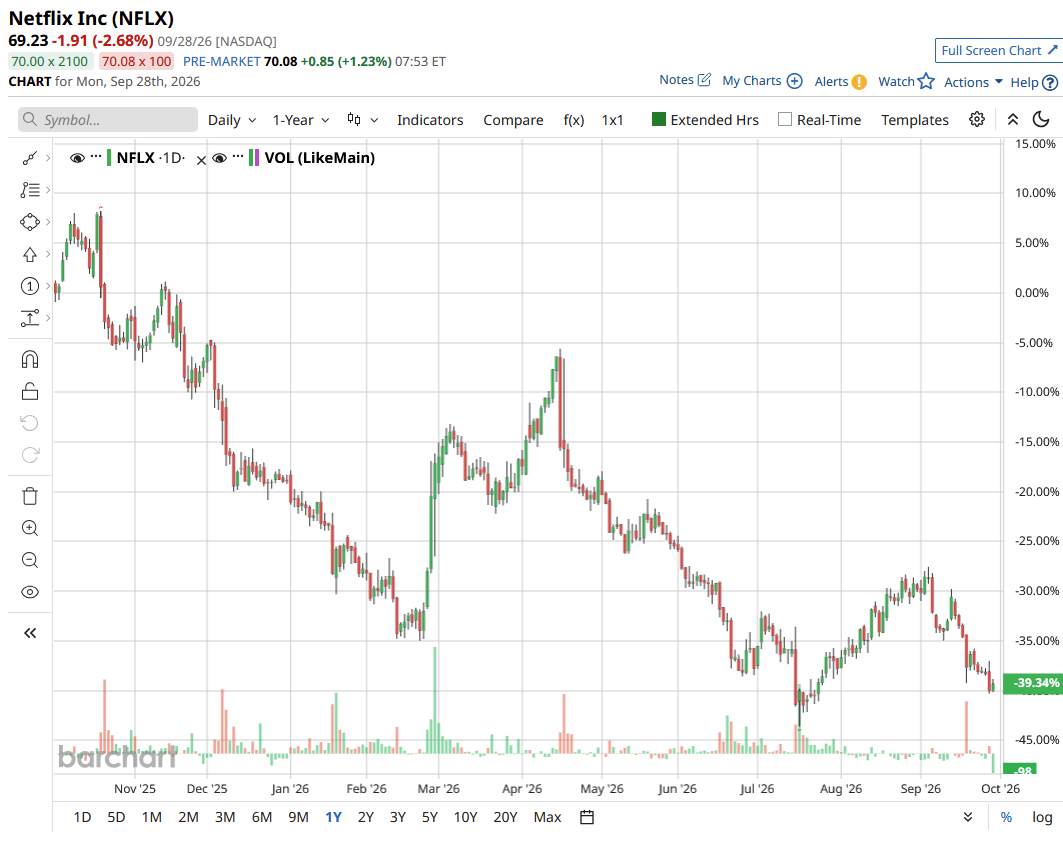
Over the past six months, NFLX stock is down 25%, underperforming the S&P 500’s ($SPX) gain of 21% during the same period. Recently, Wells Fargo downgraded the stock to “Underweight” from “Equal Weight” and cut its price target to $57 from $80. The downgrade reflects concerns over the company’s weakening engagement trends and content strategy. Wells Fargo argued that, due to Netflix's expansion strategy, viewership fell 8% year-over-year (YOY) in the first half of 2026, while hours viewed for its Top 100 Originals fell 3% in the same period. Furthermore, Wells Fargo expects a more than 20% YOY drop in Top 100 Originals in the second half of fiscal 2026.
One of the reasons for the decline in engagement could be that Netflix is not producing enough shows that capture widespread attention. In the past, the company has successfully delivered highly popular originals that have attracted new subscribers and kept existing users engaged. However, the company is increasingly expanding into sports, documentaries, gaming, and reality programming. Wells Fargo argues that this shift could move the company’s focus away from its blockbuster original programming that has historically driven its success. If engagement keeps falling, Netflix may have to increase content spending, which would hurt margins and increase uncertainty around future earnings.
Can New Content Categories Strengthen Engagement?
As Netflix expands into new content categories, it is no longer relying solely on water-cooler originals to drive engagement. This is where Wall Street remains divided. Bulls argue that the company’s strategy is designed to increase the number of reasons users open Netflix each week, reducing dependence on a handful of hit shows.
The advertising business adds to this bull thesis. Wells Fargo is focused on declining viewing trends, but bulls argue that Netflix’s growing ad business gives management another reason to expand content offerings beyond blockbuster originals. The company remains on track to generate approximately $3 billion in ad revenue in 2026. Therefore, the key question for investors is whether Netflix’s engagement slowdown reflects a temporary content cycle or evidence that the platform is losing its competitive edge.
About Netflix Stock
Netflix is a global entertainment company that provides streaming services and offers a wide range of content, including TV shows, documentaries, movies, and games. It also provides members with the ability to receive streaming content through a host of internet-connected devices, including TVs, digital video players, and mobile devices. Founded in 1997, the company is headquartered in Los Gatos, California.
NFLX stock has continued to decline this year. The stock currently trades near its 52-week low of $65. Year-to-date (YTD), NFLX stock has also declined by 26%, significantly underperforming the S&P 500’s gain of 12% in the same period. The decline has been driven primarily by weaker-than-expected forward guidance and growing investor concerns about the next phase of growth.
Revenue Growth Remains Healthy, But Momentum Is Slowing
Netflix reported its second-quarter fiscal 2026 earnings on July 16. The company reported revenue of $12.56 billion, coming in slightly below the $12.58 billion forecast. FX-neutral revenue grew 12% YOY, while EPS came in at $0.80, rising 11% YOY and beating the Wall Street consensus estimate of $0.79.
Looking forward, Netflix guided 12% reported revenue growth and 11% FX-neutral growth for Q3 fiscal 2026. For the full year, the company expects top-line growth of 13% to 14%, or roughly $51 billion to $51.4 billion in revenue. Management also said content spending is expected to rise about 10% in 2026, slower than revenue growth, which should help support margins over time. The company is planning to invest in live programming, video podcasts, vertical video clips, games, and AI tools while keeping its core focus on TV series and films.
What Do Analysts Expect for NFLX Stock?
Wall Street remains divided on Netflix stock. Wells Fargo downgraded NFLX stock to “Underweight” from “Equal Weight” with a price target of $57 per share. The downward revision is due to the firm’s concerns over the company’s engagement trends. Wells Fargo believes Netflix’s lineup of original shows and movies in the second half of 2026 is weaker than in previous years, and estimates that viewing hours for Netflix’s Top 100 original titles could fall by 21% compared to last year. In contrast, Bernstein analyst Laurent Yoon has a “Buy” rating on Netflix stock with a price target of $95.
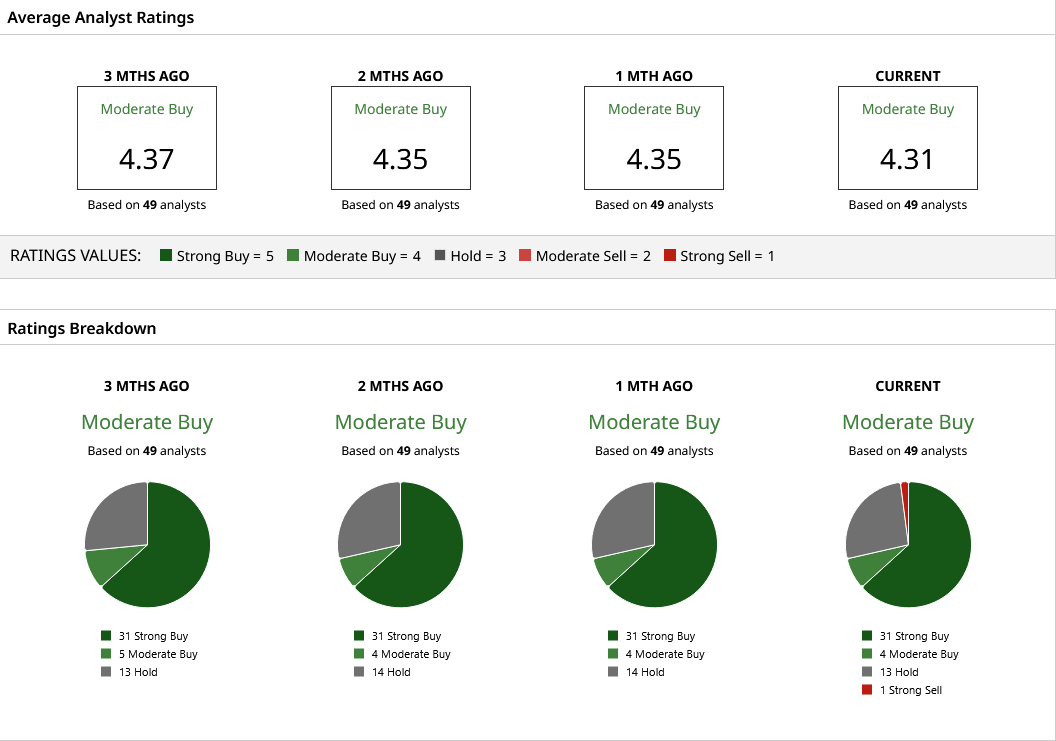
Overall, Netflix has a consensus “Moderate Buy” rating on Wall Street. The mean price target of $94.77 reflects potential upside of 36% from current levels.
On the date of publication, Jabran Kundi did not have (either directly or indirectly) positions in any of the securities mentioned in this article. All information and data in this article is solely for informational purposes. For more information please view the Barchart Disclosure Policy here.