


Nvidia (NVDA) remains one of the biggest beneficiaries of the artificial intelligence (AI) boom. However, as AI continues to grow, investors are increasingly debating whether the company can maintain its dominance as competitors invest heavily in their own offerings. Recent comments from Nvidia CEO Jensen Huang addressed these concerns. CEO Jensen Huang said that Nvidia expects to double its chip volume next year due to strong AI demand.
“I expect Nvidia to sell twice as many chips as this next year as we do this year,” Huang remarked at a summit. “The reason for that is because AI has so much contribution to the benefits of different industries, different economies, and you can see that in almost every single country that we’re in, people want to invest in AI.”
This suggests that demand for Nvidia’s products remains strong despite concerns about the pace of AI infrastructure spending. Huang said the increase would come from Nvidia’s expanding portfolio of AI products, including GPUs, CPUs, networking equipment, and complete AI systems. These comments reinforce the bullish view that major cloud providers and enterprises are still investing aggressively in AI infrastructure.
The Debate Is Shifting From Demand to Market Share
While Huang’s comments reinforce demand strength, some institutional investors argue the key question is no longer whether AI spending is growing but whether Nvidia can maintain its current share of that spending. In this context, it is also worth noting that the firm announced a $150 billion buyback. But on the business front, it faces competition from several market peers.
Advanced Micro Devices (AMD) recently crossed $1 trillion in market capitalization as investors continue to gain confidence in its expanding AI business. Similarly, Chinese technology companies are investing heavily in domestic chips and computing systems. In addition, deploying AI infrastructure requires significant power, networking, and data-center capacity. These factors have led some investors to argue that future growth will depend not only on demand but also on Nvidia’s ability to defend market share and navigate broader industry constraints.
While these risks could create challenges for Nvidia over the long term, its current valuation provides some context for investors. Nvidia’s valuation looks attractive on almost every measure. For example, the forward price-to-earnings (P/E) ratio of 24.7 times sits about 52% below its five-year average of 51.9 times. So, even as the company remains the center of the AI boom, NVDA stock trades at a discount to its historical norms.
For Nvidia, the key debate is no longer whether AI demand exists but whether the company can continue capturing a large share of that demand. Huang’s comments suggest that AI infrastructure spending remains robust and that Nvidia expects growth to continue. At the same time, rising competition and industry bottlenecks could create challenges over the long term. However, with NVDA stock trading well below its historical valuation multiples, investors appear to be weighing those risks against Nvidia’s continued leadership in the AI market.
About Nvidia Stock
Nvidia operates as a data center-scale AI infrastructure company. The company operates through two main segments. The Compute & Networking segment provides data center accelerated computing, networking platforms, and AI solutions, while the Graphics segment offers GeForce GPUs for gaming and PCs. The company outpaces competitors like AMD and Intel (INTC) because it does not just sell silicon chips; Nvidia sells an entire integrated technology ecosystem. Founded in 1993, the company is headquartered in Santa Clara, California.
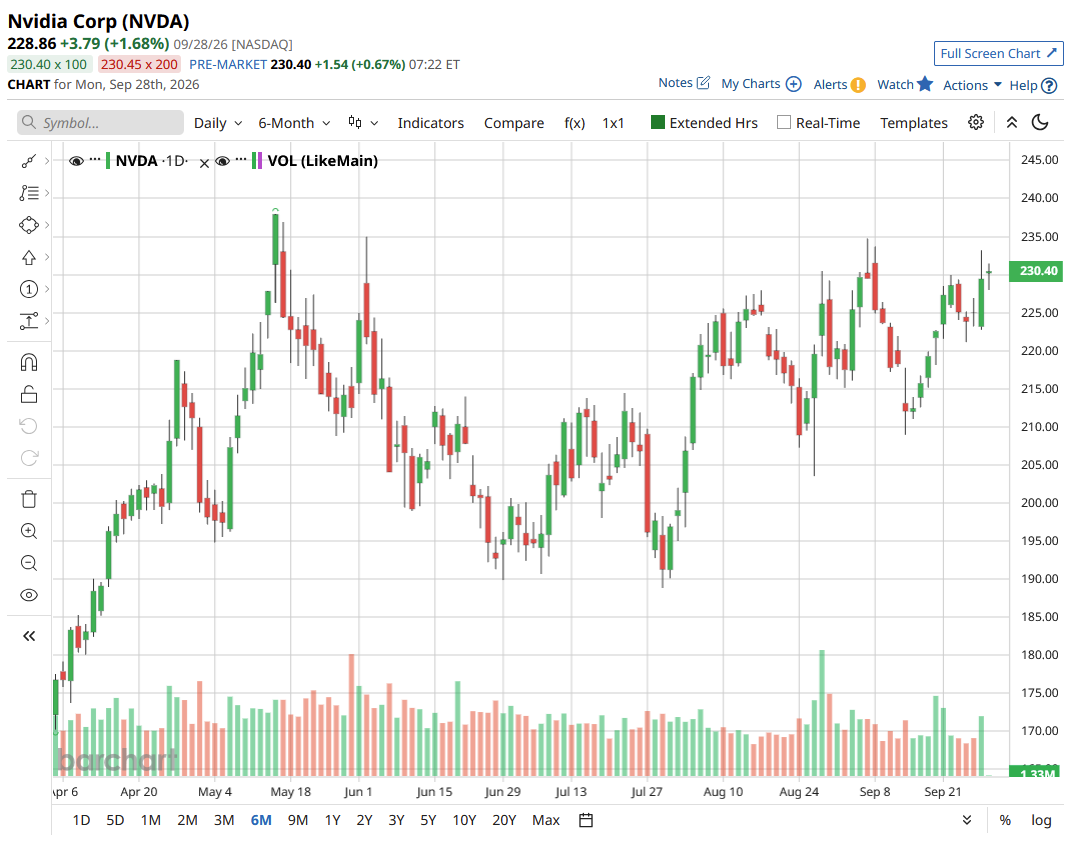
Over the past 12 months, NVDA stock has surged 22%, underperforming the iShares Semiconductor ETF’s (SOXX) gain of 110% during the same period. After reaching its 52-week high of $236.54 in May, Nvidia stock fell to $192 in late June. Since then, however, the stock has regained some traction, now trading near the $228 level.
Nvidia Raises the Bar for Fiscal 2028
Nvidia reported its second-quarter fiscal 2027 earnings on Aug. 26. The company reported total revenue of $96.2 billion. Adjusted EPS came in at $2.22, beating the Wall Street consensus of $2.08 per share. Both GAAP and non-GAAP gross margins were 75%, largely unchanged from the previous quarter due to a similar product mix. CFO Colette Kress described cost drivers and spending, saying that GAAP and non-GAAP operating expenses were up 10% and 11% sequentially. This was primarily due to high compute-infrastructure costs as well as compensation and benefits costs.
Looking forward, Nvidia expects Q3 fiscal 2027 revenue to be $108 billion. The company also guided for gross margins of 74% and operating expenses of $9.2 billion on a GAAP basis and $9 billion on a non-GAAP basis.
Nvidia’s Vera Rubin shipments began in August, and the new platform is already seeing purchase orders from major hyperscalers, AI cloud providers, and system makers. Vera Rubin is expected to account for about 20% of data-center revenue in the current quarter.
On the Q2 earnings call, Morgan Stanley asked why Nvidia is guiding for about 70% revenue growth in fiscal 2028 when demand appears to be growing closer to 100%. CEO Jensen Huang said that Nvidia now has much better visibility into both customer demand and its supply chain. AI demand is stronger than Nvidia’s 70% growth forecast. However, the company is only guiding for 70% growth because that is the level it believes it can reliably support with its expected chip supply.
What Do Analysts Expect for NVDA Stock?
Wall Street remains largely bullish on Nvidia stock. Earlier this month, William Blair analyst Sebastien Naji reiterated a “Buy” rating on NVDA stock, maintaining his bullish stance due to a combination of factors tied to the company’s strengthening position in AI data-center security. Similarly, Bernstein recently maintained a “Buy” rating on Nvidia with a price target of $400.
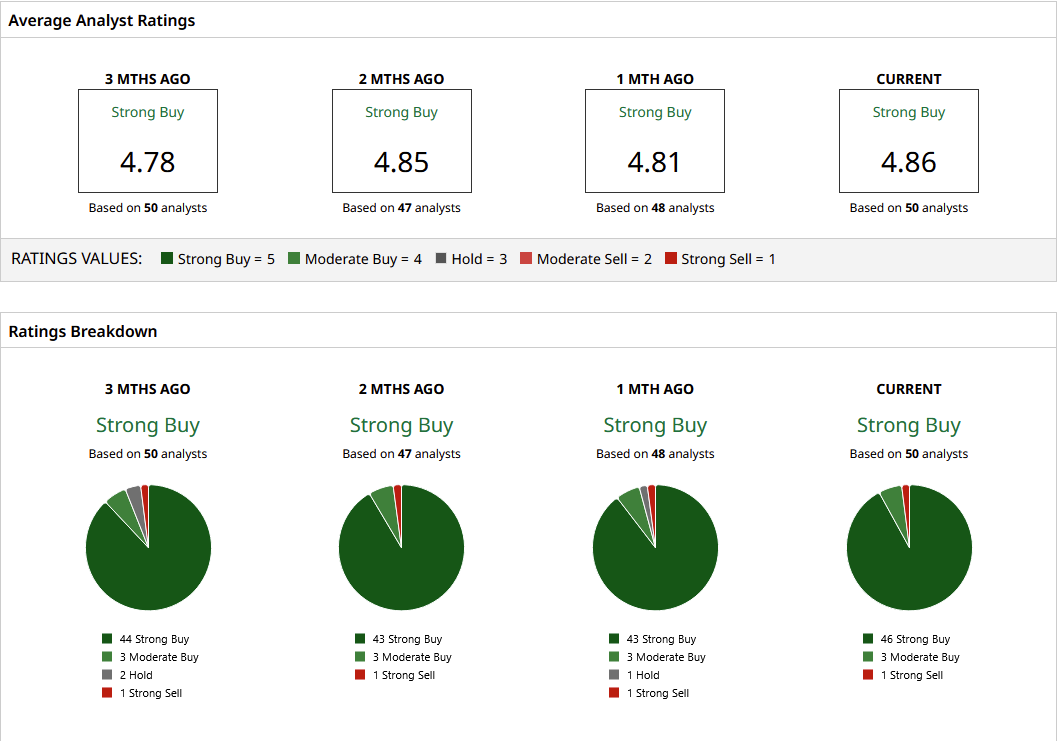
Based on 50 Wall Street analysts covering the stock, Nvidia has a consensus “Strong Buy” rating. The mean price target of $326.90 reflects potential upside of 43% from current levels. Meanwhile, the high price target of $515 implies impressive potential upside of 126% from here.
On the date of publication, Jabran Kundi did not have (either directly or indirectly) positions in any of the securities mentioned in this article. All information and data in this article is solely for informational purposes. For more information please view the Barchart Disclosure Policy here.