


South Korea just hit pause on part of its bond sales plan, and that small shift in government funding could ripple through funding costs, valuations and sentiment across the financial sector. Lower planned issuance in October narrows supply, which can help ease the yield burden on everything from bank debt to insurance portfolios. This article walks through 3 South Korean financial stocks that are directly exposed to this news and explains how that backdrop might matter for your portfolio.
The stocks below are just a starting sample, and the full screen surfaced 9 more South Korean banks and insurers with equally compelling stories that are not covered here. If you want to identify where easing bond pressure might matter most, head straight into the South Korean Financials (Banks and Insurers) screener.
KB Financial Group (KOSE:A105560)
KB Financial Group is a flagship South Korean lender in this screener, with earnings and funding costs closely tied to local bond yields, so any easing in sovereign rates can feed directly into how its banking, card, securities and insurance arms price money and manage risk.
KB Financial Group runs a broad financial platform anchored in South Korea, earning about ₩4.3b from retail banking, ₩4.3b from corporate banking and ₩2.3b from other banking services, alongside securities, cards and insurance segments, and carries a market value near ₩59.7t.
"Accelerated digital adoption in Korean financial services is expected to lower its cost-to-income ratio and increase customer acquisition via expanded digital platforms and fintech investments, which in turn could influence net margins and transaction-driven revenue."
What really matters from here is how one quiet shift in its funding mix ultimately flows through to those future margin and dividend decisions.
That funding shift is only one layer in the story, and the full narrative for KB Financial Group shows how KB Financial Group’s digital push and capital choices could reshape the risk reward mix.

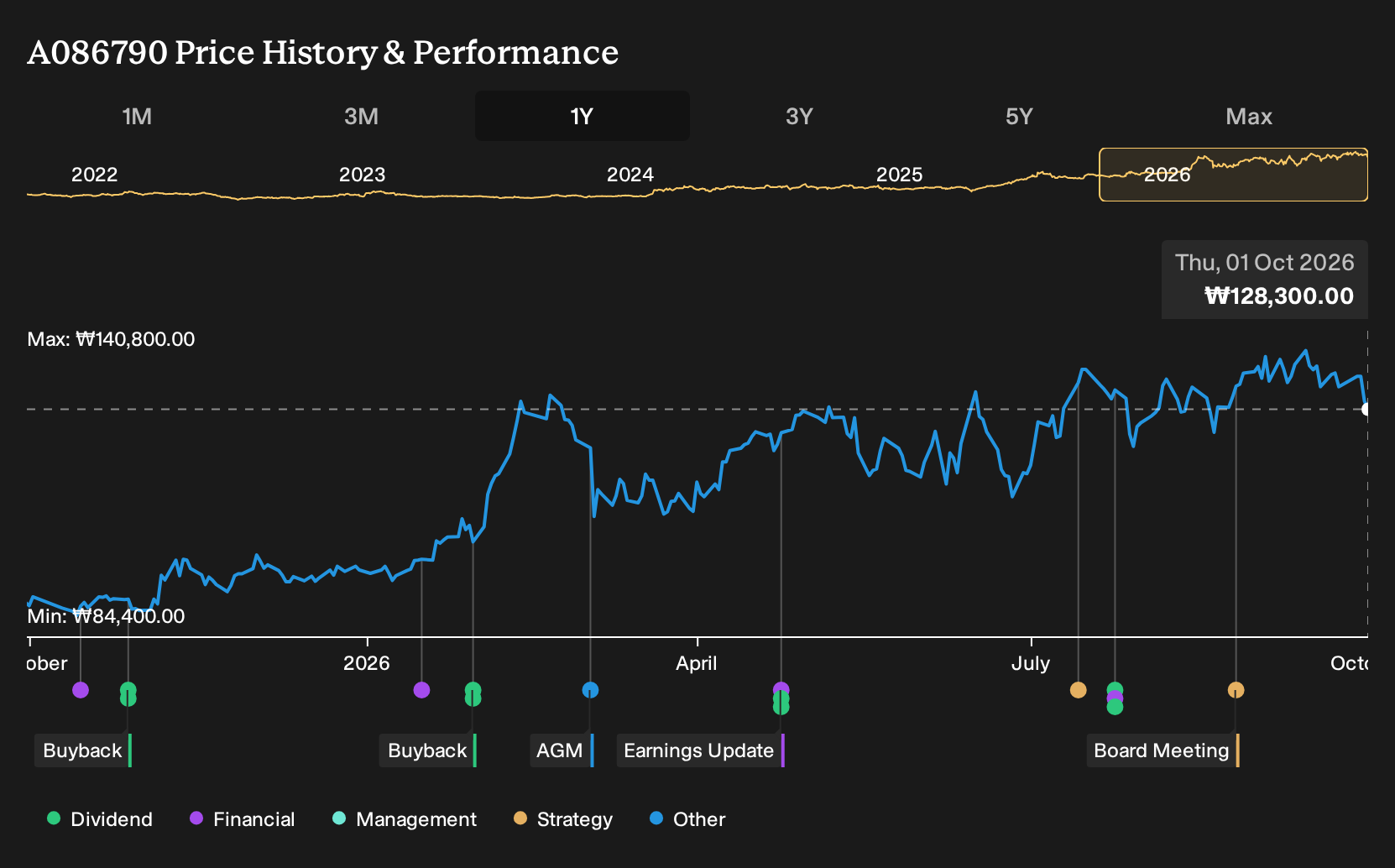
Hana Financial Group (KOSE:A086790)
Hana Financial Group is one of the big South Korean lenders in this screener theme, where lower government bond yields can directly influence funding costs across its banking, securities, card and capital financing arms. It generated about ₩10.0b from banking within a roughly ₩34.7t market value.
Hana Financial Group is a broad financial services platform whose funding and balance sheet strength are tightly linked to South Korean bond conditions, so any shift in government yields matters for how shareholders think about returns and risk.
"Accelerating digital disruption in Asian financial services is likely to intensify competition from both domestic and global fintechs, which could erode Hana Financial Group's fee income, compress net interest margins, and affect long-term profitability as new entrants innovate more rapidly."
The key issue is how one unresolved pressure on its profitability ultimately shapes investors’ expectations for margins and future payout capacity.
That tension between pressure and potential is exactly what the full narrative for Hana Financial Group unpacks, highlighting where accelerating digital change could still reward patient Hana Financial Group shareholders.
Shinhan Financial Group (KOSE:A055550)
Shinhan Financial Group is one of the clearest rate-sensitive plays in this South Korean banks and insurers screen, with a large domestic lending book and sizeable investment portfolio that both respond quickly when government bond yields and funding costs start to ease.
Shinhan Financial Group runs a broad financial platform across banking, cards, securities and insurance. It generates about ₩9.8b from banking, ₩1.9b from securities, ₩1.7b from credit cards, and roughly ₩0.9b from insurance, within a market value around ₩49.8t.
"The 2025 Value-up plan aims to improve ROE by more than 50 basis points year-over-year through stable bank earnings and structural improvement of non-bank businesses, which could positively impact future earnings."
What really moves the dial for Shinhan Financial Group is how one quiet shift in domestic funding conditions interacts with that value-up agenda for margins and payouts.
That interaction is exactly what the full narrative for Shinhan Financial Group unpacks, mapping how rate shifts, capital moves and non bank momentum could reshape Shinhan Financial Group's risk reward profile.

Curious About Alternative Market Paths
Fresh ideas move first. Breakout themes and quiet compounding stories rarely stay under the radar for long. Before the crowd catches what is flying or dropping, act now.
- Spot cash generative businesses early and filter for resilient balance sheets with the list of solid balance sheet and fundamentals (205 results) while it still focuses on under the radar strength.
- Ride early momentum in companies powering AI infrastructure and track where capital is already building with the 90 AI infrastructure stocks before that interest spills into headlines.
- Target steady income from companies with strong payouts by scanning the 159 dividend fortresses before yield hunters compress spreads and narrow your entry options.
This article by Simply Wall St is general in nature. We provide commentary based on historical data and analyst forecasts only using an unbiased methodology and our articles are not intended to be financial advice. It does not constitute a recommendation to buy or sell any stock, and does not take account of your objectives, or your financial situation. We aim to bring you long-term focused analysis driven by fundamental data. Note that our analysis may not factor in the latest price-sensitive company announcements or qualitative material. Simply Wall St has no position in any stocks mentioned.
Have feedback on this article? Concerned about the content? Get in touch with us directly. Alternatively, email editorial-team@simplywallst.com