


The Zhitong Finance App learned that Saudi Arabia, a major oil producer in the Middle East, has increased the crude oil transportation volume of its key cross-border pipeline to more than 80% of its transportation capacity. As it reduced the supply of crude oil to domestic refineries, the amount of crude oil available for export on the west coast of the country reached its highest level since the outbreak of the US-Iran war at the end of February. As pipeline restoration and expectations for global oil release promoted by French President Emmanuel Macron jointly ease supply anxiety, the market is beginning to reassess crude oil scarcity premiums and energy cost pressures.
A person familiar with the matter said that Saudi Aramco, the largest Saudi state-owned enterprise and one of the world's largest energy giants, transports close to 6 million barrels of crude oil per day through an east-west pipeline. Since non-public information was being discussed, the person requested anonymity. The source said that after deducting crude oil supplied to Saudi refineries on the west coast, the company can currently export about 4.5 million barrels of crude oil per day.
Saudi Aramco and the Saudi Ministry of Energy did not respond to requests for comment outside of normal business hours.
Earlier this week, the pipeline, which has a daily delivery capacity of 7 million barrels, was still operating at about half its capacity, and since then the company has rapidly increased its delivery volume. During the Iran war, this pipeline has been an important channel for maintaining crude oil exports, enabling Saudi Arabia to export nearly 4 million barrels of crude oil per day through the Red Sea earlier this year without having to rely on a dangerous voyage through the Strait of Hormuz.
However, this route has come under pressure in recent months. Last month, the pipeline stopped operating after being hit by projectiles fired from within Iraq.
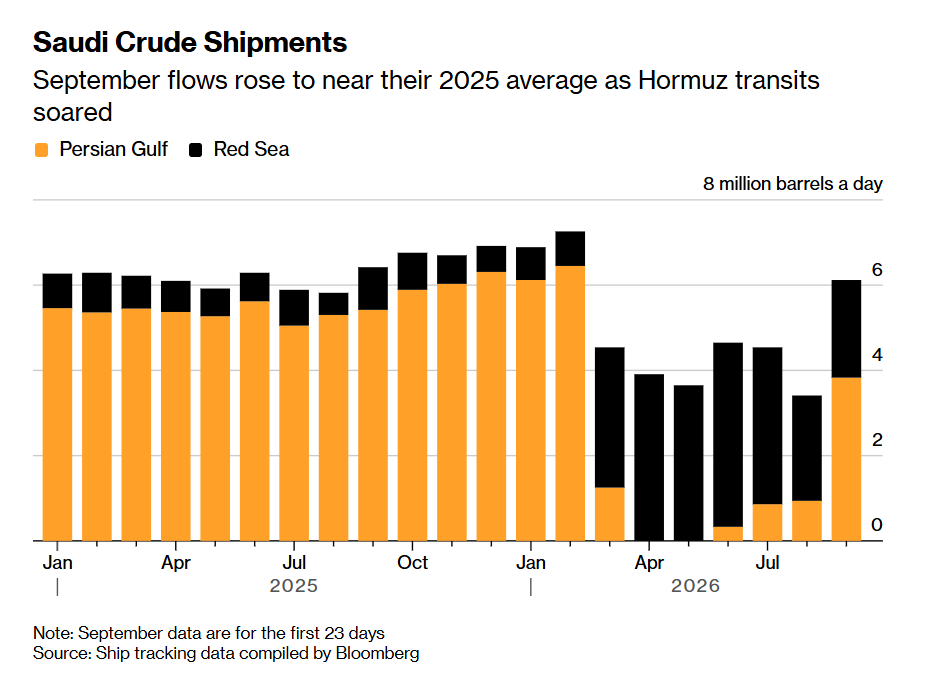
As shown in the chart above, Saudi crude oil shipments rose to close to the 2025 average in September as traffic surged in the Strait of Hormuz. Note: September data only covers the first 23 days of the month. Source: Ship-tracking data compiled by Bloomberg.
Saudi Arabia has responded to pipeline shutdowns by drastically increasing traffic through the Strait of Hormuz in recent weeks. Shipments have also resumed at Yanbu Port in the Red Sea, where the east-west pipeline ends. J.P. Morgan and Goldman Sachs estimate that these factors combined to drive Saudi crude oil shipments to a sharp recovery in overall Middle East oil exports, close to pre-war levels.
The overall increase in exports helped drive oil prices down this week, and Brent crude oil in the London market finally fell below $100 per barrel on Friday. As the US sends an additional aircraft carrier and troops to the Middle East, futures traders in the commodity market are also actively watching the risk that hostilities in the Middle East may escalate.
Saudi Arabia opens “crude oil pressure relief valve”
Saudi Arabia's crude oil transportation capacity to bypass the Strait of Hormuz is being released at an accelerated pace, becoming an important supply background for the fall in pre-market oil prices for US stocks today. The actual volume of east-west pipelines has risen from about half of the load earlier this week to nearly 6 million b/d, equivalent to about 86% of its nominal transportation capacity of 7 million b/d; after deducting the supply from West Coast refineries, about 4.5 million b/d of crude oil can be exported, reaching the highest level since the war. At the same time, Saudi Arabia's previous increase in Hormuz transportation complements the resumption of shipping at Yanbu Port, enhancing the resilience of crude oil exports. However, a precise distinction is needed: 4.5 million barrels are the amount of crude oil available for export, which is not equal to the quantity that has already been loaded, left port, or delivered.
Supply restoration and European discussions to release reserves have jointly lowered pre-market energy prices. At 20:02 Beijing time on October 2, Brent crude oil futures were reported at $99.78 per barrel, down 2.47%; WTI reported $89.55 per barrel, down 3.57%. The European diesel benchmark futures fell about 4.1% to $1,390/ton during the same period. Based on the settlement prices of Brent of $72.48 and WTI of $67.02 on February 27, the last trading day before the war broke out on February 28, the two were still up about 37.7% and 33.6%, respectively, from before the war. This means that the market is lowering supply interruption premiums, but prices have yet to return to pre-war levels.
However, military and transportation risks still coexist. The US is sending a third aircraft carrier strike group and about 9,000-10,000 personnel to the Middle East; while maintaining diplomatic channels, Iran is preparing a broader response for America's possible resumption of large-scale attacks. Although there are more tankers passing through Hormuz, three oil tankers were reported to have been hit by unknown projectiles on September 29; fighting continued in Yemen in the southern Red Sea, and on October 2, government forces announced 20 air strikes against Ta'iz-Houthi targets. The current more accurate market narrative can be described as “the recovery of crude oil exports and the coexistence of shipping risks”, and the sustainability of supply improvements is being tested.
The “crude oil decompression line” has moved forward, and refined oil products and global interest rates have yet to be loosened
This recovery involves not only the acceleration of pipelines, but also the redistribution of crude oil between domestic refineries and exports. Media reports did mention that Saudi Arabia has reduced the supply of domestic refineries, increasing the amount of crude oil that can be exported from the West Bank.
Therefore, after the global market obtains more crude oil, it also depends on whether the receiving refinery can process it into products such as diesel and aviation coal. Reducing the flow of oil from a certain pipeline to refineries cannot directly deduce a decline in oil refining volume across Saudi Arabia, as refineries may use other sources or stocks. The IEA previously announced that due to the production capacity maintenance process and the Middle East and Russia's refining capacity being hit by war fire, global refinery processing volume decreased by 4.2 million b/d in August over the same period last year, which is enough to show that the refining and chemical process itself is still a supply constraint.
Transportation routes also need to be determined separately. The east-west pipeline transports crude oil to Yanbu Port in the Red Sea and can bypass Hormuz; however, shipping from Yanbu south to Asia still faces safety risks in the Mander Strait, and it is not necessary to go through the Mander Strait if it travels north to Europe via Suez. The latest Saudi pipeline restoration process has improved route selection capabilities, and final export fulfillment also depends on shipping, insurance, and safe navigation.
The “crude oil decompression line” is moving forward, and the “fuel decompression line” still depends on refining and cross-border delivery. If the price of crude oil falls and the cracking price difference between diesel and crude oil is still high, it means that the improvement in supply has not been fully transmitted to terminal fuel costs. Global long-term bonds have partially recovered, but they are still in a high yield range. According to estimates that can be verified before the announcement, the yield on US 10-year treasury bonds was about 5.22%, lower than the 5.34% that was once hit on October 1; the UK 10-year term was about 5.33%, which also declined somewhat after breaking 6% before the 30-year term; Japan's 10-year term was about 3.11% and the 30-year term was about 4.21%, which is still high.
The cooling of oil prices will help ease the expected pressure of inflation and interest rate hikes, but the normalization of Japan's policies, financial supply, and actual capital needs of various countries will still affect long-term interest rates. As far as optimistic expectations of the global AI bull market are concerned, the investment significance of this transmission chain is that if the improvement of energy supply in the Middle East continues to reduce the pressure on terminal costs, it may cool down the “anchor of global asset pricing” and reduce the financing threshold for AI capital expenditure and the valuation discount pressure on technology stocks.