


Another global segment leader has knocked on the capital market.
On September 29, Liudao Industrial Holdings Co., Ltd. (“Liudao Industrial” for short), a global precision temperature control technology company, officially submitted a listing application to the main board of the Hong Kong Stock Exchange. CICC and CITIC Securities acted as joint sponsors. In terms of revenue, the company is the world's largest supplier of hot runner systems. In 2025, the company held the top position with a global share of about 12.5% and an Asian share of about 21.5%, and ranked first in the Chinese and Korean markets.
The leading barriers are deep, and the basic market is stable, but the growth rate is slowing down
According to the prospectus, Liudao Industrial is a global leader in hot runner systems with precise temperature control technology as the core. It also ranks first in the world in the two major terminal application markets of automobiles and electronic appliances. The essence of its business is to provide differentiated heat control products and solutions around the heating, cooling and flow of materials in plastic injection molding.
The company is the only player in the market that can provide a full range of hot runner systems and in-house production of all key components. Vertical integration and full product line capabilities form the core moat. The downstream covers automobiles, electronic appliances, packaging and other industries. More importantly, the company is transforming from a product supplier to a technology-driven solution provider, and plans to extend precision thermal control technology to new scenarios such as ultra-precise fluid-free molding of contact lenses, in-mold polyurethane coating, supercritical fluid foaming in the midsole, and multi-material co-injection molding, opening up a second curve for medium- to long-term growth.
On the revenue side, the company's revenue from 2023 to 2025 was 367 million, 373 million, and 381 million US dollars respectively, showing a moderate growth trend, but the compound growth rate was less than 2%, indicating that the global hot runner market has entered a mature period, and there is limited room for overall expansion of the industry. Revenue for the first half of 2026 was US$182 million, a slight decrease of 3.4% from US$188 million in the same period in 2025. We need to be wary of growth pressure brought about by fluctuations in the demand cycle in the downstream automotive, home appliance and packaging industries.
However, the bottom line of the company's profit quality is excellent. From 2023 to 2025, the company's gross margin stabilized at around 54% (further rising to 55.3% in the first half of 2026). In the field of equipment manufacturing and materials, gross margins of more than 50% are extremely rare, which confirms its vertical integration advantage of “all key components are produced in-house” and the strong pricing power brought by a full range of product portfolios. The high-margin moat ensures that when the company's revenue reaches its peak, it still has strong resilience to risks.
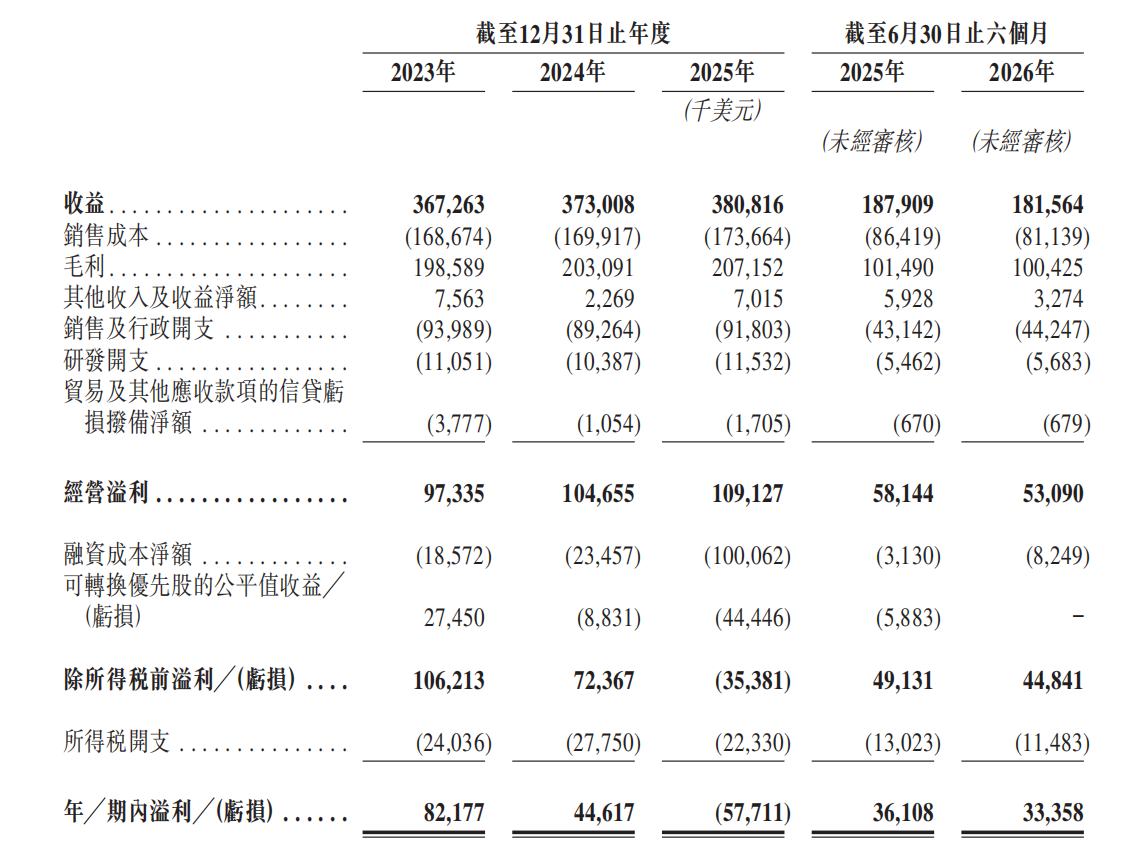
Specifically, the company's core business performance was very strong. Operating profit grew steadily from US$97 million to US$109 million from 2023 to 2025. However, there was a serious divergence between the company's net profit and operating profit: profit for the 2023, 2024, and 2025 periods was 82 million, 45 million, and -58 million US dollars, respectively, and changed from profit to loss in 2025. However, this is not a deterioration in the main business; it is due to two major non-operating factors: First, changes in the fair value of convertible preferred stocks: contributing income of US$27 million in 2023, loss of US$0.09 billion in 2024, and expansion of losses to US$44 million in 2025. This is usually an accounting treatment resulting from pre-IPO financing and is a non-cash book loss. Second, net financing costs have surged: net financing costs surged from US$23 million in 2024 to US$100 million in 2025; reaching US$08 billion in the first half of 2026 (a significant increase from US$0.3 billion in the same period in 2025). This reflects that the company may have carried out debt restructuring or introduced higher-cost loans before listing, putting substantial pressure on actual cash flow.
Simply put, Liu Dao Industrial's submission shows the undertone of a mature segment leader: although growth has slowed, profit quality is extremely high, and the “loss” in net profit is probably more the result of pre-listing financial restructuring.
Highly concentrated business, accelerated expansion of new applications into new perspectives
According to the Zhitong Finance App, Liudao Industrial's position as the global leader in hot runner systems is quite clear, but its revenue is highly dependent on the complete set of hot runner system equipment. Revenue growth is close to stagnating, and the growth prospects are not without worries.
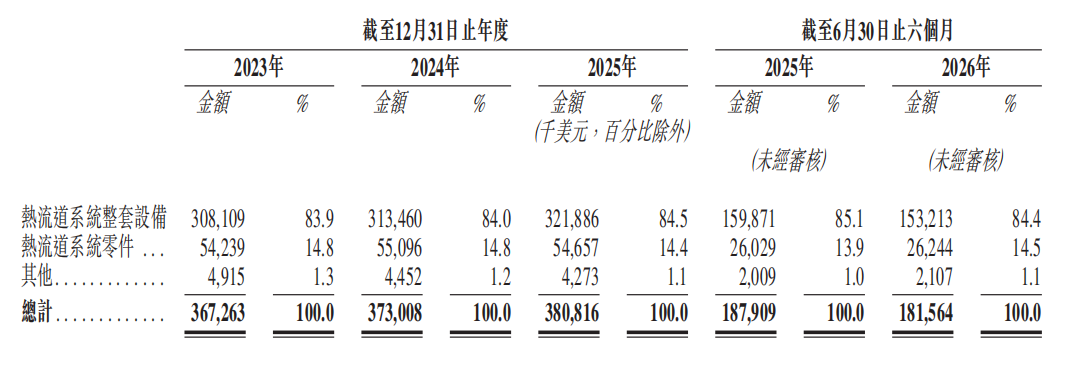
From 2023 to 2025, the revenue share of complete hot runner system equipment was 83.9%, 84.0%, and 84.5%, respectively, and 84.4% in the first half of 2026; the share of hot runner system parts stabilized at around 14%, and other businesses accounted for only 1%. This structure indicates that the company's main business is focused, but it also means that the source of revenue is relatively single, and it is highly sensitive to machine sales and downstream capital expenses.
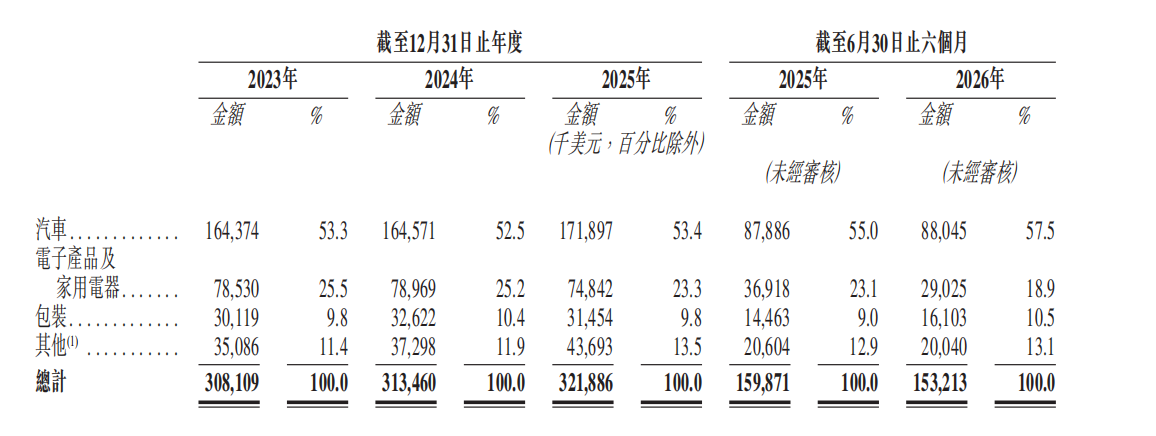
In terms of downstream applications, automobiles are the company's largest terminal market. The revenue share continued to rise from 53.3% in 2023 to 57.5% in the first half of 2026; the share of electronic products and household appliances fell from 25.5% to 18.9%; the packaging industry accounted for about 10%, and other industries rose from 11.4% to 13.1%. The increase in the share of automobiles is consistent with the largest application field of global hot runner systems, but it also means that the company's dependence on the automotive industry cycle has deepened. Fluctuations in capital expenditure in the automotive industry, pressure on automakers to cut costs, and price competition in the NEV industry chain may all be transmitted to hot runner suppliers.
Looking at macro performance, the global hot runner system market is about US$3,014 billion in 2025, and is expected to reach US$4.04 billion in 2030. The compound growth rate from 2025 to 2030 is about 6.0%, up from 1.5% from 2020 to 2025. The market for precise temperature control solutions is expected to reach US$405.1 billion in 2030, with a compound growth rate of 5.2% from 2025 to 2030. Looking at the long term, the direction of the manufacturing industry from rough heat dissipation management to precise temperature control is clear, and there is still room for improvement in the penetration rate of hot runners. However, it should be pointed out that industry growth is a slow variable, and the decline in average selling prices over the past few years has partially offset the increase in sales volume. As a global leader, the company's market share has reached 12.5% and the Asian market share is 21.5%. There is relatively limited room for further increase in share, and future growth will depend more on the overall expansion of the industry.
What is worth looking forward to is that the company plans to expand precision thermal control technology to new applications such as ultra-precise fluid-free molding of contact lenses, supercritical fluid foaming in footwear midsoles, in-mold polyurethane coatings, and multi-material co-injection molding. There is potential demand in these directions, but most are still in the early stages, with limited revenue contributions, and uncertainty about the pace of commercialization, customer verification, and return on capital expenses. The company's R&D expenditure is stable at around 11 million US dollars per year, accounting for about 3% of revenue. The scale is absolutely small, and it will take time to test whether the new business can be formed on a large scale.
In summary, Liudao Industrial is a leader in the segment. Operating profit margins are stable, and customer repurchases and vertical integration form certain competitive barriers. However, the company's revenue growth has almost stagnated, its dependence on automobiles has increased, and the electronics sector has weakened. Future performance will still depend on the overall expansion of the industry and the development of new application levels.