


Berkshire Hathaway quietly lifting its Lennar stake to 11.2% has thrown fresh light on U.S. housing just as mortgage rates sit at 7.30% and homebuilder sentiment cools. That mix of conviction buying, slower recent purchases, and an underweight call from Morgan Stanley is creating pockets of mispricing. This article explains how that tension affects mortgage finance and highlights 3 stocks exposed to this news that may warrant closer analysis.
The stocks covered below are a small sample, and the full screen on U.S. housing finance surfaced another 27 companies with equally compelling mortgage narratives that are not discussed here. To identify and analyze which of these might best fit your own risk profile and return goals, head straight into the U.S. Housing-Finance and Mortgage Services Stocks screener.
TPG Mortgage Investment Trust (MITT)
TPG Mortgage Investment Trust sits squarely in the housing finance theme because it owns and finances pools of residential mortgages, so Berkshire’s renewed focus on U.S. housing puts fresh attention on how this REIT turns those loan flows into income for shareholders.
TPG Mortgage Investment Trust is a U.S. residential mortgage REIT that earns about US$90 million from loans and securities and has an overall market value of roughly US$182 million, giving investors a pure way to track mortgage finance cash flows.
"Although Arc Home currently contributes about US$0.04 per share to EAD each quarter and has delivered US$6.6m of excess capital back to TPG Mortgage Investment Trust, its higher lock and funding volumes mean future profitability is tightly linked to continued non agency origination growth and stable gain on sale economics. Any slowdown in locks or pressure on spreads would directly affect EAD and fee income."
What happens to margins if a single pressure point inside that mortgage engine shifts even slightly will be crucial for investors to watch.
That sensitivity cut both ways, but the full narrative for TPG Mortgage Investment Trust shows how the mortgage engine could still accelerate if spreads stabilize and capital recycling surprises on the upside.

Redwood Trust (RWT)
Redwood Trust is a U.S. specialty finance platform closely linked to mortgage origination, securitization, and housing credit. Sequoia and CoreVest mortgage banking feed loans into Redwood Investments, which generated about US$77 million alongside US$64 million from CoreVest, on a roughly US$458 million market value.
Redwood Trust provides focused exposure to how residential mortgages are created, packaged, and funded, rather than to homebuilding itself. Because mortgages are its primary business, not a side activity, it can serve as a more direct way to follow housing credit volumes, particularly if one unresolved funding pressure changes how aggressively it can support that pipeline.
If that constraint on capacity is what you are watching, the 3 key rewards and 2 important warning signs (2 are major!) lays out where Redwood Trust’s pipeline risk could flip into upside.
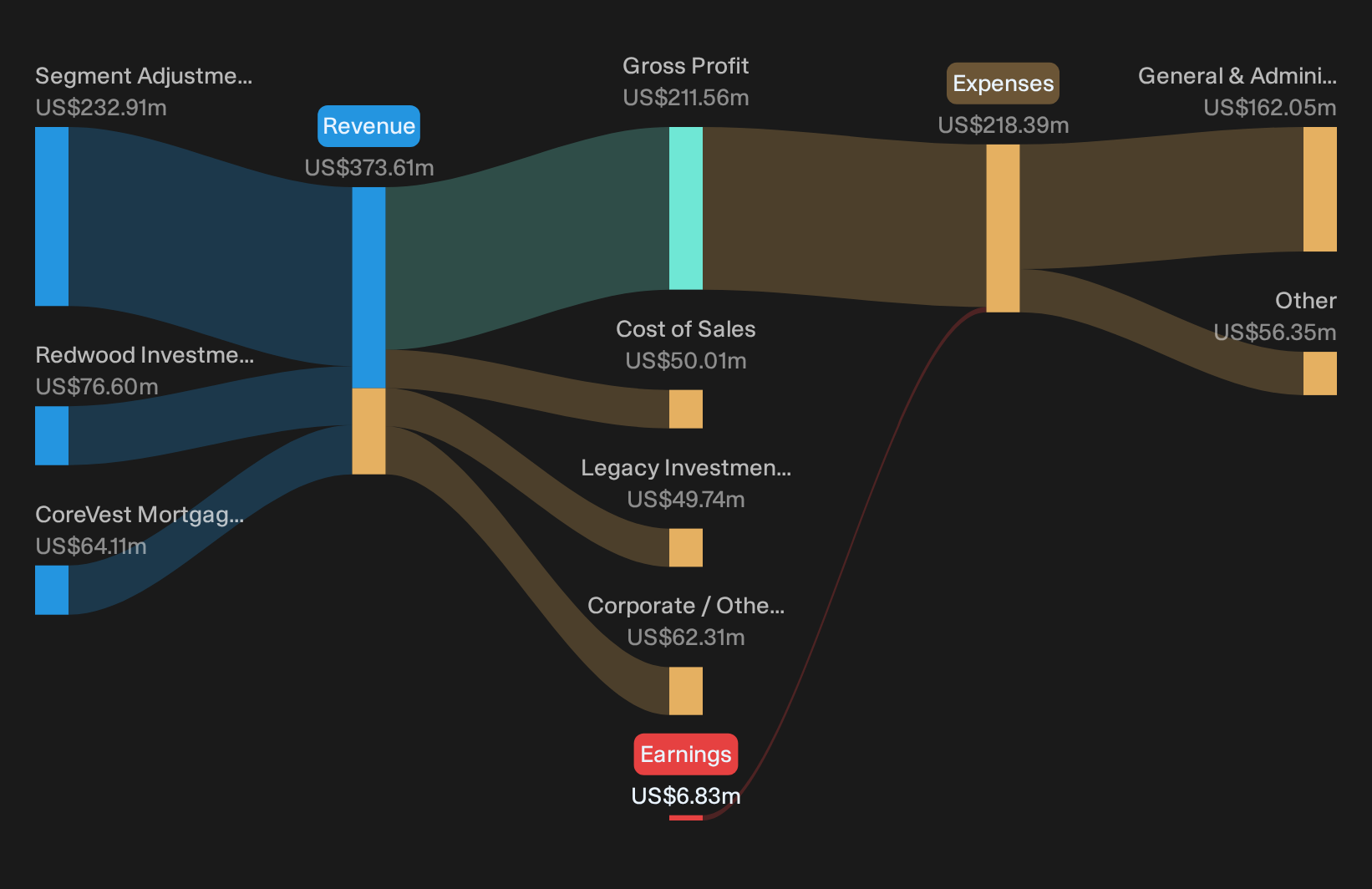
Angel Oak Mortgage REIT (AOMR)
Angel Oak Mortgage REIT plugs directly into the housing finance theme through first lien non-QM loans, with all of its US$36 million of reported revenue coming from acquiring, investing in, and financing mortgage related assets, on a roughly US$169 million market value.
Angel Oak Mortgage REIT gives you exposure to the plumbing of U.S. mortgage credit, not homebuilding. This is exactly what this screener is built to surface, and the key question is how its specialist non-QM engine converts that focus into income when conditions shift.
"Growing demand for specialized non-QM and HELOC products, where Angel Oak has a scaled origination and purchase platform, supports healthy volume at attractive yields. This should sustain elevated asset coupons and bolster net interest margins."
Any change in a single funding assumption behind that income stream could have a significant impact on how those margins actually play out.
That funding swing is exactly what the full narrative for Angel Oak Mortgage REIT unpacks in detail, showing where Angel Oak Mortgage REIT’s non-QM engine could be accelerating or quietly stalling next.

Seeking Alternatives Before The Crowd Moves
Fresh ideas move first. By the time headlines catch a breakout, early momentum can be gone or prices already flying. Scan these under the radar screens now and get in early.
- Target dependable income streams while others chase stories by reviewing a curated group of high yield payers through the 7 dividend fortresses.
- Spot under followed operators with pricing power and healthy cash positions by checking the curated list of solid balance sheet and fundamentals (26 results).
- Ride infrastructure momentum around AI capacity while it is still building by screening the specialist picks inside the 90 AI infrastructure stocks.
This article by Simply Wall St is general in nature. We provide commentary based on historical data and analyst forecasts only using an unbiased methodology and our articles are not intended to be financial advice. It does not constitute a recommendation to buy or sell any stock, and does not take account of your objectives, or your financial situation. We aim to bring you long-term focused analysis driven by fundamental data. Note that our analysis may not factor in the latest price-sensitive company announcements or qualitative material. Simply Wall St has no position in any stocks mentioned.
Have feedback on this article? Concerned about the content? Get in touch with us directly. Alternatively, email editorial-team@simplywallst.com