


- CSX recently opened a hands on rail safety training institute at Florida State College at Jacksonville, giving first responders realistic hazardous materials response practice using life like rail incident scenarios.
- The new training hub points to CSX treating safety and hazardous cargo handling as an operating capability, with potential implications for risk management costs and service reliability over time.
- We will now assess how CSX's investment narrative could be influenced by this expanded hazardous materials safety training effort.
Scan how CSX's renewed focus on safety compares with other transport operators by reviewing a curated group of 31 resilient stocks with low risk scores that aim to keep operational risk firmly in check.
CSX Investment Narrative Recap
To own CSX, you need to believe this railroad can keep pairing steady earnings growth with tight cost control while safely absorbing more volume on new corridors. The near term swing factor still sits in basic execution, especially train crew availability and keeping dwell times in check as industrial projects and intermodal routes come online.
The biggest risk remains service strain that triggers public criticism or stricter rules, which could lift expenses and slow margin progress. The new hazardous materials training institute looks helpful for risk management, but on its own it does not materially change near term earnings catalysts or headline risk.
The new rail safety training institute in Jacksonville is the clearest recent announcement linked to this theme. It plugs directly into CSX safety programs that analysts already fold into expectations for network fluidity, accident rates and ultimately the cost side of the income statement over time.
For you, the question is whether this kind of hands on hazardous materials training lowers the probability and severity of incidents that could pressure margins or force heavier capital spending. If industrial projects and intermodal corridors scale as expected, having a deeper safety bench can help protect those growth catalysts from operational setbacks.
How CSX's Safety Push Intersects With Consensus Forecasts
CSX's narrative projects US$16.9b revenue and US$4.5b earnings by 2029. That profile lines up with analyst assumptions for 5.2% yearly revenue growth and an earnings increase of about US$1.3b from US$3.2b today.
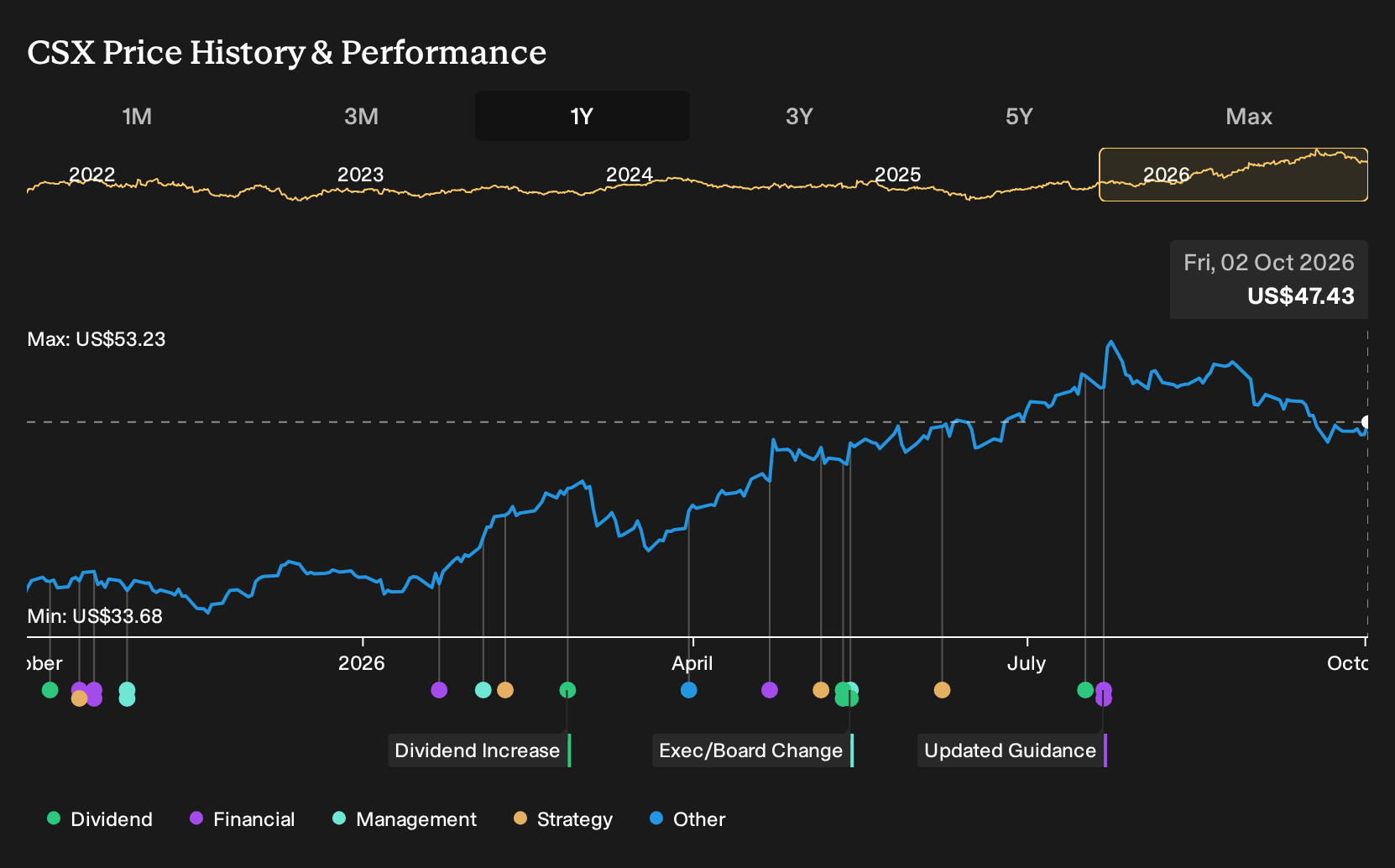
Uncover why CSX's fair value indicates a 12% potential upside to its current price that may not last much longer.
Exploring Other Perspectives
One alternate view worries less about safety and more about CSX needing heavy capital spending that keeps returns muted. Those bearish analysts still penciled in about US$16.6b of revenue and US$4.4b of earnings by 2029 before this training institute opened, yet they applied a lower 21.3x P/E. Use that gap to compare different narratives and decide which seems closer to your own expectations.
Explore 3 other CSX fair value estimates, including one that indicates as much as 6% downside from the current price.
Form Your Own Verdict
Don't just follow the ticker. Dig into the data and build a conviction that's truly your own.
- A great starting point for your CSX research is our analysis highlighting 3 key rewards and 2 important warning signs that could impact your investment decision.
- See our latest analysis for CSX. The report includes a comprehensive fundamental analysis summarized in a single visual, the Snowflake, making it easy to evaluate CSX's overall financial health at a glance.
Looking For More Investment Ideas Beyond CSX?
Once you have a handle on CSX, it can be useful to compare it with other opportunities that match different goals, whether you care more about value, income, or balance sheet strength.
- If you want potential value setups with solid quality checks, scan through a curated group of 31 high quality undervalued stocks that might deserve a spot on your watchlist.
- For investors who care most about income resilience, review a focused set of 7 dividend fortresses that prioritize yield and staying power over headline excitement.
- To keep risk management front and center, filter for businesses in the list of solid balance sheet and fundamentals (25 results) and compare how their financial footing stacks up against CSX.
This article by Simply Wall St is general in nature. We provide commentary based on historical data and analyst forecasts only using an unbiased methodology and our articles are not intended to be financial advice. It does not constitute a recommendation to buy or sell any stock, and does not take account of your objectives, or your financial situation. We aim to bring you long-term focused analysis driven by fundamental data. Note that our analysis may not factor in the latest price-sensitive company announcements or qualitative material. Simply Wall St has no position in any stocks mentioned.
Have feedback on this article? Concerned about the content? Get in touch with us directly. Alternatively, email editorial-team@simplywallst.com